Spanish Colonial interior design is a warm, rustic style built on white plaster walls, terracotta or saltillo tile floors, dark carved-wood beams, and wrought-iron detailing. Rooted in the 16th- to 19th-century Spanish settlements of Mexico and the American Southwest, it favors handmade materials, arched openings, and earthy colors over polish and shine. The result reads as grounded, textured, and quietly grand.
What defines Spanish Colonial interior designWhat defines Spanish Colonial interior design
Spanish Colonial interiors are defined by a short, repeatable set of elements: thick whitewashed plaster walls, red terracotta floors, exposed dark-wood ceiling beams, wrought iron, and hand-painted tile. Because the style grew from practical building in hot climates, almost every feature does double duty — mass walls stay cool, arches carry load without steel, and tile survives sun and traffic. That honesty is what separates it from purely decorative "Spanish-look" rooms.
- White plaster walls — thick, hand-troweled, slightly irregular; the neutral backdrop for everything else.
- Terracotta or saltillo tile floors — warm red clay, often sealed with a matte finish and paired with area rugs.
- Exposed wood beams — dark, heavy, often carved or roughly hewn, running across white ceilings.
- Wrought iron — railings, light fixtures, window grilles, and hardware in matte black.
- Arches — doorways, hallways, and window openings shaped as rounded or slightly pointed arches.
- Hand-painted tile — talavera and mosaic accents on stair risers, backsplashes, and fountains.
- Carved and turned wood furniture — solid, dark, low-slung pieces with leather or woven seats.
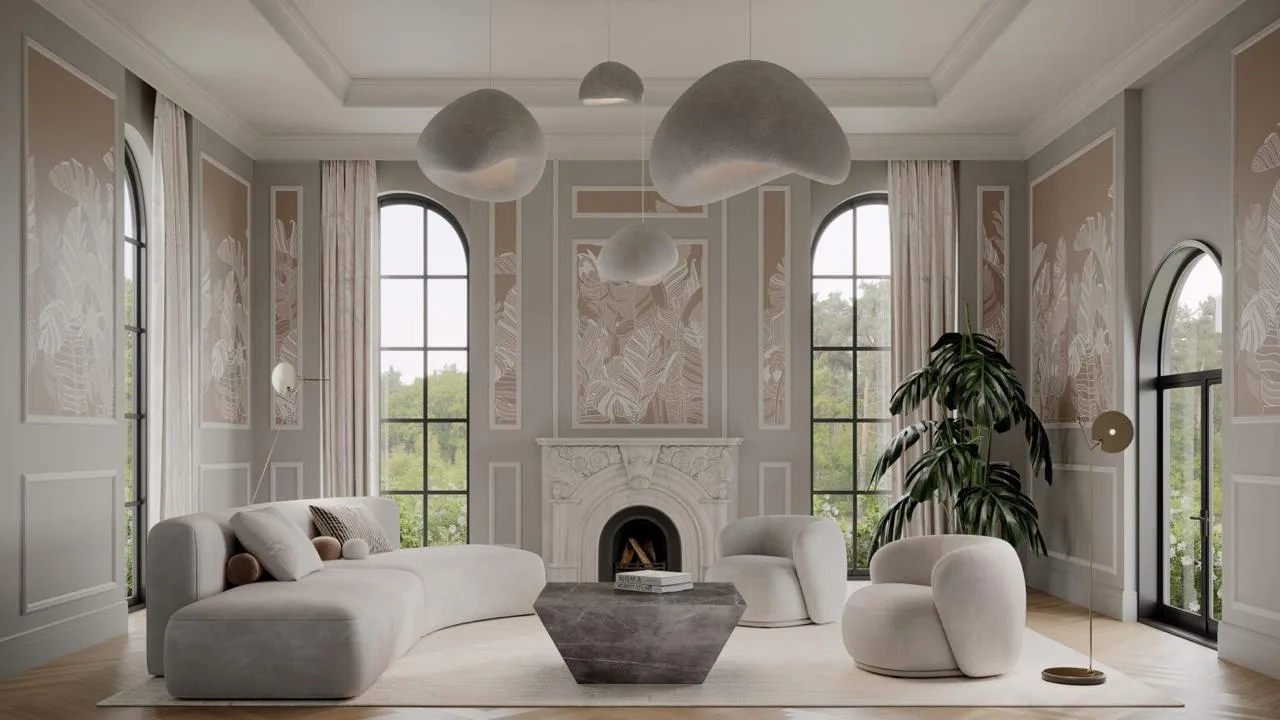
Spanish Colonial colors and materials palette
The Spanish Colonial color palette is earthy and sun-baked: warm white plaster as the base, terracotta and clay reds underfoot, and deep browns from wood and leather. Accents pull from Spanish and Mexican folk art — cobalt blue, saffron yellow, ochre, and rust — usually in tile, textiles, and ceramics rather than on the walls. The rule of thumb is neutral shell, colorful objects.
Materials matter more than any single color, because the style lives on texture. Every surface is meant to look handmade and to age well.
| Material | Where it is used | Why it reads Spanish Colonial |
| Lime or clay plaster | Walls, fireplace surrounds, niches | Soft, irregular white surface that catches warm light |
| Terracotta / saltillo tile | Floors, stair treads, patios | Warm red clay tone unique to the style |
| Dark solid wood | Ceiling beams, doors, furniture | Heavy, carved, honest structure on show |
| Wrought iron | Lighting, railings, grilles, hardware | Handforged black lines against white plaster |
| Hand-painted ceramic tile | Backsplashes, risers, fountains | Cobalt-and-saffron folk-art color accents |
| Leather and woven fiber | Seating, rugs, baskets | Natural, tactile, and warm underfoot |
Spanish Colonial living room, bedroom, and kitchen
The same elements shift room by room. A Spanish Colonial living room leads with a carved fireplace, exposed beams, and low leather-and-wood seating; the bedroom softens into plaster, iron, and textiles; the kitchen leans hardest on tile and warm metals.
Living room
- A plaster fireplace as the anchor, often with a carved wood or tile surround.
- Exposed beams overhead and terracotta tile with a large woven or Persian rug.
- Low, solid wood-and-leather sofas and chairs, plus a heavy carved coffee table.
- Wrought-iron chandelier or lantern-style fixtures for warm, low light.
Bedroom
- A carved or iron bed frame against a plain white plaster wall.
- Layered natural textiles — linen, wool, and embroidered accents in warm tones.
- An arched niche or small window with an iron grille for depth.
- Dark wood nightstands and a hand-painted ceramic lamp or tile detail.
Kitchen
- Hand-painted talavera tile backsplash as the color statement.
- Plaster range hood, open wood shelving, and terracotta or tile floors.
- Warm metals — brass or hammered copper — with matte black iron hardware.
- A heavy wood island or farmhouse table for a lived-in, handmade feel.
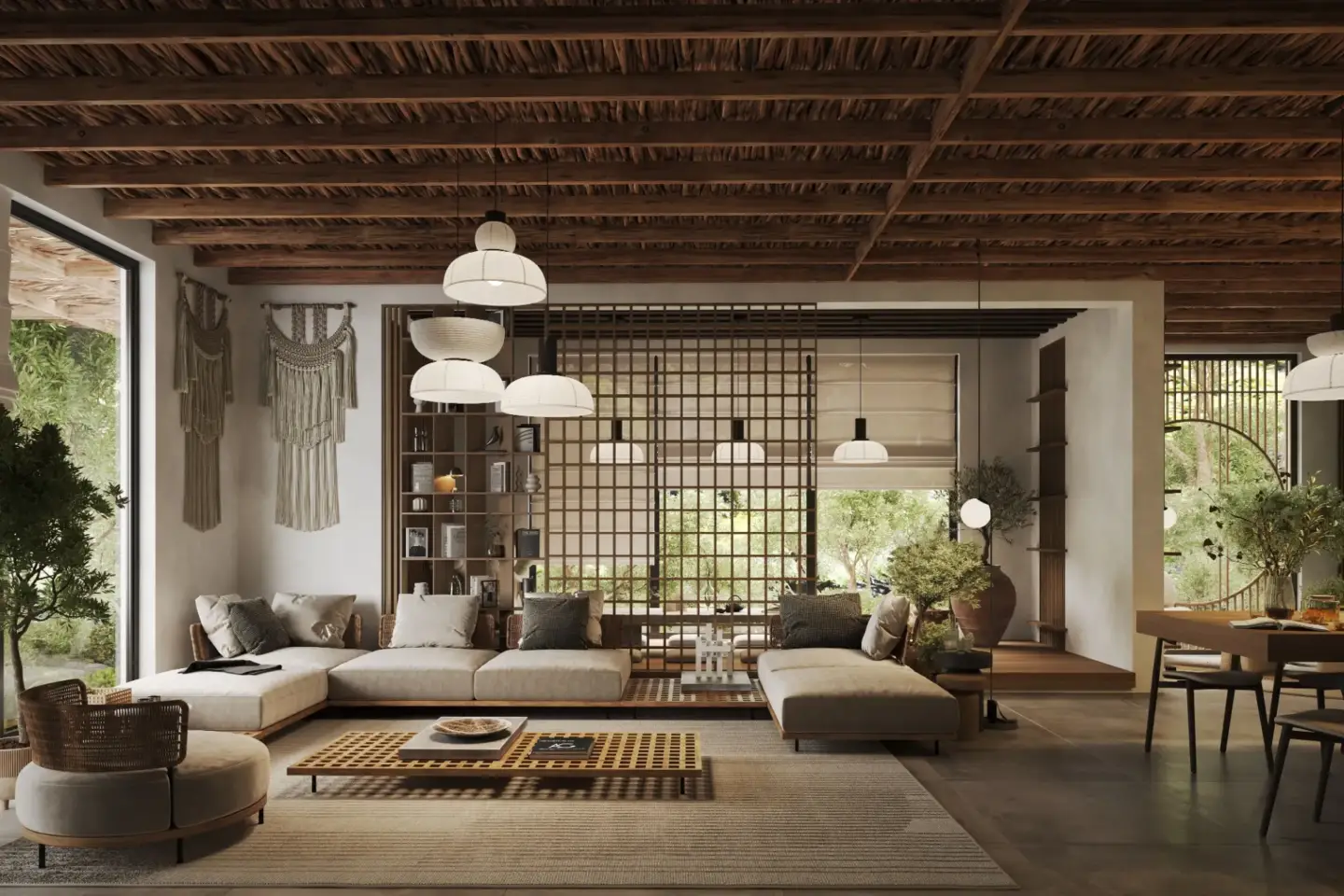
Modern vs traditional Spanish Colonial interiors
Modern Spanish Colonial interior design keeps the shell — plaster, arches, beams, terracotta — but strips the clutter, opens the floor plan, and cools the palette toward creamy whites and soft neutrals. Traditional rooms are darker, more ornate, and more saturated, with heavy carved furniture and layered folk-art color. Most current projects sit between the two: authentic materials, lighter and more edited styling.
| Feature | Traditional | Modern |
| Palette | Warm, saturated, folk-art color | Creamy whites, soft neutrals, restrained accents |
| Furniture | Heavy, carved, dark wood | Cleaner lines, mixed woods and upholstery |
| Layout | Compartmentalized rooms | Open plan with arched thresholds |
| Detailing | Ornate ironwork and tile everywhere | Iron and tile used as focused accents |
| Feel | Old-world, rich, layered | Airy, calm, gallery-like |
Spanish Colonial vs Spanish Revival vs Mediterranean
These three labels get used interchangeably, but they are not the same thing. Spanish Colonial is the original, built during Spain's colonization of the Americas. Spanish Colonial Revival is a 1915–1930s American reinterpretation, lighter and more decorative. Mediterranean is a broader umbrella that blends Spanish, Italian, and Moorish influences. Knowing the difference keeps a room coherent instead of a mix of half-styles.
| Style | Era / origin | Interior character |
| Spanish Colonial | 1500s–1800s, Spanish Americas | Rustic, handmade, mass plaster walls, dark beams, terracotta |
| Spanish Colonial Revival | 1915–1930s, U.S. (California, Florida) | Lighter, more ornamental, refined tile and ironwork |
| Mediterranean | Broad, southern-European blend | Airier, mixes Spanish, Italian, and Moorish elements |
For the exterior side of the story, see our guide to Spanish Colonial architecture, and for the wider umbrella, Mediterranean architecture. This piece sits inside our broader roundup of interior design styles.
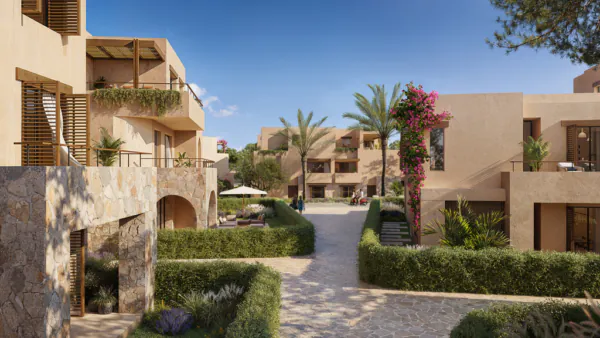
How Spanish Colonial interiors translate to 3D renders
In a 3D render, Spanish Colonial reads through a handful of high-impact cues: the irregular plaster surface, the warm bounce of terracotta, the mass of dark beams, and low, warm lighting. Get those four right and the style is legible before any single object names it. Photoreal materials — subtle plaster bumps, sealed-tile reflections, aged iron — do more work than adding more furniture.
In our studio, clients rarely hand us a style label. They send three reference photos of a warm, arched, terracotta-floored room and say "make it feel like this." That is the useful lesson of Spanish Colonial: the elements carry the identity, not the name. When we spec a room, we lock the plaster tone, the tile red, the beam color, and the light temperature first — the decor follows. If you are visualizing a project in this style, our 3D interior rendering services build rooms exactly this way, material by material.