A virtual showroom is a digital, interactive space where customers explore products online the way they would in a physical store — browsing items, inspecting them from every angle, and seeing prices in 3D. Accessible through a web browser, VR headset, or AR app, it blends product visualization with real e-commerce functionality.
What Is a Virtual Showroom?What Is a Virtual Showroom?
A virtual showroom is a digital version of a physical showroom: an interactive 3D environment where customers browse products, inspect them from every angle, check specifications, and often see prices — all from a web browser, VR headset, or AR app. Unlike a static product page, it recreates the feeling of walking through a store and handling the products yourself.
The format spans several types, depending on how immersive the experience needs to be:
- Web-based 3D showroom — runs in any browser with no app or headset required; the most common and accessible format.
- VR showroom — explored through a headset for a fully immersive, room-scale experience, much like virtual reality in architecture.
- AR showroom — projects products into the customer’s real space through a phone or tablet.
- Configurator-style showroom — lets buyers customize products (color, finish, layout) and see the changes in real time.
Whichever format you choose, the goal is the same: let buyers explore and evaluate products online with the confidence they would have in person.
How a 3D Virtual Showroom Works
A virtual showroom is not a single render or one 360° photo — it is a layered build. It starts with 3D models of every product, moves to a navigable 3D or 360° environment, and ends with integration into a website or sales platform where customers can click, configure, and buy.
- 3D modeling — each product is rebuilt as an accurate 3D model, with real materials, dimensions, and finishes.
- Scene and navigation — the models are placed in a 3D or 360° space the customer can move through, zoom into, and interact with.
- Platform integration — the showroom is embedded into your website, e-commerce store, or a dedicated app, wired to product data, pricing, and checkout.
That third layer is where most projects get underestimated. The visualization is only half the job; making it live inside an existing site — with the right product feed, performance, and checkout — is the part that varies most in scope.
The biggest mistake clients make is assuming they can bolt a virtual showroom onto their existing site without touching it — or that they can order the renders from one team and the integration from their web developer separately. It doesn’t work that way. You either commission the site and the showroom turnkey, or you have both teams working in parallel from day one. And the price isn’t really estimable up front, because it depends entirely on what the site is and how the showroom has to integrate into it.
— Dim Kuzmenko, Maverick Frame
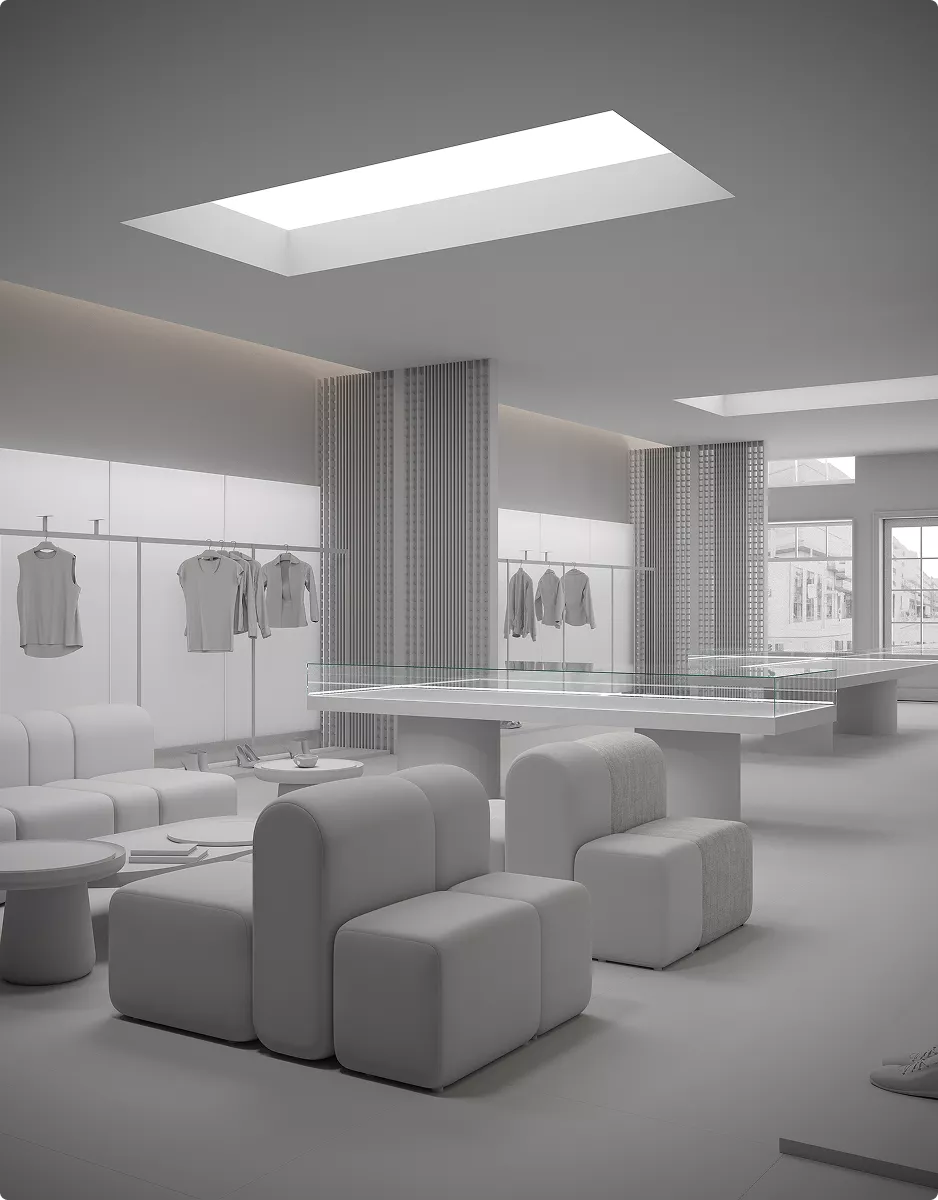
Virtual Showroom vs Virtual Tour vs 360° Panorama
These three terms get used interchangeably, but they solve different problems. A virtual tour moves you through a space point to point — it is about navigating a place. A virtual showroom is closer to a store or a product configurator: the focus is the products, what they cost, and how you interact with them, not the walls around them. A 360° panorama is a single immersive viewpoint of one scene.
| Format | What it’s for | Best fit |
| Virtual showroom | Browse, configure, and buy products in a store-like 3D space | Retail, furniture, product, automotive |
| Virtual tour | Navigate through a property or space, point to point | Real estate, hospitality, venues |
| 360° panorama | View a single scene from one immersive vantage point | Property listings, single-room showcases |
If your goal is moving people through a property, a navigable 3D virtual tour is the right tool; for a single immersive viewpoint, a 360° panorama render fits better. A virtual showroom is the choice when the products themselves are what you are selling — it behaves more like a configurator than a walkthrough.
Benefits of a Virtual ShowroomBenefits of a Virtual Showroom
A virtual showroom removes the two biggest limits of a physical store — location and inventory space — while giving buyers a richer experience than a flat product page. The payoff shows up in both sales and engagement.
- Sell beyond geography — anyone can visit, anytime, without travel or appointments.
- Show unlimited inventory — display every variant, finish, and configuration without floor space.
- Boost engagement — interactive 3D keeps visitors on the page longer, which strengthens behavioral signals.
- Reduce returns — buyers who inspect products in 3D understand what they are getting before they order.
- Cut physical costs — no real estate, staging, or restocking for the showroom itself.
- Stay open 24/7 — the showroom keeps selling while the team sleeps.
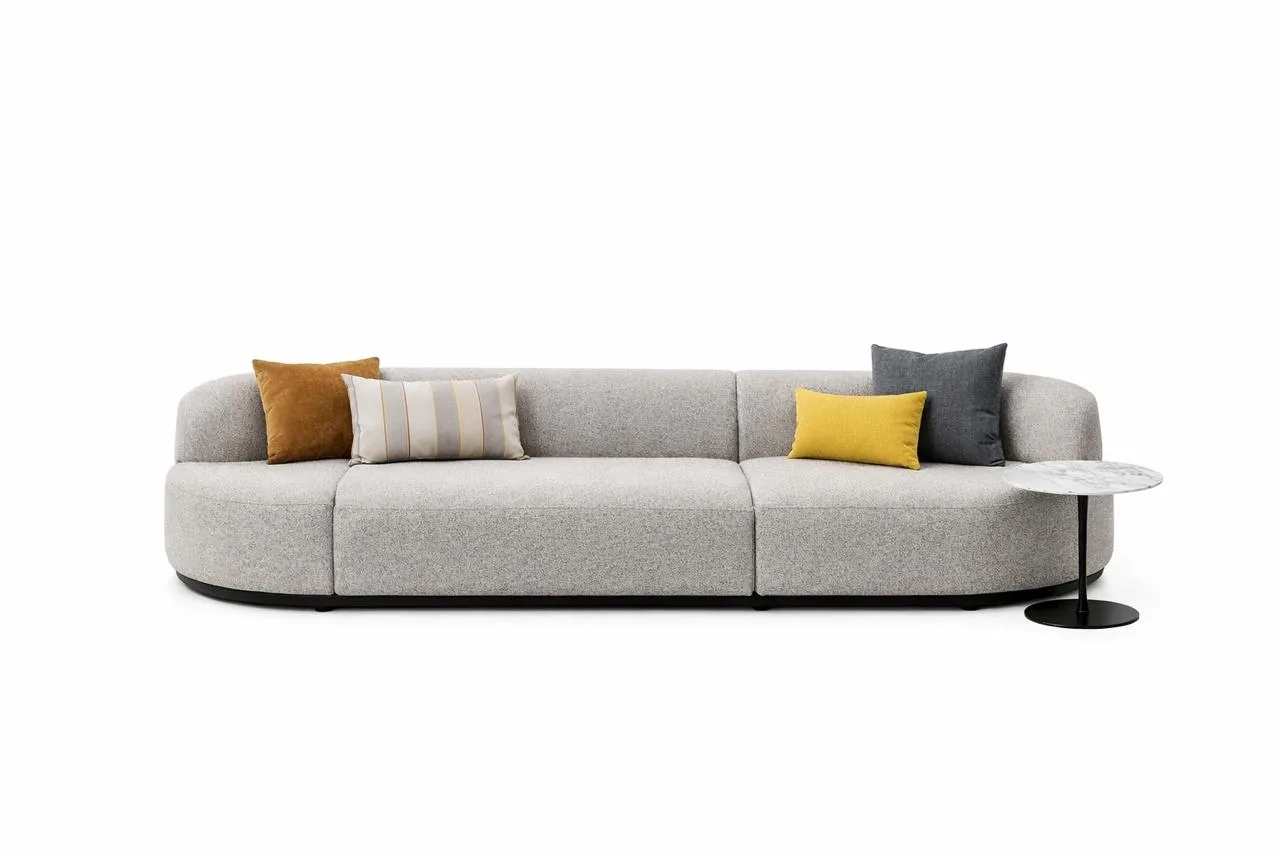
Virtual Showroom Examples Across Industries
Virtual showrooms started in fashion and automotive but now appear across almost any industry that sells a considered purchase. The common thread: the product benefits from being seen, configured, or understood in space.
- Furniture — buyers see scale, materials, and how pieces work together before ordering.
- Consumer products — electronics, appliances, and packaged goods shown in interactive 3D.
- Automotive — dealerships let shoppers explore and configure vehicles online; Toyota and BMW both run virtual showrooms.
- Real estate — developers present finishes, fittings, and unit options for off-plan properties.
Right now a virtual showroom pays off in almost every industry, because it works on one of two levels — either the person actually buys, or they interact more and spend more time on the site. That time on site and engagement feed your behavioral signals, which push the site up in search, which indirectly drives more sales. Either way, it is a very profitable thing to have.
— Dim Kuzmenko, Maverick Frame

How to Create a Virtual Showroom
Building a virtual showroom follows a predictable path, but it starts before any 3D work — with a conversation about what you actually need. Skipping that step is the fastest way to mis-scope the whole project.
- Define the goal — clarify what the showroom must do (browse, configure, checkout) and where it will live.
- Prepare 3D models — model each product accurately, or convert existing CAD and product data into 3D assets.
- Build the environment — assemble the navigable 3D or 360° space and its lighting.
- Add interactivity — hotspots, product information, pricing, and configurator logic.
- Integrate and launch — embed into your site or app, connect product data and checkout, and test across devices.
Virtual Showroom Software and PlatformsWhen a client just asks for a “virtual showroom,” that on its own means almost nothing. You always have to get on a call, ask questions, and dig into what they are really after — otherwise you will misjudge the scope and misprice it. Two requests with the exact same words can turn out to be completely different projects.
— Dim Kuzmenko, Maverick Frame
Virtual Showroom Software and Platforms
A range of platforms can host a virtual showroom, from no-code builders to fully custom developments. Off-the-shelf tools such as ByondXR, JOOR, NuOrder, and rooom let brands stand up a showroom quickly, while custom builds give full control over branding, interactivity, and integration. The right choice depends on how deeply the showroom needs to connect to your existing site and product data.
For brands whose products carry the sale, the visual quality of the 3D assets matters as much as the platform. A polished platform showing mediocre models still undersells the product, which is why high-end 3D product rendering and furniture rendering are what make a virtual showroom convert rather than just look modern.

Turn Ideas Into Visual Stories
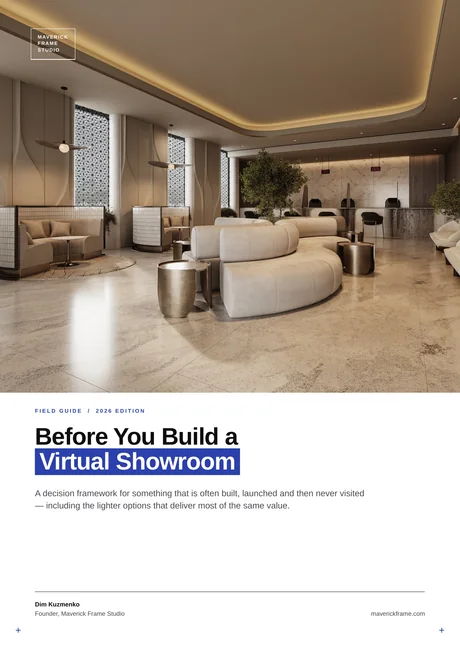
Free field guide
Before You Build a Virtual Showroom
A decision framework for something that is often built, launched and then never visited — including the lighter options that deliver most of the same value.
If it didn't open, download it here.
Download the PDF