Amazon, Wayfair and Shopify all accept 3D furniture models, but only one of them publishes a full specification. Amazon caps assets at 200,000 triangles in glTF or GLB with 2K to 4K PBR textures. Shopify accepts GLB and USDZ up to 500 MB. Wayfair keeps its supplier standard behind its partner portal.
The table below is the part most furniture brands are missing: a single view of what each platform actually asks for, and where the public record simply stops. Everything marked not published below is not an omission on our side. Those platforms do not release the number.
| Requirement | Amazon | Wayfair | Shopify AR |
| File format | .GLB (binary) or .glTF exported as separate .glTF + .bin + textures | GLB — Wayfair’s own Realtime 3D Model API serves .glb and zipped .obj | GLB and USDZ |
| Maximum file size | Not published | Not published | 500 MB |
| Optimisation threshold | Not published | Not published | Files over 15 MB are optimised automatically |
| Triangle budget | 200,000 triangles maximum | Not published | Not published |
| Texture files | .PNG or .JPG; glTF files with textures embedded in the JSON are rejected | Not published | Not published |
| Texture resolution | 2,048 × 2,048 minimum, 4,096 × 4,096 maximum, square and power of two, on all sides | Not published | Not published |
| Material model | PBR metal-roughness; BaseColor, Metallic and Roughness maps required | PBR: geometry plus materials | PBR through glTF and USDZ |
| UV layout | One texture atlas, inside the 0–1 coordinate space, UV space maximised | Not published | Not published |
| Real-world scale | Required — model dimensions must match assembled product dimensions | Product dimensions exposed in inches through the 3D API | Required for correct AR placement |
| Up axis and front | ‘Up’ is positive Y; model front faces positive Z | Not published | Not published |
| Pivot and origin | Pivot at 0,0,0; floor models rest on the Y=0 plane, centred at the base in X and Z | Not published | Not published |
| Double-sided textures | Not supported | Not published | Not published |
| Animation, cameras, lights | Not allowed in the asset | Not published | Not published |
| Human imagery | Not allowed | Not published | Not published |
| Validation | Khronos glTF-Validator must be used before submission | Supplier portal review | Automatic conversion to both GLB and USDZ |
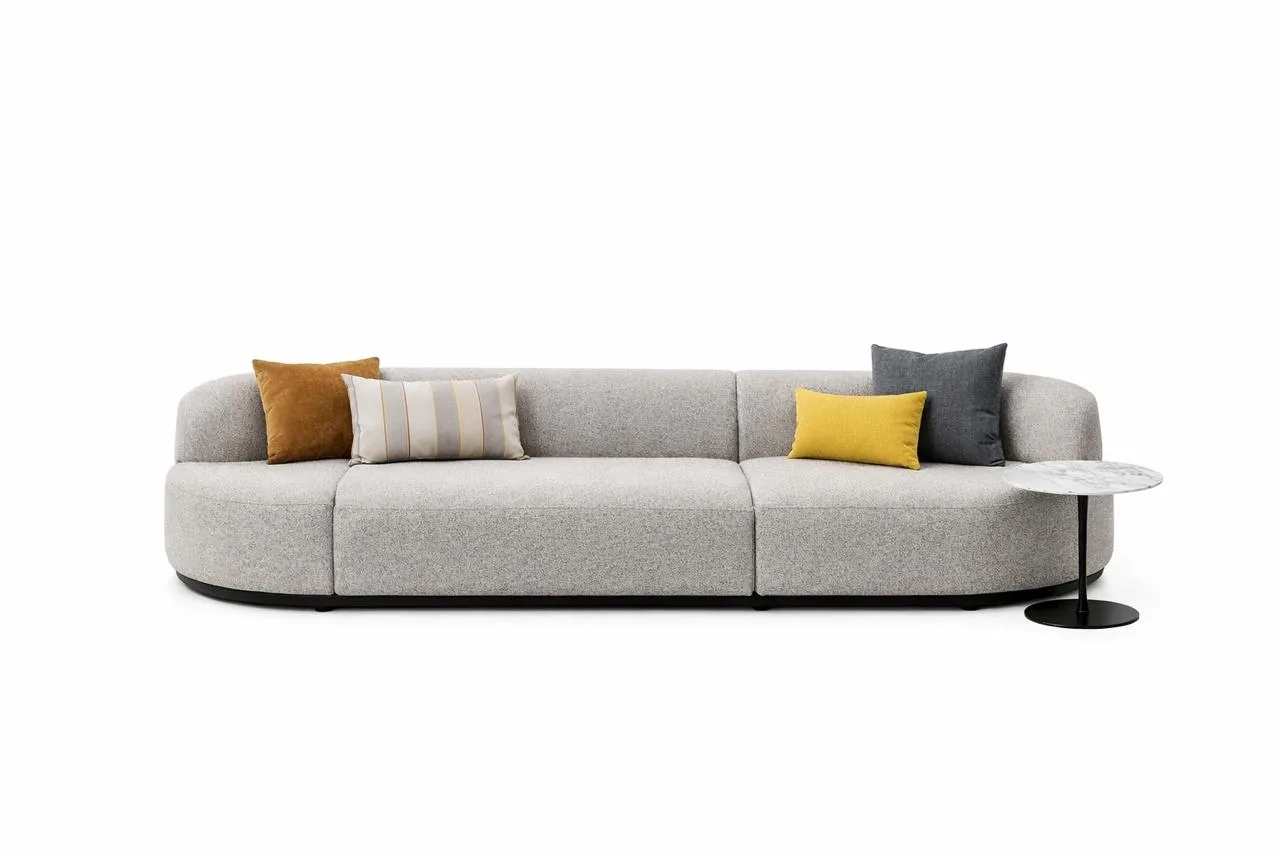
Amazon 3D model requirements for furniture listings
Amazon publishes the most detailed public 3D specification of the three platforms, and it is strict. An asset that fails any of the geometry or texture rules below is delayed or rejected at quality assurance, not silently downgraded.
Geometry rules
- The model is built at real-world scale, so its dimensions match the assembled product.
- The asset must not exceed 200,000 triangles.
- Mesh integrity is verified: no invalid triangles, edges, vertices, faces or flipped normals.
- The model must contain no modifiers, animation key frames, cameras or lights.
- The size and shape of every part is proportional in relation to the other parts.
Texture and material rules
- Textures are supplied as .PNG or .JPG. glTF files with image resources embedded directly in the JSON are not accepted.
- Texture resolution must be at least 2K (2,048 × 2,048) and no larger than 4K (4,096 × 4,096), square and power of two on all sides.
- One texture per channel. Double-sided textures are not supported.
- All materials are PBR metal-roughness compliant. BaseColor in RGB, Metallic in greyscale and Roughness in greyscale are required; Normal, Opacity, Height, Thickness and Occlusion are optional.
- UVs sit within one texture atlas, in the 0–1 coordinate space, with UV space maximised.
- Transparency belongs in the alpha channel of the BaseColor map — but glass, thick plastic and acrylic must use the KHR_materials_transmission glTF extension instead.
Amazon supports a fixed list of glTF extensions, including KHR_materials_transmission, KHR_materials_clearcoat, KHR_materials_ior, KHR_materials_volume, KHR_draco_mesh_compression and KHR_interactivity. Extensions outside that list are not currently supported, which is a common failure mode when a studio exports from a renderer with its own material extensions enabled.
One rule catches lifestyle-minded brands off guard: 3D assets may not include any imagery of humans. A model baked with a person in the scene, or a texture containing a figure, will not pass.
Wayfair 3D model specs: what is public and what sits behind the supplier portalWayfair 3D model specs: what is public and what sits behind the supplier portal
Wayfair does not publish a public 3D asset specification. Its modelling standards are distributed to suppliers through the Wayfair supplier portal and Wayfair 3D University, the curriculum Wayfair launched in 2018 as a set of 3D-modelling standards for home furnishings suppliers. If you are quoting a spec sheet for Wayfair from a blog post, it was not sourced from Wayfair.
What is verifiable from Wayfair’s own public engineering material is still useful, because it tells you the shape of the asset Wayfair keeps in production:
- Wayfair’s Realtime 3D Model API serves what it calls production grade models stored as realtime 3D assets — meaning optimised, game-engine-class geometry, not archviz-weight meshes.
- Each model in that API is returned as a .glb file, with a zipped .obj alongside it.
- Every record carries a
dimensions_inchesobject with x, y and z values — Wayfair’s dimensional truth is stated in inches. - Wayfair engineering describes a model as two parts, geometry and materials, and has published work on machine learning applied to its own 3D modelling pipeline.
- Roughly 1,000 Wayfair models were released to SketchUp’s 3D Warehouse in 2017 for designers — a separate, download-facing library, not the supplier submission path.
The practical consequence for a supplier is simple: build to a real-time budget, not a rendering budget, and be ready to state dimensions in inches even though your source file is almost certainly in millimetres or metres.

Shopify AR model requirements: GLB, USDZ and the 15 MB optimisation line
Shopify is the most permissive of the three and the most automated. A 3D model on a Shopify product page must be a GLB or USDZ file of up to 500 MB, and Shopify handles the cross-platform work for you.
| Model size | What Shopify does to geometry and materials | What Shopify converts |
| Smaller than 15 MB | The model is not optimised. Geometry and materials are unchanged. | Both a .USDZ and a .GLB version are generated, so the model works on Android and iOS. |
| Larger than 15 MB | The model is optimised. Geometry and textures are compressed while preserving the visual output of the original file. | Both a .USDZ and a .GLB version are generated, so the model works on Android and iOS. |
That 15 MB line is the number to design around. Above it, Shopify decides how your model is compressed. Below it, your own decisions about topology and texture size survive into what the customer sees. For furniture, staying under 15 MB is achievable on most single-SKU pieces if texture sets are shared and 4K maps are reserved for the surfaces a shopper will actually zoom into.
A store also needs a theme that supports 3D models and videos, or a theme modified to render them. Uploading a compliant GLB to a theme that cannot display it produces a silent failure that looks like a broken asset.
Polygon budget and texture rules that decide whether a furniture asset passesPolygon budget and texture rules that decide whether a furniture asset passes
Furniture is the product category most likely to blow a triangle budget, because the details that sell it are geometric: button tufting, piping, turned legs, cane webbing, woven rattan, quilted panels. Modelled honestly, a single tufted headboard can exceed 200,000 triangles on its own.
The way through is the standard real-time pipeline, and it is the reason a marketplace asset is a different deliverable from a hero render:
- Model the piece at full detail as a high-poly master.
- Retopologise to a clean, quad-based low-poly mesh that holds the silhouette.
- Bake the high-poly detail into a normal map so tufting, stitching and wood grain read as surface, not geometry.
- Pack UVs into a single 0–1 atlas per material, maximising the space used.
- Export at 4K where the shopper will zoom, 2K where they will not, and never below Amazon’s 2K floor.
Silhouette is where the budget should go. A shopper rotating a chair in a product viewer sees the outline against the background before anything else — a faceted seat edge or a polygonal chair leg reads as cheap instantly, while a slightly soft fabric weave does not.
In our studio, the assets that come back from marketplace review are almost never rejected for looking wrong. They come back for units, pivots, orientation and texture dimensions — the parts nobody proofs visually because they do not show up in a render. A model that passes an internal art review can still fail an automated technical check, and that is the check the platform runs first.
Real-world scale: why furniture models fail on units before they fail on looksReal-world scale: why furniture models fail on units before they fail on looks
Scale is the single most common technical failure in marketplace 3D, and it is a unit problem, not a modelling problem. The glTF specification treats one unit as one metre. Furniture data, especially in the North American market, arrives in inches.
Take a real Wayfair record: an accent chair returned by Wayfair’s 3D API carries dimensions of 34.29 × 27.86 × 32.46 inches. Modelled in a scene set to inches and exported to glTF without a unit conversion, that chair arrives in a customer’s living room as a 34-metre object. In an AR viewer it does not look slightly large; it fills the street outside the window.
Amazon states the requirement plainly: model dimensions must match assembled product dimensions, and inaccurate dimensions may cause delays in asset publication. Alignment rules follow the same logic:
- The ‘up’ world axis is positive Y, and the model front must face positive Z.
- Floor and tabletop pieces — which covers most furniture — rest on the Y=0 plane with all geometry extending into positive Y.
- Those pieces are centred at the base of the bottom surface in both X and Z, with the pivot point at 0,0,0.
- Wall-mounted pieces have their backside aligned to the XY plane at Z=0, centred in X and Y, pivot at 0,0,0 on the back surface.
- Ceiling-mounted pieces hang from the base of the top surface, sitting at or below Y=0, with geometry extending into negative Y.
Get the pivot wrong and the AR placement anchors from the middle of the sofa rather than its feet, so the piece sinks into the floor or hovers above it. That is a five-second fix in the source file and a rejected submission if it ships.
What a marketplace-ready furniture asset package containsWhat a marketplace-ready furniture asset package contains
A furniture 3D asset is a package, not a file. Amazon’s own guidance requires glTF exports to ship as separate parts, and the export they illustrate contains the asset, its binary buffer and one texture file per channel.
- The model itself: a single .glb, or a .glTF with its .bin buffer alongside.
- A texture set with one map per channel — base colour, metallic-roughness, normal, and any transmission or occlusion maps the material needs.
- A dimension sheet stating assembled dimensions in the unit the platform expects, matched to what the listing copy claims.
- A validator report. Amazon requires the Khronos glTF-Validator be used to confirm files meet technical requirements before submission.
- Variant exports if the SKU ships in multiple finishes — the same geometry with swapped texture sets, not a re-model per colourway.
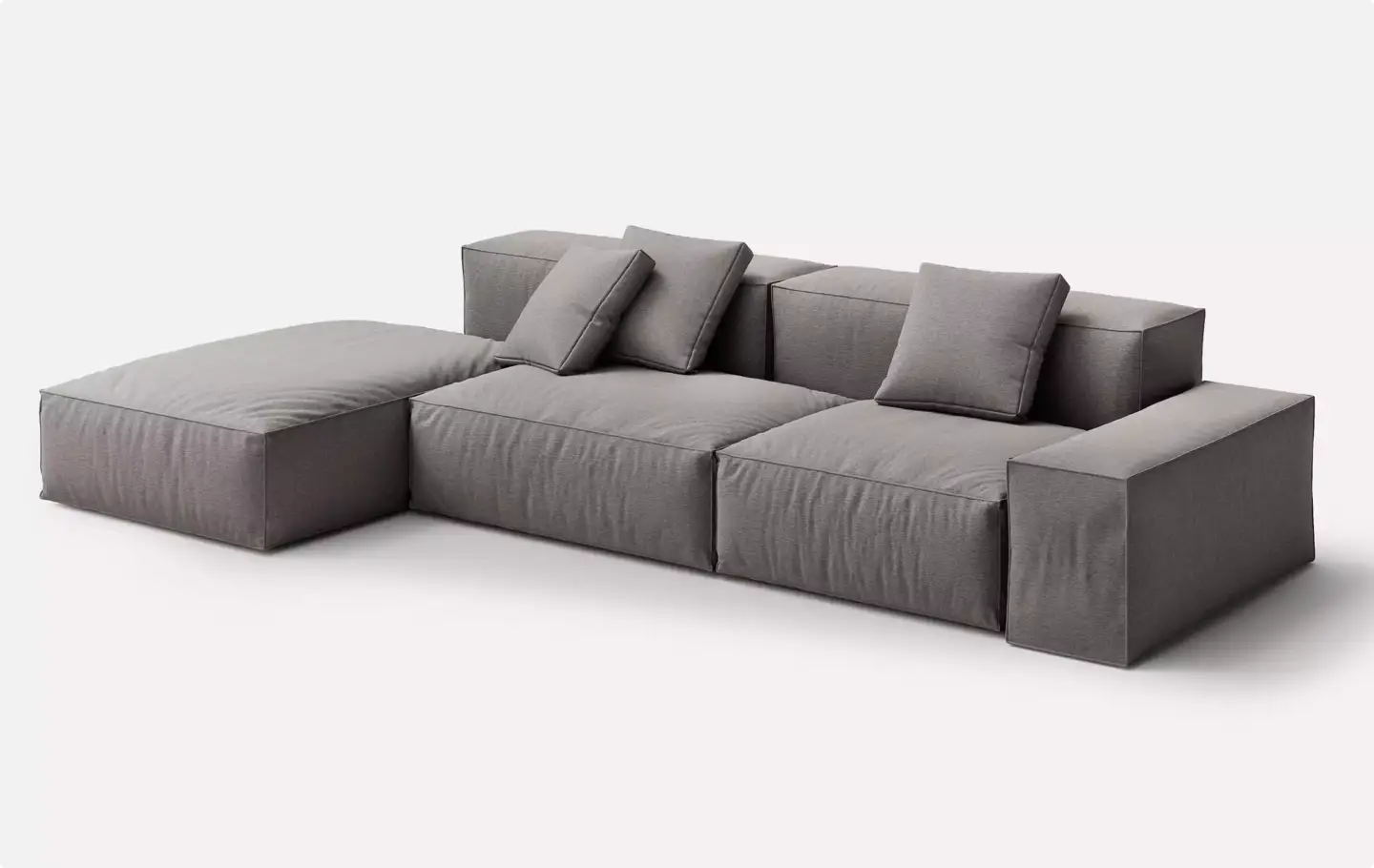
The variant point is where the economics of a furniture catalogue live. A modular sofa sold in twelve fabrics is one geometry and twelve texture sets. Treating it as twelve models is the difference between a catalogue that can be maintained and one that is abandoned after the first season.
One master asset, three exports: building for all three platforms at onceOne master asset, three exports: building for all three platforms at once
Because the three specifications overlap rather than conflict, a single production standard satisfies all of them. Build to the strictest constraint on each axis and every platform is covered.
| Production decision | Build to this and all three platforms accept it |
| Triangle count | Stay under Amazon’s 200,000 triangle cap. Nothing else published is tighter. |
| Textures | 2K minimum, 4K maximum, square, power of two, one map per channel, PNG or JPG. |
| Materials | PBR metal-roughness, single UV atlas in 0–1 space. |
| Scale | Real-world dimensions in metres in the glTF, with an inch figure documented alongside. |
| Orientation | Y up, front to +Z, pivot at 0,0,0, resting on Y=0. |
| File weight | Target under 15 MB so Shopify leaves your optimisation decisions intact. |
| Master format | GLB. Shopify derives USDZ automatically; Amazon and Wayfair both take GLB. |
That single standard is also what makes marketplace assets and marketing imagery share a pipeline. The high-poly master built for furniture 3D rendering is the same geometry that gets retopologised and baked down into the marketplace asset — one modelling investment, two very different deliverables.
Looking to download Wayfair or IKEA furniture models instead?Looking to download Wayfair or IKEA furniture models instead?
This page is written for the supplier side: you own the product and need an asset a marketplace will accept. If you arrived looking to download existing retailer models for a design project, that is a different lane and a different set of sources — SketchUp’s 3D Warehouse hosts the Wayfair library released in 2017, and stock marketplaces sell furniture models under their own licences.
Two things worth knowing before you use either as a listing asset. Those libraries are licensed for visualisation, not for submission as your own product data. And they are not built to the specifications above — a SketchUp-era design model will typically fail on triangle count, texture layout and pivot placement even when it looks correct.

Turn Ideas Into Visual Stories
Maverick Frame Blog FAQ
What file format do Amazon, Wayfair and Shopify accept for 3D models?
Amazon accepts .GLB and .glTF, with glTF exported as separate .glTF, .bin and texture files. Shopify accepts GLB and USDZ and converts uploads so both versions exist. Wayfair’s own Realtime 3D Model API serves .glb files, so GLB is the safe master format for all three platforms.
How many polygons should a furniture 3D model have?
Amazon sets the only published ceiling: 200,000 triangles maximum. Wayfair and Shopify do not publish a triangle limit, so building under Amazon’s cap satisfies all three. For most furniture that means a retopologised low-poly mesh with tufting and stitching baked into normal maps.
What texture resolution does Amazon require for 3D models?
Texture resolution must be no smaller than 2K (2,048 × 2,048 pixels) and no larger than 4K (4,096 × 4,096 pixels), square and power of two on all sides. Textures are supplied as .PNG or .JPG, one map per channel, and double-sided textures are not supported.
Can I use the same 3D model on Amazon, Wayfair and Shopify?
Yes, if it is built to the strictest constraint on each axis. A GLB under 200,000 triangles, with 2K to 4K PBR metal-roughness textures, real-world scale, Y-up orientation and a pivot at 0,0,0 meets every published requirement across the three platforms.
Does Wayfair publish its 3D model requirements publicly?
No. Wayfair distributes its 3D modelling standards to suppliers through its supplier portal and Wayfair 3D University, launched in 2018. Publicly verifiable details are limited to its Realtime 3D Model API, which returns .glb files and product dimensions in inches.
Why does my 3D furniture model appear the wrong size in AR?
Almost always a unit conversion error. The glTF specification treats one unit as one metre, while furniture data is often authored in inches or millimetres. A 34-inch chair exported without conversion becomes a 34-metre object. A misplaced pivot causes the second most common fault, sinking or floating.