To start an interior design business, pick a niche, check your state's interior design rules, form an LLC, buy liability insurance, set a pricing model and choose your software. Then build a portfolio before your first client with 3D renders of concept projects, and write a plan that models fees, hours and cash flow.
- Choose a niche: Pick one client type and project size, such as small home renovations, short-term rentals or dental clinics.
- Check state rules: Find out whether your state regulates the title or the practice of interior design before you name the firm.
- Form the business: Register an LLC, get an EIN, open a business bank account and get a resale certificate if you will sell furniture.
- Insure the firm: Buy general and professional liability cover before you sign the first client contract.
- Set your pricing model: Choose hourly, flat fee, percentage of project cost or per square foot, and write it into a standard contract.
- Choose software: Start with one drawing tool and one project and billing tool, and add more only when the work demands it.
- Build a portfolio: Design two or three concept projects and show them as photoreal renders before any client exists.
- Line up a render partner: Agree prices and turnaround with a 3D studio so you can present concepts without learning to render.
- Write the business plan: Model fees, billable hours, overhead and cash flow for the first twelve months.
- Find first clients: Publish the portfolio, set up local search and ask contractors and realtors for referrals.
Interior Design Business Startup Costs
A home-based interior design business can start for a few thousand dollars, because the core costs are registration, insurance, software and a portfolio. A showroom or retail space changes the numbers completely, so most new firms start from home and meet clients on site. The table shows typical ranges, not quotes, each taken from the public source named in the last column.
| Cost item | Typical range | Source |
|---|---|---|
| LLC state filing fee | $35 (Montana) to $500 (Massachusetts) | LegalZoom state fee table |
| General liability insurance | About $589 a year (median) | Insureon, interior designer policies |
| Professional liability insurance | About $708 a year (median) | Insureon, interior designer policies |
| SketchUp Pro | $33.25 a month, billed annually (about $399 a year) | Trimble SketchUp price list |
| AutoCAD | $2,095 a year | Autodesk price list |
| Portfolio renders, 5 to 8 interior views | $600 to $1,500 freelancer, $1,500 to $4,000 studio | Our studio's review of the rendering market |
On top of that, budget for a simple website, a library of fabric and finish samples, contract templates reviewed by a lawyer, and enough personal savings to cover the months before fees arrive. Full-service residential projects often run for months, and the largest payments tend to come late, so cash flow is the real startup cost for most new firms.
Choosing an Interior Design Business Niche
The niche is the first decision because it sets almost every other one. A residential e-design service needs little more than a laptop and a drawing tool. A commercial practice for offices, clinics or shops needs code knowledge, CAD drawings and, in some states, registration. The niche also decides who refers work to you and how you price it.
- Full-service residential: whole-home or room-by-room design with furniture sourcing, which brings high fees but long projects.
- E-design: remote design boards, layouts and shopping lists for a flat fee, which is easy to run from home.
- Kitchen and bath: technical, renovation-led work that often comes through contractors.
- Short-term rentals and staging: fast, budget-driven projects for owners and investors.
- Commercial interiors: offices, clinics, retail and hospitality, where codes and drawings carry more weight.
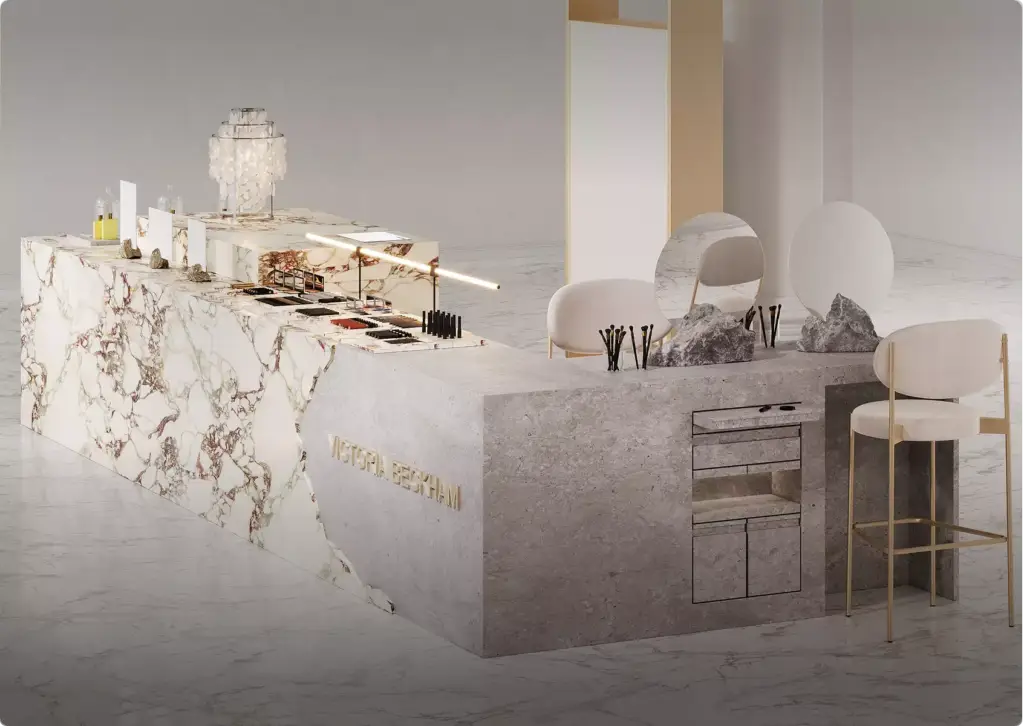
If you want to design model units and sales suites, it helps to understand how a real estate developer plans a project, because developers buy on schedule and budget rather than on style alone.
Interior Design Business Licensing: NCIDQ and State Rules
In the U.S., interior design rules are set state by state. According to Business of Home, interior design is regulated in 31 states plus Washington, D.C. and Puerto Rico, and 20 of them allow NCIDQ-certified designers to sign and seal their own documents. The rest have no specific interior design law.
Title Acts and Practice Acts
CIDQ, the council that runs the NCIDQ exam, describes two main kinds of law. A title act protects a title such as "registered interior designer": registration is optional, but you cannot use the protected words without it. A practice act goes further and requires registration to do the work at all. Practice acts cover a small group of places, including Louisiana, Nevada, Washington, D.C. and Puerto Rico, and Florida keeps its rules for commercial interior design. Laws keep changing: in July 2026, Missouri signed Senate Bill 1233, which lets NCIDQ-certified designers approve their own plans without review by an outside architect or engineer.
For a new firm, this means two practical checks. First, read your state board's rules before you choose a business name or print a card, because the word "designer" may be protected. Second, check whether your niche needs permit drawings. Residential decorating and furnishing usually sit outside these laws, while commercial work that touches codes, exits or fire ratings is where registration matters most.
NCIDQ Certification
The NCIDQ is made of three exams: the IDFX on fundamentals, the IDPX on professional practice, and the PRAC, a practicum built on case studies. Students in the final year of an interior design degree can sit the IDFX. The other two need both education and work experience. According to PPI's summary of CIDQ routes, a graduate of a CIDA-accredited bachelor's program needs 3,520 hours, about two years, while most other routes need 5,280 hours. If you are not yet eligible, you can still open a residential or e-design firm in most states and certify later.
Legal Setup for an Interior Design Business
Most small firms form an LLC to keep business debts apart from personal assets, then get an EIN from the IRS and open a separate business bank account. If you plan to buy furniture and resell it to clients, register for sales tax in your state and get a resale certificate, so you do not pay tax twice on goods you pass on.
Insurance comes before the first contract. General liability covers injury and property damage, and professional liability covers claims that your design advice caused a loss. According to Insureon, median premiums for interior designers are about $589 a year for general liability and $708 a year for professional liability, and workers' compensation runs about $660 a year once you hire staff.
Your client contract does more work than any other document. It should name the scope, the number of design rounds, the fee model, deposits and payment stages, how purchasing and markups work, who owns the drawings, and whether you may photograph the finished project for your portfolio.
Interior Design Business Pricing Models
You can charge by the hour, by a flat fee, by a share of the project cost or by the square foot, and many firms mix two. The ranges below are what homeowners pay, according to Angi's cost guide. They are typical ranges, not quotes, and your local market may sit higher or lower.
| Pricing model | Typical range (Angi) | Works best for |
|---|---|---|
| Hourly | $100 to $500 an hour | Consultations, small jobs, unclear scope |
| Flat fee | $2,000 to $12,000 | Full-service design with a clearly defined scope |
| Percentage of project | 10% to 30% of the project total | Large, high-end or luxury renovations |
| Per square foot | $5 to $17 per square foot | Larger homes and new construction |
New firms often do well with flat fees split by phase: concept, design development, documentation and installation. Clients see a fixed number, and you get paid as each phase ends, which protects your cash flow on long residential projects. Track your hours anyway, even on flat-fee jobs, because that data shows whether the fee was right and sets the price of the next project. If you resell furniture, decide how you share trade discounts and markups, and put that in writing.
Interior Design Business Software Stack
Buy software for the niche you chose, not for the one you might reach later. Most firms need four kinds of tools:
- Drawing and 3D modeling: SketchUp Pro is a common start at about $399 a year. AutoCAD costs $2,095 a year and suits firms that produce construction drawings. Revit matters mainly in commercial teams that work with architects.
- Rendering: real-time and photoreal engines turn the model into images. Learning one to client quality takes months of practice.
- Project management and billing: tools such as Studio Designer, Houzz Pro or HoneyBook handle proposals, purchase orders and invoices.
- Accounting: a standard small-business ledger, linked to your business bank account.
For a side-by-side view of engines and plugins, see our comparison of rendering software for interior design. Many new owners model in SketchUp and send the model out for final images, which keeps their own hours for design and client work.
Building an Interior Design Business Portfolio Before Your First Client
Clients hire from pictures, and since a new firm has no finished jobs to photograph, the practical fix is a set of concept projects: real rooms you redesign on paper and present as if for a client. Good sources are your own home, a friend's apartment, a listing you re-plan, or a design competition brief.
Each concept should show the full process, not just a pretty picture: the existing plan, the new layout, a mood board, a material and furniture schedule, and two or three photoreal views. Label them honestly as concept work. A small set of complete projects reads as more credible than a large set of mood boards.
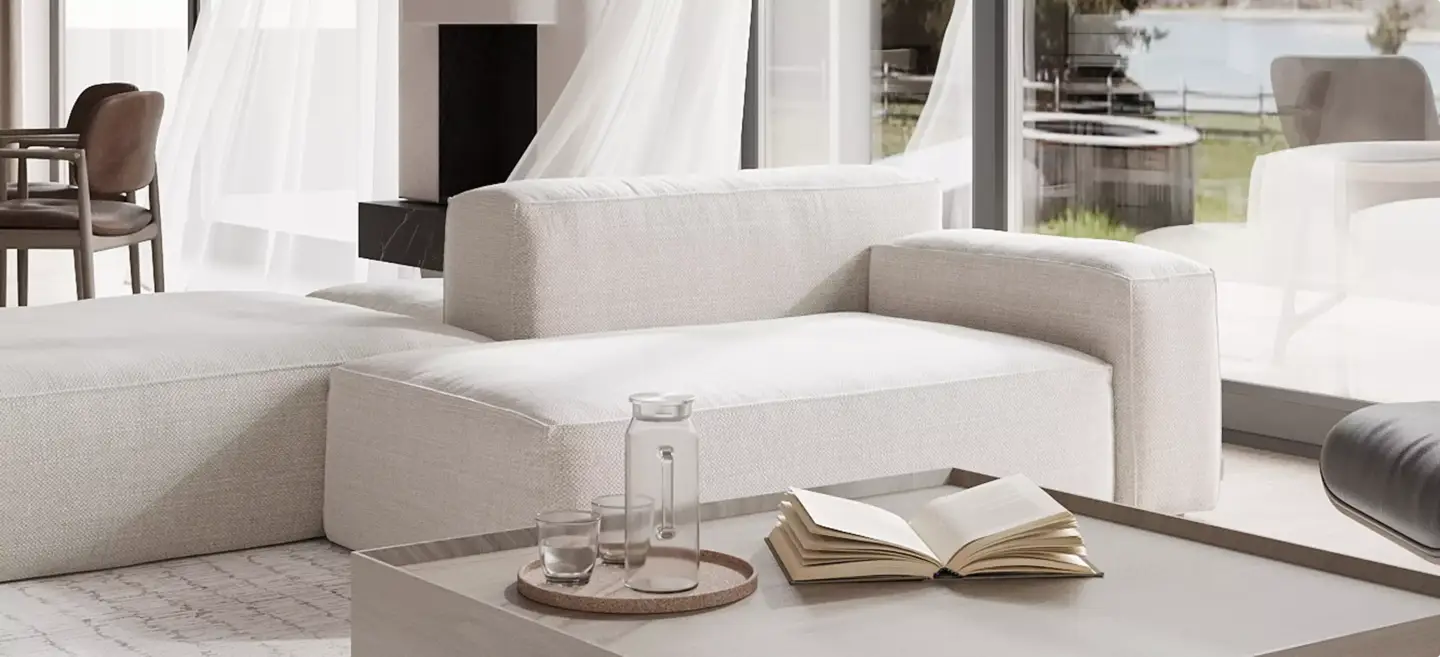
Pick concepts that match your niche. If you want kitchen and bath work, show a kitchen with real cabinet details. If you want clinics, show a reception and a treatment room. The portfolio is your first marketing tool, so it should attract the client you actually want.
Outsourcing 3D Renders for an Interior Design Business
Before launch, the visuals you need are two or three photoreal stills per portfolio concept, a 3D floor plan for at least one project, and later a set of views for each live client pitch. Outsourcing them lets you present concepts at a high level from day one. Market prices vary widely, and in our studio's review of the market, an interior still costs $120 to $350 from a freelancer and $300 to $700 from a studio, a package of 5 to 8 views costs $600 to $1,500 or $1,500 to $4,000, and animation runs $1,000 to $3,000 or $3,000 to $8,000 per minute. These are typical ranges, not quotes.
Our own architecture rate is $39 an hour. A still usually starts at about 8 hours, roughly $300, and animation starts from $2,200 per finished minute. The full breakdown is in our 3D rendering pricing guide. We give a price within one business day of the brief.
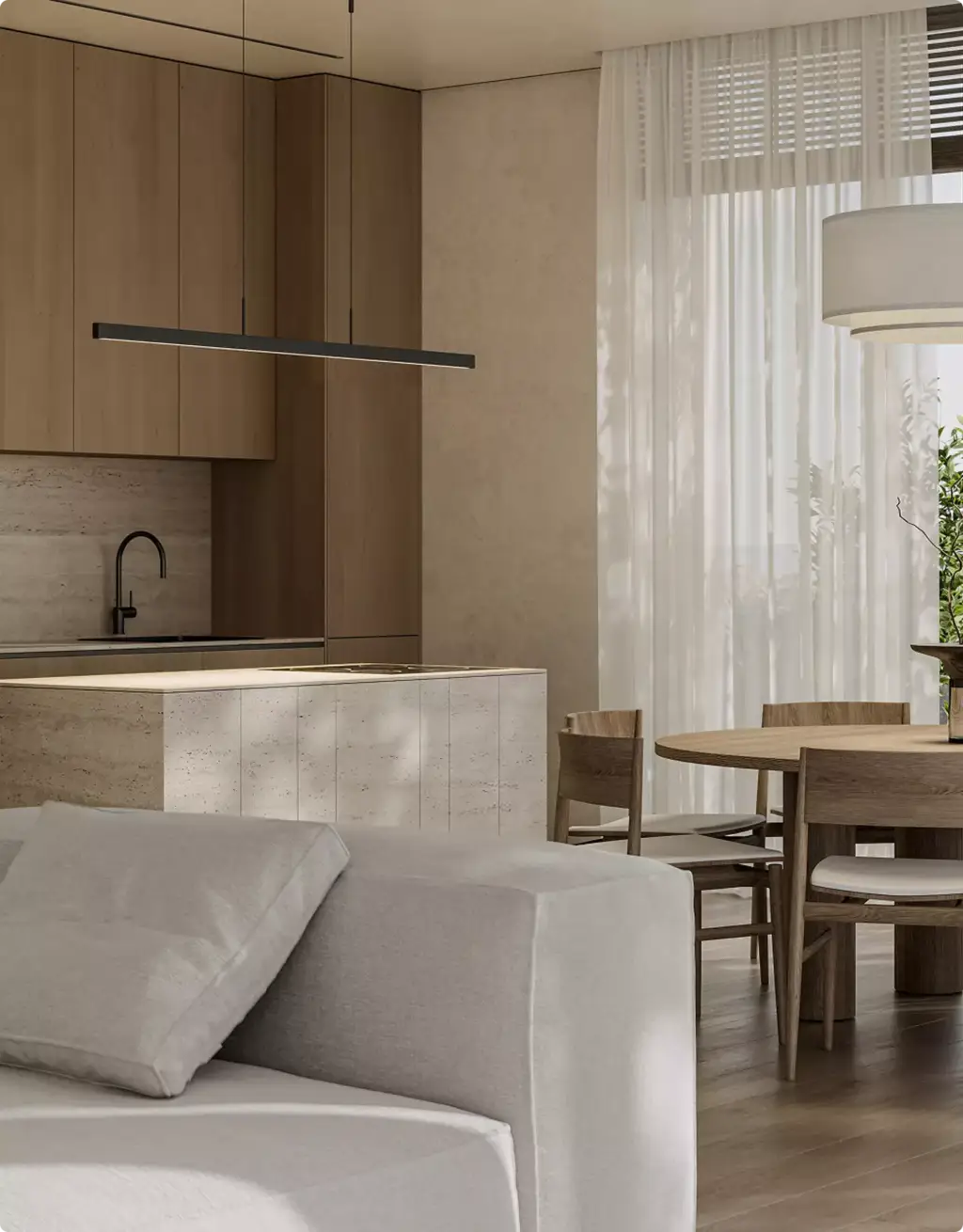
Timing matters as much as price. A draft still takes 3 to 5 business days from a full brief, a package of 5 to 8 views takes 2 to 3 weeks, and an animation up to one minute takes 4 to 6 weeks. Revisions include two rounds on the draft and one on the final. To get there, send a dimensioned plan, elevations, a mood board, a furniture and material list with links, and the camera angles you want.
Designers often worry about who sees their work. We can work under NDA, and then we do not show the project; rights to the final images are agreed in the contract. Our interior rendering team handles single rooms and full homes, and firms that need regular output can use our rendering support for design studios.
Interior Design Business Plan: What to Model Before You Launch
The plan does not need to be long, but it needs real numbers. For an interior design firm it should cover:
- Niche and ideal client: who you serve, the project size and the area you cover.
- Services and packages: what each phase includes and what it does not.
- Pricing model: fee type, deposits, payment stages and furniture markup policy.
- Market: local competitors, their fees and how you differ.
- Marketing: portfolio, website, local search and referral partners.
- Operations: software, trade accounts, render partner and contractors.
- Financials: revenue per project, billable hours, overhead, cash flow and break-even.
The key number is your effective hourly rate. As an example, if you want $90,000 in yearly fees and can bill about 20 hours a week for 48 weeks, that is 960 billable hours, so you need about $94 for each billable hour. If that is above what your market pays, change the niche, the fee model or the target. Model cash flow month by month, since a full-service project may pay its largest stage months after you start.
Finding First Clients for a New Interior Design Business
Early clients rarely come from advertising; they usually come from people who already meet homeowners and business owners: contractors, realtors, stagers, architects and furniture showrooms. Builders are a strong source for kitchen, bath and renovation work, and our guide on starting a construction company shows what a new contractor looks for in a design partner.
At the same time, set up a business profile in local search, publish each portfolio concept as its own page, and ask every early client for a review. Our guide to SEO for interior designers covers local search in detail. Start with smaller projects you can finish well, photograph them, and replace concept work with real jobs as they arrive.
Turn Ideas Into Visual Stories