To become a real estate developer, you first learn the trade inside a development team, builder, lender or brokerage, then save or raise equity, form a company, and take on one small project. That first deal teaches feasibility, entitlement, financing and pre-sales, and it builds the track record that lenders and investors ask for.
- Learn the trade: Spend a few years on a development team, at a home builder, a construction lender or a commercial brokerage.
- Pick a niche: Choose one product type and one market you can study closely, such as townhouses in one metro area.
- Build capital: Save equity and line up partners, because lenders expect you to fund part of the cost yourself.
- Form the company: Set up an operating company and, for each deal, a separate project entity on your attorney's advice.
- Assemble the team: Bring in an attorney, architect, civil engineer, general contractor, lender and broker before you buy land.
- Test the first site: Run a feasibility study on zoning, cost, price and timeline before you sign a purchase contract.
- Secure entitlements: Get the zoning, site plan and permits that let you build what the numbers assume.
- Close the financing: Combine your equity, partner money and a construction loan sized to the total project cost.
- Pre-sell with visuals: Use renderings, animation and virtual tours to market units before construction starts.
- Build and report: Deliver the project, sell or lease it, and report results to investors to fund the next deal.
What a Real Estate Developer Actually Does
A real estate developer turns land or an old building into something people will buy or rent. The developer does not lay bricks or sign every lease. The job is to control a site, decide what to build, raise the money, hire the people who design and build it, and carry the risk until the project is sold or stabilized.
That is why most search results on this topic talk about careers, courses and licenses. Those matter, but they are not the hard part. The hard part is the order of decisions. A first-time developer who buys land before testing zoning, or starts marketing after the foundation is poured, pays for those mistakes in interest and lost months.
There is no single license for this work in most places, but local rules can apply. The City of Chicago, for example, requires a Residential Real Estate Developer license for anyone who buys vacant land and erects a new residential building, or converts a building to condominium ownership. Check your city and state before you buy anything.
Real Estate Developer Startup Costs and Where the Money Goes
Before you plan a career move, it helps to see how a finished project spends its money. The table below shows how the sale price of an average new single-family home in the U.S. was split in 2024, according to the National Association of Home Builders (NAHB) Cost of Constructing a Home survey. These are typical shares, not quotes for your project.
| Share of the sale price | Typical share (NAHB, 2024) | What it means for a new developer |
|---|---|---|
| Construction cost | 64.4% | The biggest line, and the one most exposed to price swings |
| Finished lot | 13.7% | Land plus site work; often where your own equity goes first |
| Builder profit | 11.0% | Your margin if everything goes to plan |
| Overhead and general expenses | 5.7% | Office, staff, insurance and admin |
| Sales commission | 2.8% | Brokers who sell the units |
| Financing | 1.5% | Interest and loan fees during construction |
| Marketing | 0.8% | Signage, website, ads and visuals |
Two things stand out. First, an 11% margin leaves little room for a six-month delay. Second, marketing is the smallest line, yet it decides how fast the project sells and how soon the loan is repaid. A modest marketing budget spent early often does more than a larger one spent late.
Experience You Need Before Becoming a Real Estate Developer
Lenders and investors back people, not ideas. They want to see that you have been close to a real project from land to sale. The most common ways in are:
- Working for a developer as an analyst, project coordinator or development manager.
- Working for a builder or general contractor, where you learn costs, schedules and subcontractors.
- Working at a lender, where you see how construction loans are sized and why deals fail.
- Brokerage or appraisal, which teaches you what buyers and renters will pay.
- Architecture or engineering, which gives you an edge on design, zoning and site planning.
A degree in real estate, finance, construction management, architecture or urban planning helps, and some people add a graduate degree in real estate development. It is not a legal requirement. What you need is proof that you can read a budget, follow a schedule and close a deal. Many developers start with a duplex, a renovation or a small infill lot to build that proof.
Capital and Partners for a First-Time Real Estate Developer
Construction lenders rarely fund the whole project. C-Loans, a commercial loan marketplace, notes that most construction lenders cap loan-to-cost at 80%, so the developer must bring at least 20% of the total cost. The same source says land often makes up 20% to 25% of the total cost, which is why land and early design fees are usually where the developer's equity goes first.
If you do not have that equity yourself, you have three common options:
- Joint venture with a capital partner. An investor puts up most of the equity; you earn a fee and a share of the profit for doing the work.
- Partnering with a landowner. The owner contributes the land as equity in exchange for a share of the result.
- Friends, family or private investors. Common for small first deals, but it needs proper documents and securities advice.
Whichever route you take, agree in writing who decides what, who funds overruns, and how profit is split before money moves.
How to Start a Real Estate Development Company
Most developers run two layers. The operating company employs people, holds the brand and earns fees. Each project then sits in its own entity, often an LLC, so the risk of one deal does not spill into the next. Lenders often prefer a single-purpose entity for each loan. Ask a real estate attorney and an accountant to set this up for your state and tax situation.
The First Team for a Real Estate Development Company
You do not need full-time staff on day one. You need the right advisers on call:
- a real estate attorney for contracts, entities and investor documents;
- an architect and a civil engineer for design, site plan and permits;
- a general contractor who can price the design early;
- a construction lender or mortgage broker;
- a local broker who knows what sells and at what price;
- a marketing and visualization partner for the pre-sales stage.
Real Estate Development Feasibility: Testing the First Site
Feasibility is where a first project is won or lost. Do it before you sign a land contract, or negotiate a due-diligence period that lets you walk away. A useful study answers five questions:
- Can you build it? Zoning, height, density, parking, setbacks and any overlays.
- What will it cost? Land, hard costs from the contractor, soft costs such as design, permits, legal and financing.
- What will it sell or rent for? Recent comparable sales or rents from your broker.
- How long will it take? Entitlement, permits, construction and sales.
- Does the margin survive a bad case? Test higher costs, lower prices and a slower schedule.
Early 3D massing is useful here. A simple model on the real site shows how many units fit, how the building sits next to its neighbors, and what a planning board will see. It costs far less than redrawing a full design set after a hearing goes badly.
Entitlement and Financing for Your First Real Estate Development
Entitlement is the approval to build what your numbers assume. On a by-right site it may only mean a site plan review and building permits. If you need a rezoning, a variance or a subdivision, expect public hearings, neighbor meetings and more time. Clear drawings and renderings help planners and residents understand the scheme, which can make those meetings shorter and calmer.
Financing usually follows entitlement. Many lenders will not close a construction loan until permits are in hand. A typical stack for a first deal looks like this: your equity and partner equity cover land and early costs, and the construction loan covers most of the build. For condominiums, the buyer side matters too. Fannie Mae's Selling Guide says that, under a full review of a new condo project, at least 50% of the total units in the project or legal phase must have been conveyed or be under contract before buyers can get Fannie Mae-backed mortgages there. That makes pre-sales a financing issue, not only a marketing one.
Pre-Sales Visuals a Real Estate Developer Needs Before Construction
Buyers and investors cannot walk through a building that does not exist yet. Visuals do that job, and they need to be ready before the sales launch, which for off-plan projects means before construction. A practical set for a first project includes:
- Exterior renderings of the street view, entrance and amenities, used for permits, investors and ads;
- Interior renderings of a typical unit, kitchen and bathroom, so buyers can see finishes;
- 3D floor plans for each unit type, which answer the most common buyer questions;
- A short animation or flythrough for the website, social media and the sales gallery;
- A virtual tour of a show unit, so remote buyers can explore it without a visit.

Order matters. Start the exterior and floor plan visuals once the design is stable enough for permits, so they can serve the planning board, the lender and the buyers. Add interiors and animation once finishes are chosen. If you change the design late, you pay to redo the images.
What Pre-Sales Visuals Cost a Real Estate Developer
Market prices vary widely. As a guide, a studio exterior still usually costs $250 to $600 and an interior $300 to $700, while a package of five to eight views runs about $1,500 to $4,000. Freelancers charge less, with more risk on quality and deadlines. Animation from a studio is typically $3,000 to $8,000 per minute. These are typical ranges, not quotes, and our guide to 3D rendering prices breaks them down further.
In our studio, the architecture rate is $39 per hour and animation is $45 per hour. A single still usually starts at about 8 hours, roughly $300. Walkthrough animation starts from $2,200 per finished minute. As a rough timeline, a first draft still takes three to five working days from a full brief, a package of five to eight views takes two to three weeks, and an animation of up to a minute takes four to six weeks. Virtual tours are priced in the estimate for the scope. You can see the range of work on our architectural rendering services page, the 3D virtual tours for real estate page, and the walkthrough animation cost guide.
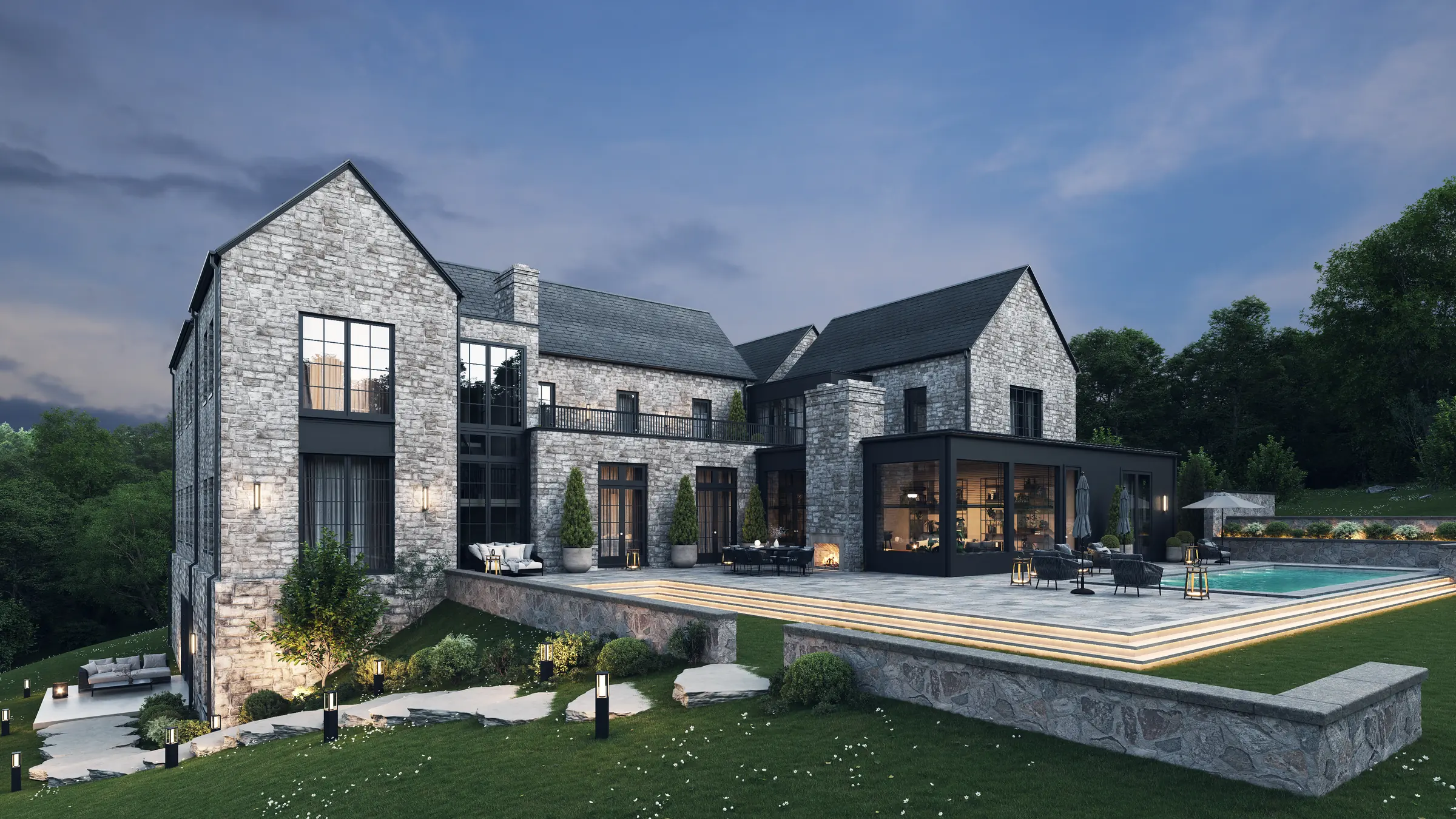
Visuals are one part of the launch. Branding, the project website, the sales gallery and paid ads come with it. Our article on marketing off-plan projects covers that plan in detail, and the real estate development marketing agency page shows how we support developers through a launch. For one example, the apartment complex case study describes how unified CGI production accelerated pre-sales for an apartment complex design.
Real Estate Development Business Plan: What Lenders and Investors Read
A real estate development business plan is not a pitch about your vision. It is a short document that shows a lender or investor you have tested the first deal and know how the company will grow. It should include:
- Company summary: who you are, your track record, and the niche and market you focus on.
- The first project: site, zoning, unit mix, design concept and early renderings.
- Market study: comparable sales or rents, absorption pace and the target buyer.
- Development budget: land, hard costs, soft costs, financing costs, contingency and marketing.
- Capital stack: your equity, partner equity, the construction loan and the terms of each.
- Schedule: due diligence, entitlement, permits, construction and sales, month by month.
- Returns and risks: profit, margin on cost, investor returns, and a downside case.
- Team: attorney, architect, engineer, contractor, broker and marketing partner.

The numbers to model carefully are the ones that move your margin: construction cost per square foot, sale price per square foot, months to sell out, and the interest you carry until then. Show the lender what happens if each one moves against you.
Turn Ideas Into Visual Stories