MAGI-2 is a video model from Sand.ai, the Beijing startup behind MAGI-1. Released on November 24, 2026, it makes clips of 4 to 30 seconds at 1080p and 25 fps, generates dialogue, sound effects and music in the same pass, and accepts up to 20 reference files. It costs $0.08 per second of output on Sand.ai’s API and on Higgsfield, so a 30-second clip is $2.40, about a seventh of what Seedance 2.5 charges at 1080p.
On the Artificial Analysis image-to-video arena it opened in first place, statistically tied with Seedance 2.5. What it is not, yet, is open source: the downloadable weights belong to the smaller MAGI-2 Preview from August. Below we compare the models, work out what a 30-second ad costs, and show where we would still put CGI next to it.
Release status, updated November 26, 2026: the latest model is MAGI-2 (November 24, 2026), and its open-weights sibling is MAGI-2 Preview (August 5, 2026). Sand.ai says the flagship weights and a technical report will follow, without a date. We update this page on the same address when a new MAGI version ships.
MAGI-2 vs MAGI-2 Preview vs Seedance 2.5 at a Glance
| Spec | MAGI-2 | MAGI-2 Preview | Seedance 2.5 |
|---|---|---|---|
| Released | November 24, 2026 | August 5, 2026 | July 31, 2026 |
| Model size | 480B parameters, about 28B active | About 114B parameters, about 6B active | Not disclosed |
| Clip length | 4 to 30 seconds | 10 seconds | Up to 30 seconds in one pass |
| Output | 1080p at 25 fps, six aspect ratios | Generated at 512×896, refined to 1088×1920 | 480p, 720p, 1080p on the official API |
| Sound | Dialogue with lip-sync, effects and music | Synchronized audio | Synchronized audio |
| References | Up to 20: 10 images, 5 videos, 5 audio clips | A text prompt, or a prompt and one still image | Up to 50: 30 images, 10 videos, 10 audio clips |
| Price per 1080p second | $0.08 | Free to run on your own GPUs | $0.569 |
| Weights | Hosted only; release promised | Apache 2.0 on Hugging Face, about 307 GB | Hosted only |
Launch posts lead with the size of the model, but the line that changes budgets is the price. At $0.08, a 1080p second of MAGI-2 costs about half of what Seedance 2.5 Flash charges for a 720p second ($0.152), and Flash does not offer 1080p at all.
What Is New in MAGI-2
Four times the model, three times the data
Sand.ai scaled the base model more than four times over the Preview: 480B parameters in a mixture-of-experts design that activates about 28B per token, pre-trained on about 4 trillion tokens, roughly three times the Preview’s data. Post-training used reinforcement learning aimed at lighting, textures, fur and materials, and a separate upscaler brings the output to 1080p at 25 fps. Six aspect ratios are supported, from 21:9 to 9:16.
30-second shots with timed cuts
One generation can run for 30 seconds and hold several shots. There is no formal timeline syntax: you write plain timestamps into the prompt, such as “0–3 seconds:” and “At 3 seconds: hard cut to…”, and the model tells a hard cut from a camera move inside one shot. Cuts do not always land on an exact frame, word or beat, so plan to trim in an editor. Higgsfield also offers a start frame with an optional end frame.
20 references and targeted edits
A native request takes up to 20 reference files: 10 images, 5 videos and 5 audio clips, with reference video and reference audio each capped at 30 seconds in total. Prompts can run to 15,000 characters. Sand.ai feeds the reference images in again during upscaling to keep faces and text stable. MAGI-2 can also edit existing footage, for example changing an action or an object while keeping the camera move, but edit support depends on the route you use.
Benchmarks: first place, but a tie
Sand.ai reports a four-task average Elo of 1150.3 on the Artificial Analysis Video Arena v2.1, 151.8 points above the Preview. On the image-to-video board with audio, the November 25 snapshot put MAGI-2 first at 1165, four points above Seedance 2.5 at 1161, with overlapping confidence intervals. On text-to-video with audio it ranked seventh on November 26, at 1150 against 1154 for Seedance 2.5 and 1164 for MiniMax H3.
Is MAGI-2 Open Source?
Not yet. Many launch posts call MAGI-2 open source, but the 480B model runs only as a hosted service. Sand.ai says it will open-source MAGI-2 together with a technical report, and names no date and no license.
What you can download today is MAGI-2 Preview: about 114B parameters with 6B active, released under Apache 2.0, about 307 GB on Hugging Face. It makes 10-second clips from a text prompt or a prompt and a still image. With that much weight data, it is a model for a GPU server, not for a laptop.
MAGI-2 Pricing: What a 30-Second Ad Costs
Sand.ai and Higgsfield both list $0.08 per output second at 1080p, and on Higgsfield that rate includes generated sound. In the Higgsfield web app MAGI-2 costs 2.5 credits per second, or 75 credits for a 30-second clip.
| Model | Per second | One 30-second clip | Ten 30-second takes |
|---|---|---|---|
| MAGI-2, 1080p | $0.08 | $2.40 | $24 |
| Seedance 2.5, 1080p | $0.569 | $17.07 | $170.70 |
| Seedance 2.5 Flash, 720p | $0.152 | $4.56 | $45.60 |
A 4-second test costs $0.32, cheap enough to try every shot of a storyboard before you commit to a long prompt. On a production schedule, check how many MAGI-2 jobs your plan can run in parallel before you promise a client a batch of variations.
In our projects the model fee is a small line next to creative direction, editing, sound and approval rounds. A cheaper model mostly changes how many directions we can show a client at the storyboard stage, not the final budget.
Where to Use MAGI-2 Today
- Higgsfield. Web app and API. Higgsfield announced MAGI-2 on November 25, 2026 as live “exclusively on Higgsfield”, with 4 to 30-second clips, references and start and end frames.
- Sand.ai API. The developer’s own platform at platform.sand.ai, at the same $0.08 per second.
- API resellers. Hosts such as EvoLink and Siray listed MAGI-2 within two days of launch. Check which features each route supports, editing especially.
- Hugging Face. The MAGI-2 Preview weights only, not the flagship.
Sites with “MAGI-2” in the domain name, such as magi2.cc, are third-party front ends, not Sand.ai. The official pages are sand.ai and platform.sand.ai.
MAGI-2 vs Seedance 2.5: Which One for Brand Video
Use MAGI-2 for:
- storyboards and animatics at final resolution instead of 480p drafts;
- long single takes of up to 30 seconds with planned cuts;
- many variations of a social ad, where the cost of each attempt decides how far you explore.
Use Seedance 2.5 for:
- large reference sets, such as a full brand kit with several products and characters;
- 4K delivery, which Higgsfield offers for Seedance 2.5;
- jobs a client has already approved on Seedance, where switching models means re-approving the look.
Arena scores are averages over generic prompts. For a product film, the deciding test is your product in your shots.
MAGI-2 in Brand Video: Where CGI Still Wins
In our AI video work we use Higgsfield, Veo, Kling, Runway, Seedance, Midjourney and ElevenLabs, and a new model joins that list when it wins a test on a real brief. A lower price does not change the main limit of generative video: it redraws the product in every shot.
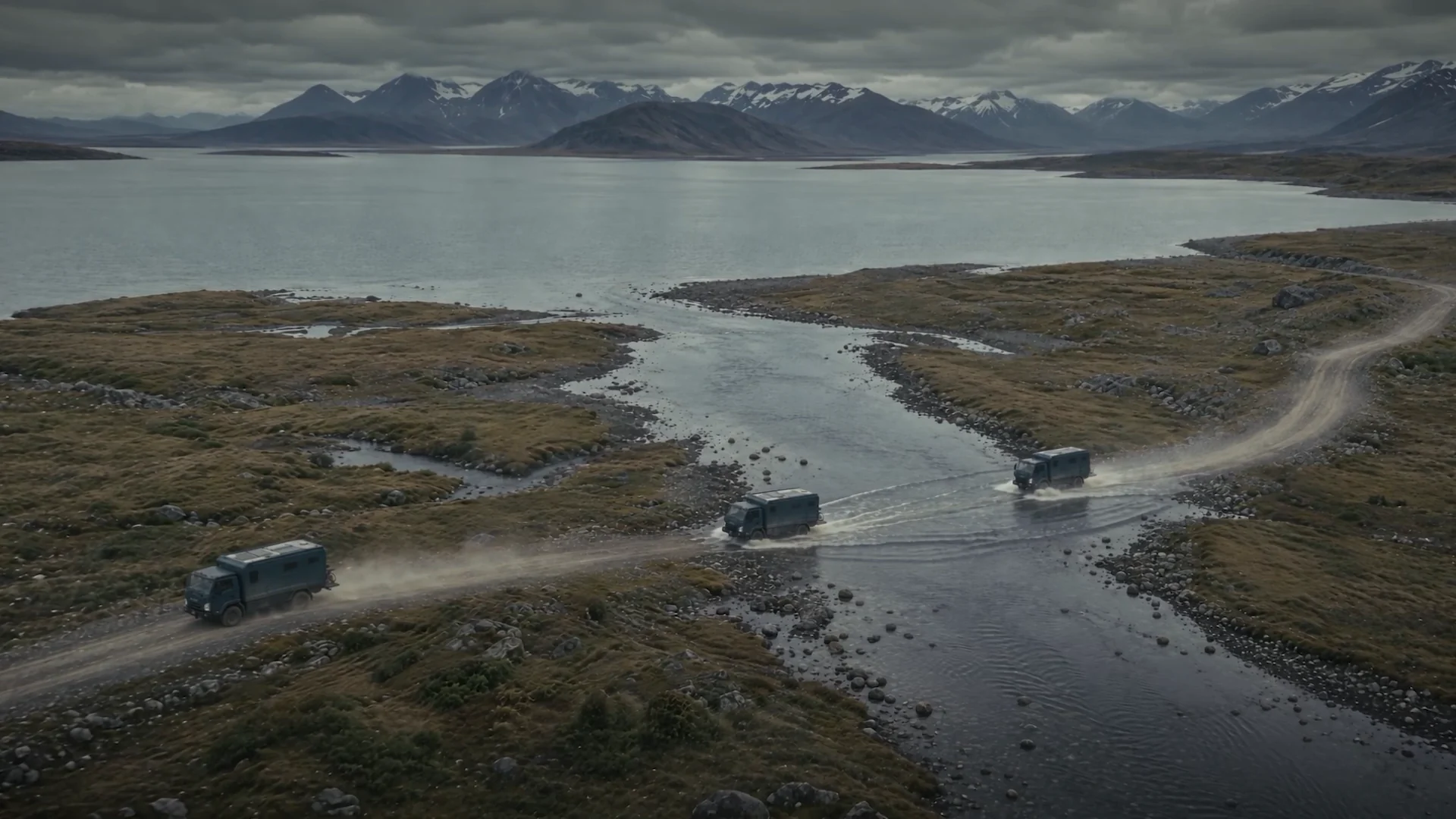
On a 49-second expedition truck camper film, we checked every truck against the client’s 3D model and corrected box height, windows, wipers and logos scene by scene until each one matched the real build. For a 73-second pool fittings brand film, the inlets had to match the manufacturer’s STEP files and real diameters, so the AI shots were guided by a 3D scene of the pool built to those sizes.
Sand.ai lists its own weak spots: very fast motion can break trajectories, medium and wide 2D animation can look too smooth, and complex soundscapes need more layering. For product work we add three checks of our own:
- The exact product. Logos, label text and proportions can drift between frames; a 3D model cannot.
- Matching shots. A launch film, a set of packshots and a 360° spin of the same product need one scene, not separate generations.
- Technical motion. Mechanisms, assembly steps and cutaways still come from a 3D model.
See how we combine the two on our AI video production page, or our AI video ads page for social campaigns.
How to Test MAGI-2 on a Product Ad Brief
- Start with 4-second tests. At $0.32 each, run every storyboard shot before you write the long prompt.
- Give Seedance 2.5 the same brief. Same references, same length and the same aspect ratio, so the comparison is about the model. Our Seedance 2.5 guide covers its limits and prices.
- Check the product first. Logo, label text and shape in the first and the last second, against your packshot or 3D model.
- Write cuts as timestamps. Then measure where each cut lands and how much trimming it needs.
- Judge the sound on its own. Lip-sync, effects and the music mix, and whether the final edit needs separate stems.
- Read the terms of your route. Sand.ai, Higgsfield and resellers each have their own terms and plans; confirm commercial use before client delivery.
We have not run our own product test on MAGI-2 yet, and this page will add the results when we do. Launch-week rankings are a reason to test on your brief, not a verdict.
MAGI Release Timeline
| Date | Release |
|---|---|
| April 2025 | MAGI-1: Sand.ai’s autoregressive video model, which generates video chunk by chunk, released with open weights |
| August 5, 2026 | MAGI-2 Preview: a 114B mixture-of-experts audio and video model, with Apache 2.0 weights, inference code and a technical report |
| November 24, 2026 | MAGI-2: the 480B flagship, up to 30-second 1080p clips with sound, on Sand.ai’s API |
| November 25, 2026 | MAGI-2 live in the Higgsfield web app and API at $0.08 per second |
Turn Ideas Into Visual Stories