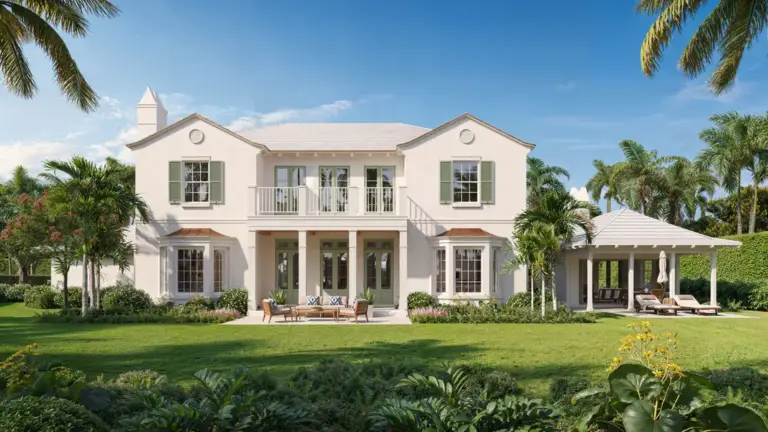
Spanish Colonial Revival architecture is an American style that peaked from about 1915 to the 1940s. It reimagines the missions and haciendas of Spain's former colonies as romantic homes with white stucco walls, low-pitched red clay-tile roofs, arched openings, and shaded courtyards. It shaped much of Southern California and Florida.
What is Spanish Colonial Revival architecture?What is Spanish Colonial Revival architecture?
Spanish Colonial Revival is a 20th-century revival style, not the actual colonial building it references. Where true Spanish Colonial construction was the plain, practical work of settlers between the 1500s and 1820s, the Revival was a romantic reinterpretation that Americans built for nostalgia and glamour. It debuted at the 1915 Panama-California Exposition in San Diego, where architect Bertram Goodhue turned Spanish, Moorish, and Mexican Baroque sources into a lush, photogenic idiom.
Rather than copy one place, the style blends several. It borrows the whitewashed walls and tile of Andalusia, the arcades of Mexican missions, and the decorative ironwork and glazed tile of Moorish Spain. That mix is why it feels warm and hand-made rather than strictly historical.
Spanish Colonial vs. Spanish Colonial Revival: what's the difference?Spanish Colonial vs. Spanish Colonial Revival: what's the difference?
The difference is roughly 300 years and one romantic re-imagining. Spanish Colonial is the real settler-era architecture built from the 1500s to the 1820s, using thick adobe or stone and almost no ornament. Spanish Colonial Revival is a 1915–1940s American style that added decorative tile, wide arches, and courtyards to make that heritage look picturesque. The table below sets the four most-confused styles apart.
| Style | Era | What it is | Where in the US | Tell-tale features |
| Spanish Colonial | 1500s–1820s | Genuine settler-era building | Florida, Texas, New Mexico, California missions | Thick adobe or stone walls, minimal ornament, flat or low roofs |
| Mission Revival | 1890–1915 | First revival of California missions | California, the Southwest | Curved mission-shaped gables, arcades, plain walls, bell-tower motifs |
| Spanish Colonial Revival | 1915–1940s | Romantic reinterpretation of Spanish colonial sources | Southern California, Florida | Smooth stucco, red-tile roofs, arches, courtyards, decorative tile |
| Mediterranean Revival | 1900s–1930s | Broader Italian-and-Spanish blend | Florida, coastal California | Larger, more symmetrical, Italianate detail, loggias |
If you want the older, plainer end of this family, see our guide to true Spanish Colonial architecture. For the wider coastal umbrella that overlaps with it, read about Mediterranean architecture.
Key characteristics of Spanish Colonial Revival homesKey characteristics of Spanish Colonial Revival homes
Spanish Colonial Revival homes are easy to recognize once you know the vocabulary. Most combine a handful of the following elements:
- White or cream smooth stucco walls
- Low-pitched red or terracotta clay-tile roofs with little overhang
- Rounded arches over doors, windows, and porches
- Interior or exterior courtyards and patios
- Decorative glazed (Talavera) tile on stairs, fountains, and risers
- Wrought-iron grilles, railings, and light fixtures
- Small, deep-set windows, sometimes with wooden shutters
- Asymmetrical facades with towers or turret-like chimneys
- Heavy carved wooden doors and exposed wood beams inside
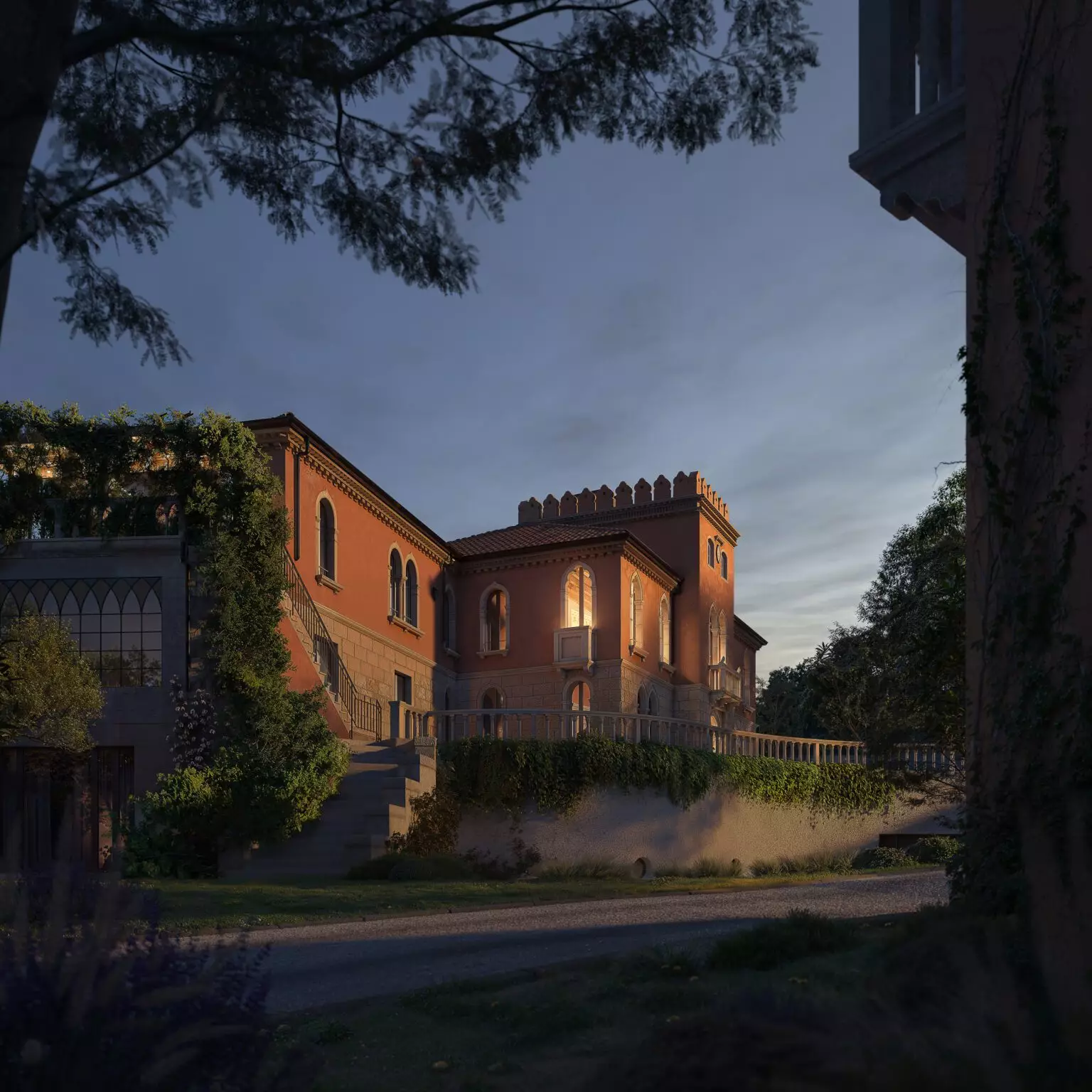
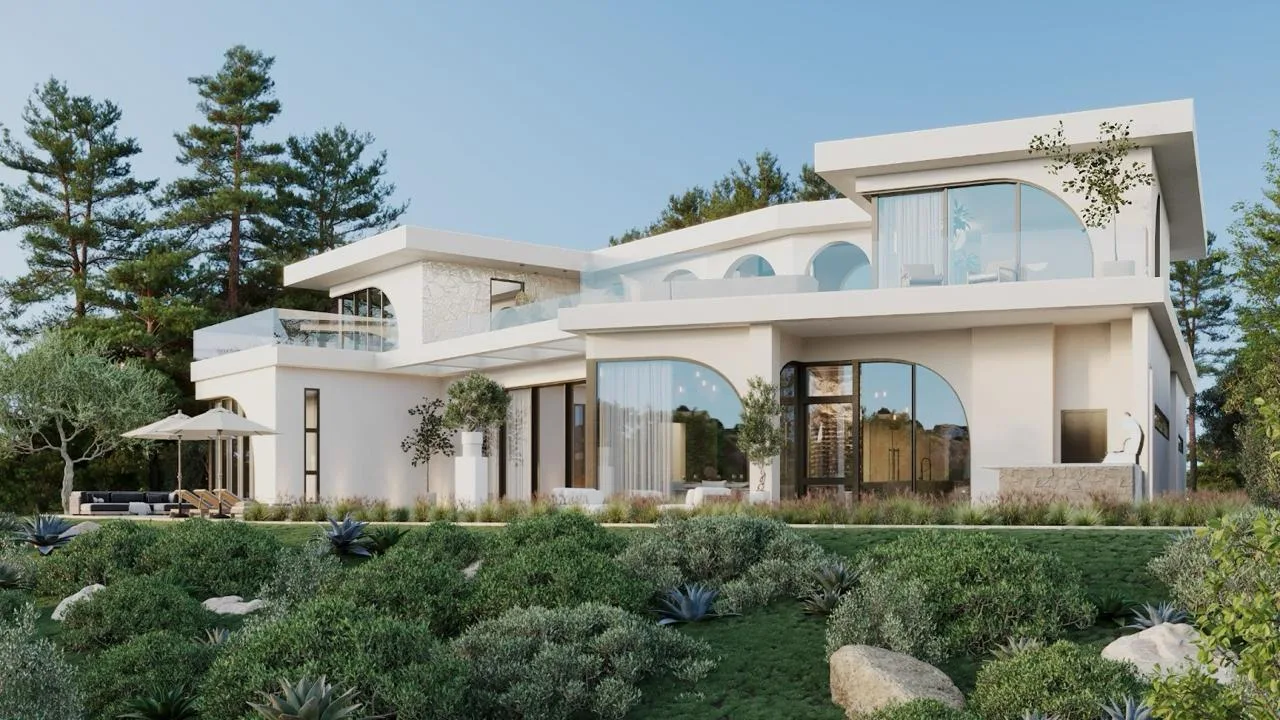
In our studio, the detail that separates an authentic Revival render from a generic "Mediterranean" one is usually the roof: a genuinely low pitch, a minimal eave overhang, and clay tiles with slight color variation read as hand-laid rather than machine-perfect. Arch proportion matters just as much — Revival arches are wider and lower than the tall, pointed arches people tend to default to.
How the style spread across California and Florida (1915–1930s)
The Revival went from novelty to regional default in barely a decade, pushed by a handful of specific events:
- 1915 — Panama-California Exposition, San Diego. Bertram Goodhue's fair buildings in Balboa Park made the style a national sensation.
- Early 1920s — Southern California adoption. Architects applied it to everyday homes; Hollywood's fashion for it added glamour.
- 1925 — Santa Barbara earthquake. The city rebuilt under design rules that all but required the style, producing the most complete Revival townscape and, in 1929, the Santa Barbara County Courthouse.
- 1920s — Florida land boom. Addison Mizner brought a lavish version to Palm Beach and Boca Raton, while George Merrick planned Coral Gables around it.
- After the 1930s — decline. The Depression and postwar taste for Ranch and Modern homes ended the boom, though the style survives in protected historic districts.
Famous Spanish Colonial Revival architects and landmarks
A small group of architects defined the style, and their landmark buildings are still the best places to study it:
- Bertram Goodhue — launched the style at the 1915 Exposition in San Diego's Balboa Park.
- Carleton Winslow — collaborated on the Exposition buildings and carried the idiom into California churches and civic work.
- George Washington Smith — refined it into elegant, restrained Santa Barbara houses; the definitive residential architect of the style.
- Addison Mizner — created the lavish Florida version in Palm Beach and Boca Raton.
- Landmarks — the Santa Barbara County Courthouse (1929), Balboa Park in San Diego, and Coral Gables, Florida.
How to identify a Spanish Revival house
Run through this quick checklist when you spot a candidate:
- Is the roof low-pitched red clay tile with almost no overhang?
- Are the walls smooth white or cream stucco rather than brick or clapboard?
- Do doorways and windows sit under rounded arches?
- Is there a courtyard, patio, or arcaded porch?
- Can you spot decorative glazed tile on steps, fountains, or house numbers?
- Are there wrought-iron grilles over windows and on balconies?
- Is the front asymmetrical, with a tower or prominent chimney?
If most answers are yes, you are almost certainly looking at Spanish Colonial Revival rather than genuine Spanish Colonial (plainer and older) or Mediterranean Revival (larger and more symmetrical).
Whether you are restoring one of these homes or designing a new one in the style, photoreal 3D exterior rendering lets you test tile color, arch proportion, and courtyard massing before anything is built, while residential rendering brings the interiors to life for buyers and approvals.