Postmodern architecture is a style that emerged in the late 1960s as a reaction against the austerity of modernism. It brought back color, ornament, historical reference, and playful, exaggerated form — trading the anonymous glass box for buildings that quote the past, embrace contradiction, and treat wit and symbolism as legitimate design tools.
What is postmodern architecture?What is postmodern architecture?
Postmodern architecture is a movement, roughly spanning the 1960s to the early 1990s, that rejected the strict functionalism and minimalism of modernist design. Where modernism preached "form follows function" and stripped buildings to clean lines and unadorned surfaces, postmodernism reintroduced decoration, historical quotation, bold color, and irony. Architect Robert Venturi captured the shift in a single retort to Mies van der Rohe's "less is more": "Less is a bore."
The intellectual groundwork was laid by two Venturi books — Complexity and Contradiction in Architecture (1966) and Learning from Las Vegas (1972) — which argued that buildings could communicate meaning, borrow from history, and even be a little vulgar. Critic Charles Jencks then named and framed the movement, notably in The Language of Post-Modern Architecture (1977), where he described postmodern buildings as "double coded": readable by both architects and the general public at the same time.
One clarification worth making up front: postmodernism is not the same as deconstructivism. Postmodern buildings put historical ornament and symbolism back; deconstructivism, which followed in the late 1980s, fractured form and geometry instead. Nor is "postmodern" simply a synonym for "modern" — the two describe opposing attitudes, as the comparison below makes clear.
Key characteristics of postmodern architecture
Postmodern architecture is defined by the deliberate return of everything modernism banished: ornament, color, history, and humor. A building is usually read as postmodern when it combines several of the traits below rather than any single one.
- Ornament and decoration return. Pediments, columns, moldings, and applied detail reappear — often oversized or used purely for effect.
- Historical quotation and eclecticism. Classical, Baroque, or vernacular motifs are borrowed and recombined, frequently with a knowing wink rather than strict revival.
- Bold color and varied materials. Polychrome facades, glossy tile, mirrored glass, and stone mix freely, rejecting the modernist palette of white, gray, and steel.
- Double coding and symbolism. Buildings communicate on two levels at once — a populist, recognizable image plus an architect's in-joke or reference.
- Wit, irony, and exaggeration. Scale is stretched, elements are cartoonish, and the design openly refuses to take itself too seriously.
- Fragmentation and contradiction. Asymmetry, clashing geometries, and "both/and" compositions replace the clean, unified modernist volume.
- Contextualism. Designs respond to their surroundings and local history rather than imposing a universal international template.
Postmodern vs modern architecture: the core differences
The clearest way to define postmodernism is against the modernism it rejected. Modern architecture (roughly 1920s–1960s) pursued purity, function, and universality; postmodernism answered with reference, meaning, and variety. The two are best compared on a few concrete axes.
| Axis | Modern architecture | Postmodern architecture |
| Guiding motto | "Less is more" / form follows function | "Less is a bore" / form conveys meaning |
| Ornament | Removed as dishonest | Restored, often exaggerated |
| Relationship to history | Rejected; a clean break | Quoted, remixed, celebrated |
| Color and materials | Neutral: white, glass, steel, concrete | Bold, polychrome, mixed and glossy |
| Form | Clean, unified, rational volume | Fragmented, playful, contradictory |
| Attitude | Serious, utopian, universal | Ironic, populist, contextual |
| Peak era | 1920s–1960s | Late 1960s–early 1990s |
For a deeper look at the movement postmodernism was reacting to, see our guide to modern architecture and its principles.
A short history: from modernism's "death" to postmodernismA short history: from modernism's "death" to postmodernism
Postmodern architecture has an unusually well-documented timeline, in part because its own critics enjoyed marking its milestones. The sequence below traces its rise and decline across roughly three decades.
- 1966 — the manifesto. Robert Venturi publishes Complexity and Contradiction in Architecture, arguing for richness and ambiguity over modernist purity.
- 1972 — the symbolic "death of modernism." Charles Jencks later pinpointed the demolition of the Pruitt-Igoe housing project in St. Louis (July 15, 1972) as the moment modernism died — a claim that became postmodern folklore.
- 1977 — the name sticks. Jencks's The Language of Post-Modern Architecture gives the movement its vocabulary, including "double coding."
- 1980 — the global stage. The Venice Biennale's "The Presence of the Past" exhibition, with its Strada Novissima of quoted facades, announces postmodernism as an international style.
- Late 1980s–1990s — the decline. Corporate overuse and critical fatigue set in; the 1988 MoMA "Deconstructivist Architecture" show signals the next movement taking the spotlight.
The movement that eventually eclipsed it took fragmentation in a very different direction — see our overview of deconstructivism architecture for how the two relate and differ.
Famous examples of postmodern architecture
The most cited example of postmodern architecture is Michael Graves's Portland Building (1982), a boxy Oregon municipal office wrapped in maroon, teal, and cream and studded with oversized decorative keystones. It is joined by a small canon of buildings that made the style famous.
- Vanna Venturi House, Philadelphia (Robert Venturi, 1964). Often called the first postmodern building — a split, symbolic gable that reads as a child's drawing of "house."
- Portland Building, Oregon (Michael Graves, 1982). The movement's poster child, and one of the earliest major postmodern public commissions.
- AT&T Building / 550 Madison Avenue, New York (Philip Johnson & John Burgee, 1984). Famous for its "Chippendale" broken-pediment top on a Manhattan skyscraper.
- Piazza d'Italia, New Orleans (Charles Moore, 1978). A neon-lit public plaza quoting classical orders with theatrical irony.
- Neue Staatsgalerie, Stuttgart (James Stirling, 1984). Monumental stone forms mixed with bright pink and blue steel accents.
- SIS (MI6) Building, London (Terry Farrell, 1994). A fortress-like riverside landmark of stacked, stepped masses.
- Harold Washington Library Center, Chicago (1991). A red-brick, heavily ornamented civic building central to Chicago's postmodern scene.
- M2 Building, Tokyo (Kengo Kuma, 1991). An exaggerated, oversized Ionic column swallowing a commercial facade.
Sub-styles and approaches within postmodern architecture
Postmodernism was a broad tent rather than a single formula, and several distinct approaches sheltered under it. Recognizing them helps explain why buildings as different as a neon plaza and a brick library both count as postmodern.
- Ironic classicism. Columns, pediments, and arches used with knowing exaggeration rather than faithful revival (Graves, Moore).
- Neo-vernacular and populism. The "decorated shed" idea from Learning from Las Vegas — ordinary buildings carrying communicative signs and symbols.
- Historicism and contextualism. Designs that weave local materials and regional history back into the facade.
- High-tech overlap. Expressive structure and services treated as decoration, bordering on postmodern theatrics.
Criticism: why postmodern architecture divides opinion
Few 20th-century styles are as polarizing as postmodernism. To admirers, it rescued architecture from sterile uniformity and gave buildings personality, color, and meaning again. To critics, the same buildings look like kitsch — cartoonish pastiche that ages badly and mistakes a joke for an idea. Online debate still swings between "why is it so bizarre?" and genuine nostalgia for its ornament and craft.
That split now shapes a preservation problem. Several landmark postmodern buildings have been threatened or altered — the Portland Building required a costly renovation, and 550 Madison Avenue's redesign sparked a public fight that ended in landmark protection. Because the style is recent, undervalued, and expensive to maintain, its best examples sit in an awkward gap: too old to feel current, too young to be automatically protected. That reception history is exactly what most "definition" articles skip, and it is central to understanding the style honestly.
Rendering postmodern architecture: a visualization view
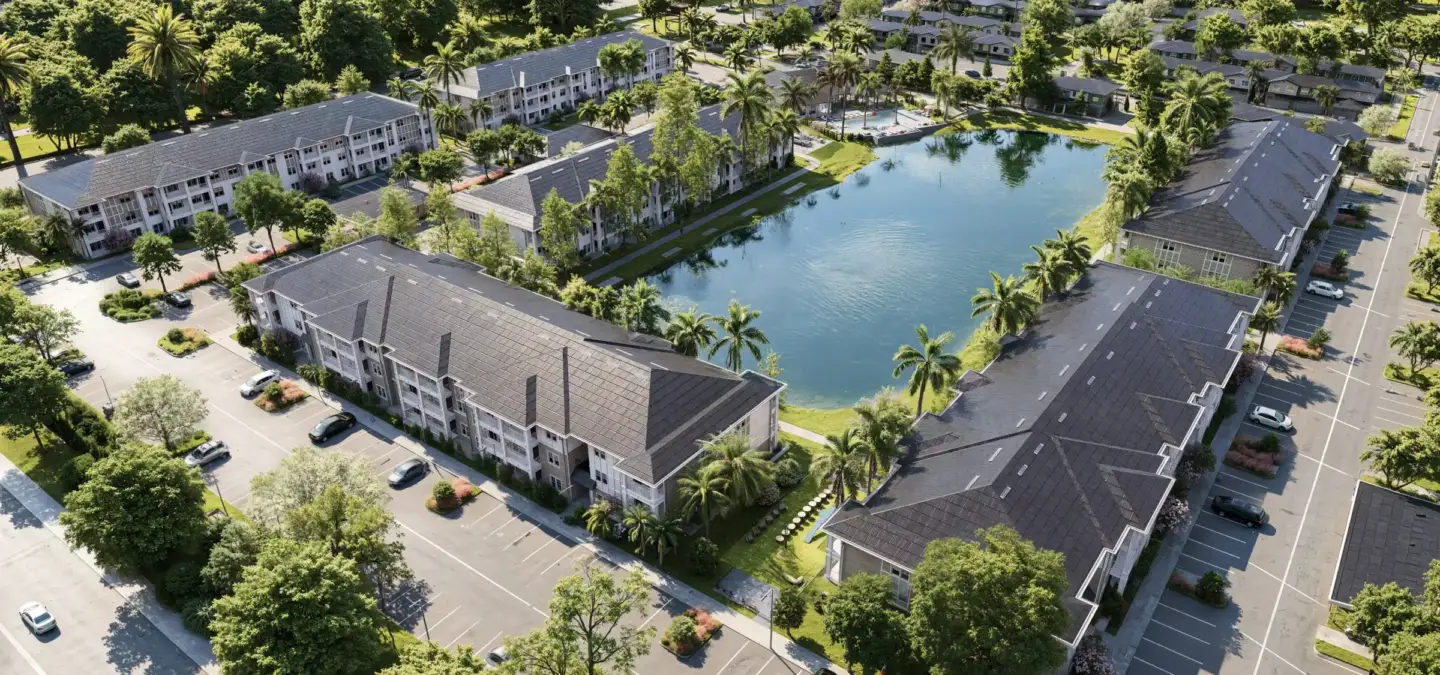
Postmodern buildings are unusually demanding to visualize, precisely because their meaning lives in details that a modernist render can ignore. Ornament, polychrome color, historical quotation, and exaggerated silhouette all have to read clearly, or the design collapses into a plain box. When we plan a postmodern exterior render, a few elements do the heavy lifting.
- Silhouette first. The broken pediment, stepped mass, or oversized column has to be legible in the roofline before any texture is applied.
- Polychrome accuracy. Postmodern color is specific — the exact maroon, teal, or pink is part of the identity, not a finish choice.
- Ornament at the right scale. Keystones, moldings, and quoted motifs must be modeled as geometry, not faked with a texture map, or they flatten on camera.
- Contextual framing. The building's dialogue with its street or skyline is part of the concept, so the camera angle should show the reference, not hide it.
In our studio, the recurring lesson is that postmodern facades reward modeled ornament over painted-on detail: a Chippendale top or a giant keystone only convinces when it catches real light and shadow in the render. That is why we treat these projects as geometry problems first and material problems second. For teams visualizing this kind of expressive facade, our 3D exterior rendering services are built to keep exactly those details sharp.
Postmodernism sits within a much larger family of movements. To see where it fits alongside its neighbors, browse our overview of popular architectural styles.