
Deconstructivism architecture is a postmodern movement that emerged in the 1980s, defined by fragmented forms, non-rectangular shapes, and a deliberate break from harmony and symmetry. Instead of clean boxes, its buildings look tilted, splintered, and almost unstable — controlled chaos engineered to make you question what a building is supposed to be.

What is deconstructivism architecture?
Deconstructivism — also called deconstructivist architecture — is a style that manipulates a structure’s surface and form to create the impression of fragmentation. It reached prominence after the 1988 Deconstructivist Architecture exhibition at New York’s Museum of Modern Art (MoMA), curated by Philip Johnson and Mark Wigley. The name fuses constructivism, the early Soviet avant-garde, with deconstruction, the philosophy of French thinker Jacques Derrida.
Because the term borrows from philosophy and an older art movement, it is easy to mix up with a few neighbours. Deconstructivism is not:
- Deconstruction — Derrida’s literary-philosophical method. It inspired the name, but the buildings are not a literal translation of the theory.
- Postmodernism — deconstructivism grew out of postmodern architecture yet rejects its playful historical quotation and ornament.
- Modern or contemporary architecture — those styles prize order, function, and clean lines; deconstructivism sets out to disrupt them.
Key characteristics of deconstructivist architecture
The characteristics of deconstructivist architecture all point one way: away from the grid. A building reads as a collision of parts rather than a single, resolved whole. The recurring traits are:
- Fragmentation — the structure appears broken into colliding pieces.
- Non-rectangular geometry — tilted walls, sharp angles, and curves that avoid right angles.
- Absence of symmetry, harmony, or visual continuity.
- Distorted skins — unpredictable, warped exterior surfaces.
- Controlled chaos — a staged sense of instability that is, in fact, precisely engineered.
- Expressed structure — engineering is often revealed rather than hidden.
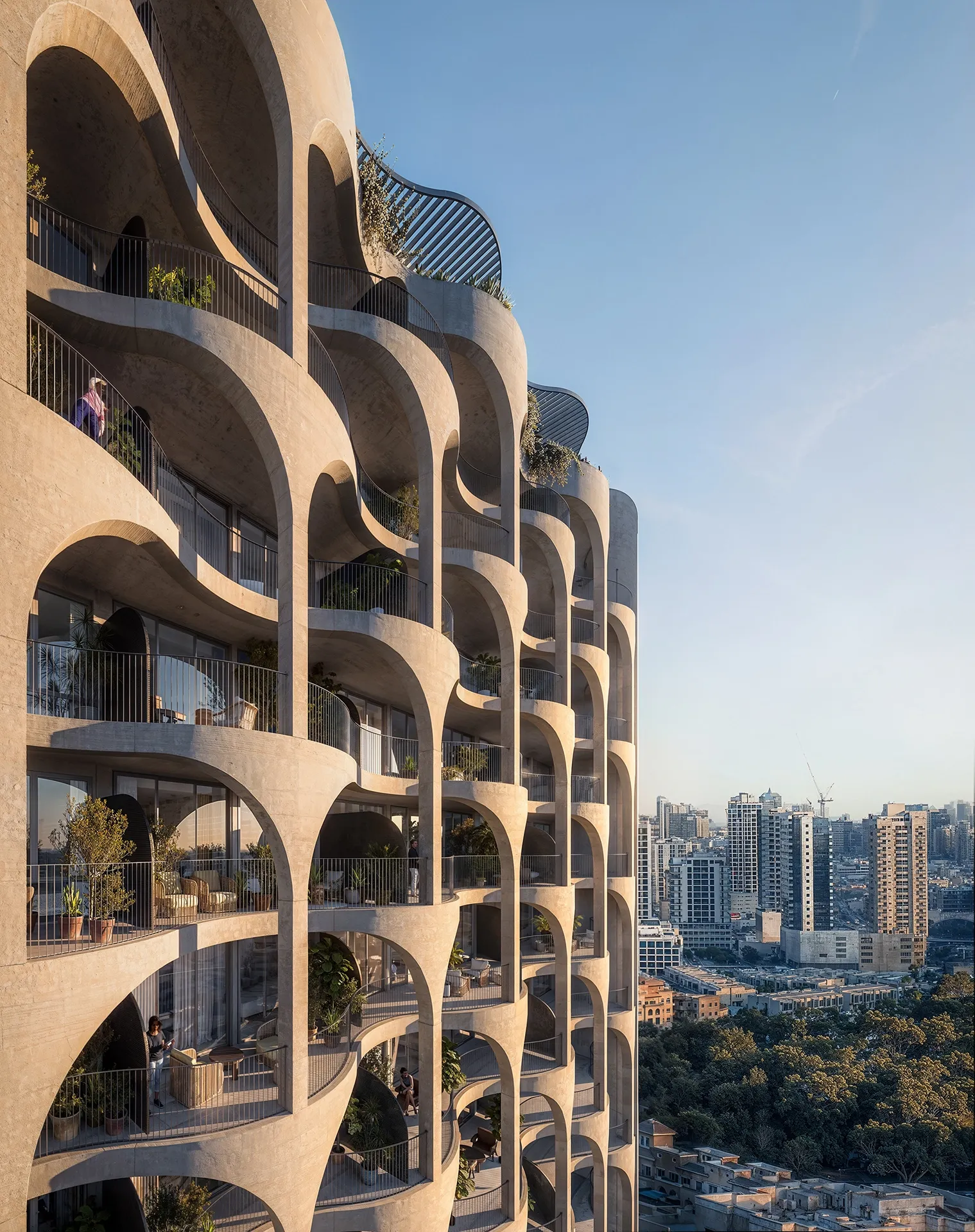
Deconstructivism vs brutalism and other modern styles
Deconstructivism is often confused with other bold twentieth-century styles because they can all look dramatic. The difference is intent: where brutalism celebrates raw material and modernism chases order, deconstructivism sets out to fracture both.
| Style | Core idea | How it looks |
| Deconstructivism | Fragmentation and broken geometry | Tilted, splintered, unstable |
| Brutalism | Honest raw material | Heavy, blocky, exposed concrete |
| Modernism | Form follows function | Clean, orthogonal, minimal |
| Contemporary | Whatever is current | Varied, fluid, technology-driven |
If raw concrete mass interests you more, see our guide to brutalist architecture. For the broader present-day picture, read what contemporary architecture actually means.
Famous deconstructivist architects and their buildingsFamous deconstructivist architects and their buildings
A handful of architects defined the movement, and their landmark buildings are the fastest way to understand it. The most famous deconstructivist architects and works include:
- Frank Gehry — Guggenheim Museum Bilbao; Walt Disney Concert Hall, Los Angeles.
- Zaha Hadid — Heydar Aliyev Center, Baku; Guangzhou Opera House.
- Daniel Libeskind — Jewish Museum Berlin.
- Peter Eisenman — Wexner Center for the Arts; City of Culture of Galicia.
- Bernard Tschumi — Parc de la Villette, Paris.
- Rem Koolhaas / OMA — CCTV Headquarters, Beijing.
- Coop Himmelb(l)au — BMW Welt, Munich.
Worth noting: many of these architects reject the “deconstructivist” label, seeing it as a critic’s convenience rather than a shared manifesto. The 1988 MoMA show grouped them together; their own paths diverged widely afterward.

The visualization challenge: rendering deconstructivist geometry
Deconstructivist buildings are among the hardest architecture to model and render in 3D. Their fragmented, non-orthogonal forms break the assumptions most CAD and rendering pipelines quietly rely on — that walls are vertical, floors are flat, and surfaces meet at clean right angles. Remove those, and every stage gets harder:
- Topology and UVs — tilted and non-planar surfaces resist the clean quad meshes that keep models editable and textures undistorted.
- Intersections — colliding volumes create awkward seams and geometry that has to be resolved by hand.
- Lighting — light bounces unpredictably across angled and curved skins, so it takes more test renders to make a scene read clearly.
- Materials — a finish has to wrap complex curvature without stretching or visible seams.
This is exactly where precise 3D exterior rendering earns its keep — turning a bold, almost unbuildable-looking concept into a clean image a client or planning board can actually approve.

Where deconstructivism sits among architectural styles
Deconstructivism is one chapter in a much larger story of how buildings look and why they look that way. To see how it lines up against the rest, browse our overview of popular architectural styles.
Is it still relevant? Yes. Its peak ran through the 1980s and 1990s, but its DNA — fragmentation, gravity-defying cantilevers, non-Euclidean form — lives on in the fluid parametric and neo-futurist buildings reshaping skylines today.