Marketing new construction homes means selling a property a buyer often cannot walk through yet — the lot may be bare or the home a framed shell. The tactics that win treat the visual asset as the product: photoreal renders, model-home tours, and a community story that lets buyers picture life inside a home that does not physically exist. Everything below builds on that one difference.
Why marketing new construction is different from resaleWhy marketing new construction is different from resale
Resale marketing sells a home the buyer can tour today. New construction marketing sells a promise: a home that is under construction, pre-sold off a floor plan, or standing as an unfinished shell. This is the empty-lot problem — the single fact that reshapes every decision, from which assets you produce to when you start promoting.
Because there is nothing physical to photograph, the marketing asset carries the entire emotional weight of the sale. A buyer signing on an off-plan home is trusting a drawing, a spec sheet, and their imagination. The builders and agents who convert best remove that leap of faith — they show the finished home, the finished street, and the finished lifestyle before a single wall is painted. Generic tactics like open houses and mailers still matter, but they only work once buyers can actually see what they are buying.
- No product to tour: the home is a lot, a plan, or a shell — visuals stand in for reality.
- Longer sales cycle: off-plan purchases close over months, so nurturing beats one-off promotion.
- Two audiences: you market to end buyers and, often, to the builder or developer who hired you.
- Inventory in phases: lots and models release over time, so the message shifts as the community fills in.
When to start marketing new construction homes
Start marketing new construction homes at the pre-construction stage — ideally the moment renders and floor plans exist, months before the model home opens. Early promotion builds a waitlist, validates pricing, and lets you pre-sell inventory before carrying costs pile up. The earlier a buyer commits, the more equity they capture as the community completes, which is itself a selling point.
A practical timeline runs in three phases. Pre-construction (renders, teaser landing page, waitlist capture) opens the funnel. Under construction (progress updates, model-home launch, hard-hat tours) converts warm leads. Move-in ready (staged photography, resident stories, urgency on remaining lots) clears the last inventory. Skipping the first phase is the most common and expensive mistake — it forfeits the buyers most willing to commit early.
9 tactics to market new construction homes9 tactics to market new construction homes
The tactics below are ordered by leverage — the assets that solve the empty-lot problem come first, because promotion channels only perform once buyers have something worth looking at.
- Lead with pre-construction CGI renders. Photoreal exterior and interior renders let buyers tour the finished home before it exists. They are the highest-leverage asset in new construction because they directly answer “what am I actually buying?”
- Open a model home and virtual tour. A physical model converts on-site; a 360° virtual tour or walkthrough animation extends that experience to buyers who cannot visit and to unbuilt floor plans.
- Sell the community and lifestyle, not just the square footage. Show the finished streetscape, amenities, and neighborhood context. Buyers commit to a way of living, not a spec sheet.
- Build a dedicated landing page per community. One page per neighborhood with renders, available lots, floor plans, and a lead form outperforms a single catch-all listing.
- Run targeted direct mail to defined zones. New construction lets you geo-target move-up buyers, renters in nearby complexes, and relocating professionals with precision resale rarely allows.
- Syndicate to new-construction portals. List on Zillow New Construction, Realtor.com, and builder aggregators where buyers specifically filter for new homes.
- Use social and short-form video. Construction-milestone reels, render reveals, and model-home walkthroughs perform well because progress content is inherently watchable.
- Partner builders with agents. Clear co-marketing agreements, agent incentives, and knowledge-sharing turn the local agent network into a distribution channel.
- Educate buyers on new-build value. Warranties, energy efficiency, lower maintenance, and customization are advantages resale cannot match — make them explicit.

How CGI renders sell homes before they are built
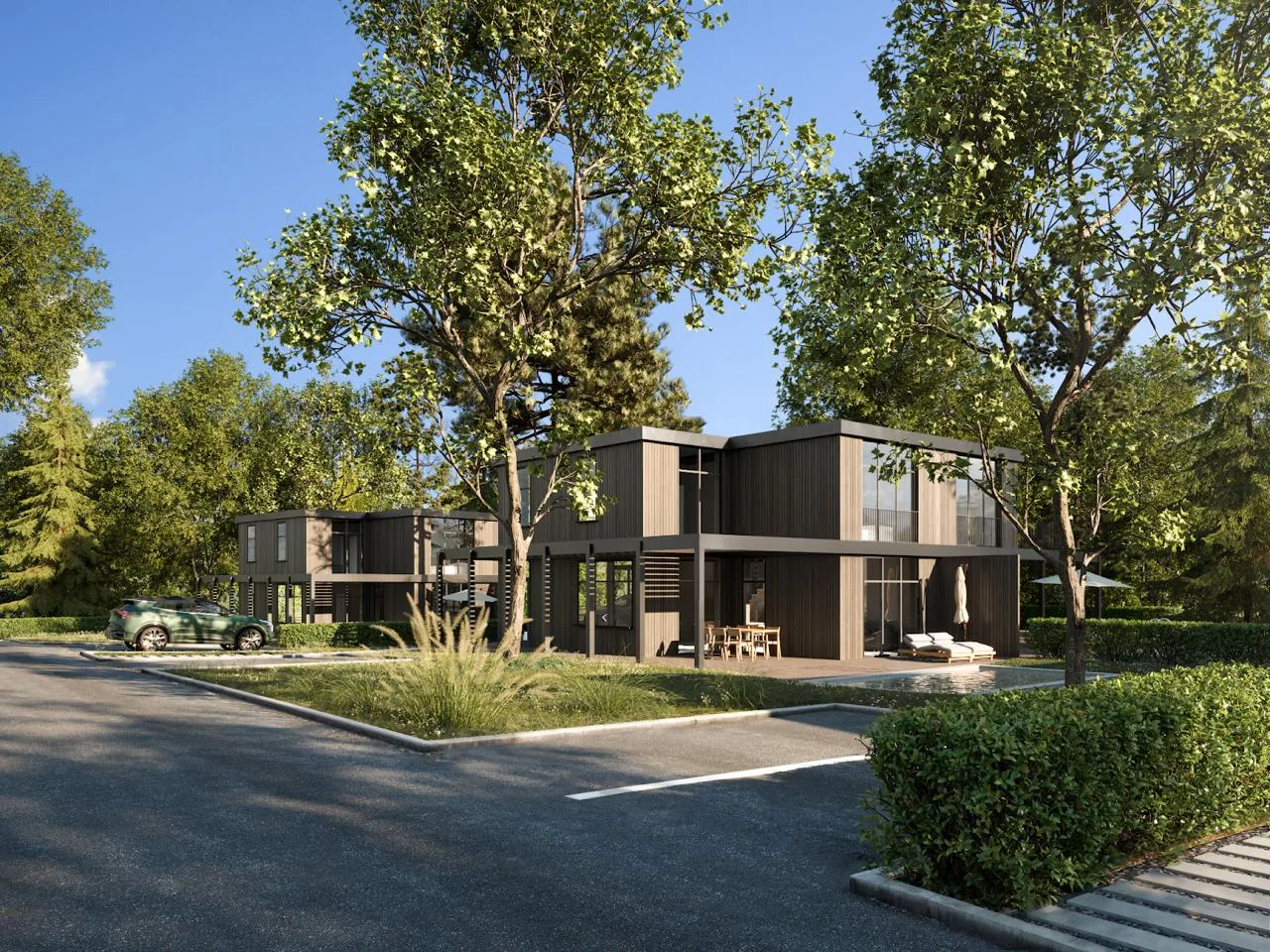
CGI renders sell unbuilt homes by replacing imagination with a photoreal picture of the finished property — exterior, interior, twilight, and aerial views produced from architectural plans. For off-plan inventory they are not a nice-to-have; they are the listing photo, the brochure hero, and the social reel all at once, months before a camera could capture anything real.
In our studio, the pattern we see most consistently is that a twilight exterior render — warm interior lights, dusk sky, landscaped frontage — pulls more inquiries than a daytime floor plan for the same unit. A flat 2D plan asks the buyer to do the visualization work; a render does it for them. That is the whole mechanism: the less a buyer has to imagine, the faster they commit.
A practical asset set for a new-construction launch covers four render types, each doing a distinct job in the funnel.
| Render type | What it shows | Where it converts |
| Exterior / twilight | Finished facade, street, landscaping | Listing hero, ads, portal thumbnail |
| Interior | Furnished rooms, finishes, light | Brochure, buyer walkthrough, upsell on upgrades |
| Aerial / site plan | Community layout, lot positions, amenities | Pre-sale of lots, phased release |
| Virtual tour / animation | Walkable sequence through the home | Remote buyers, model-home substitute |
A recent example: for pre-construction luxury home renderings, a listing agent had only DWG drawings of the exterior. The hero render was finished first for a billboard, and the rest of the set followed for the for-sale sign, the listing and social media.
Investing early in a strong visual package pays off across every other tactic on this list — the same renders feed your landing pages, mailers, social video, and portal listings. If you are producing marketing assets for an unbuilt development, our 3D residential rendering service covers the full set, and 3D exterior rendering handles facade and streetscape views for the launch hero. For a broader look at using renders across a campaign, see our guide to CGI for real estate marketing.
Marketing new construction as a realtor vs. as a builder
Realtors and builders market new construction toward the same buyer but from different positions. A builder controls the product, the pricing, and the render budget, and markets an entire community over years. A realtor markets specific inventory, competes for the builder’s listing relationship, and wins by bringing buyers and local reach the builder lacks. Knowing which role you occupy determines where you spend.
- As a builder: own the visual asset library, the community landing pages, and the phased-release narrative; recruit agents as a distribution layer.
- As a realtor: master the product inside out, build the builder relationship, and use renders and virtual tours the builder already commissioned to bring qualified buyers.
- Shared: both win by educating buyers on new-build advantages and removing the leap of faith with strong visuals.
Common mistakes when marketing new construction homes
Most new-construction marketing fails for the same handful of reasons — and nearly all of them trace back to underinvesting in what the buyer actually sees.
- Waiting until move-in ready to market. You forfeit the early buyers most willing to commit off-plan.
- Relying on floor plans alone. A 2D plan makes the buyer do the visualization; a render does it for them.
- Marketing square footage instead of lifestyle. Specs inform; the finished community and streetscape sell.
- One generic listing for a whole development. Dedicated community pages convert far better than a catch-all.
- Cheap or inconsistent visuals. Low-quality renders undercut trust exactly when the buyer needs it most.