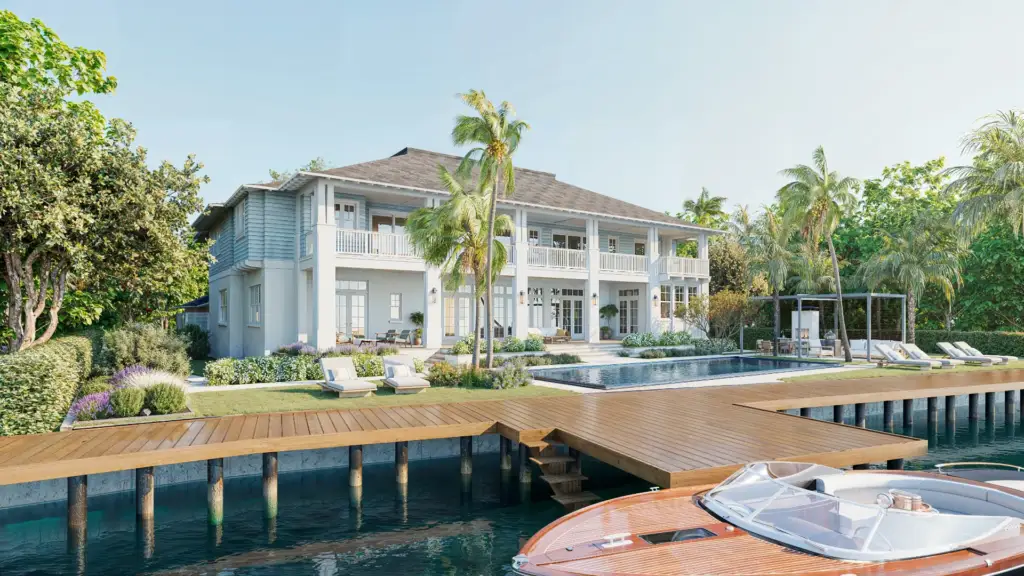
Greek Revival architecture is a 19th-century style — popular in the United States from the 1820s through the 1860s — that modeled homes, banks, courthouses, and churches on the temples of ancient Greece. Defined by bold columns, triangular pediments, and symmetrical white façades, it became America’s first truly national architectural style.
What Is Greek Revival Architecture?What Is Greek Revival Architecture?
Greek Revival is a branch of neoclassical design that looked specifically to the architecture of ancient Greece — above all the rectangular, colonnaded temple — for its forms and proportions. Where earlier classical styles borrowed freely from Rome, Greek Revival builders studied Athenian models such as the Parthenon and translated their columns, porticoes, and pediments into homes and public buildings. In America it carried strong democratic symbolism: a young republic dressing itself in the architecture of the world’s first democracy.
| At a glance | Greek Revival architecture |
| Period | c. 1820s–1860s (peaked 1830s–1850s) |
| Origin | Northern Europe (Britain, Germany), then adopted across the United States |
| Key features | Full-height columns, temple-front portico, triangular pediment, symmetry, white painted exterior |
| Common materials | Wood, brick, or stucco — typically painted white to imitate marble |
| Building types | Houses, plantation mansions, banks, courthouses, churches, civic halls |
| Modern influence | Civic and institutional buildings, Southern residential design, contemporary “modern Greek Revival” homes |
Key Characteristics of Greek Revival Architecture
Greek Revival buildings are recognized by a small set of temple-derived features. Most examples combine several of the following:
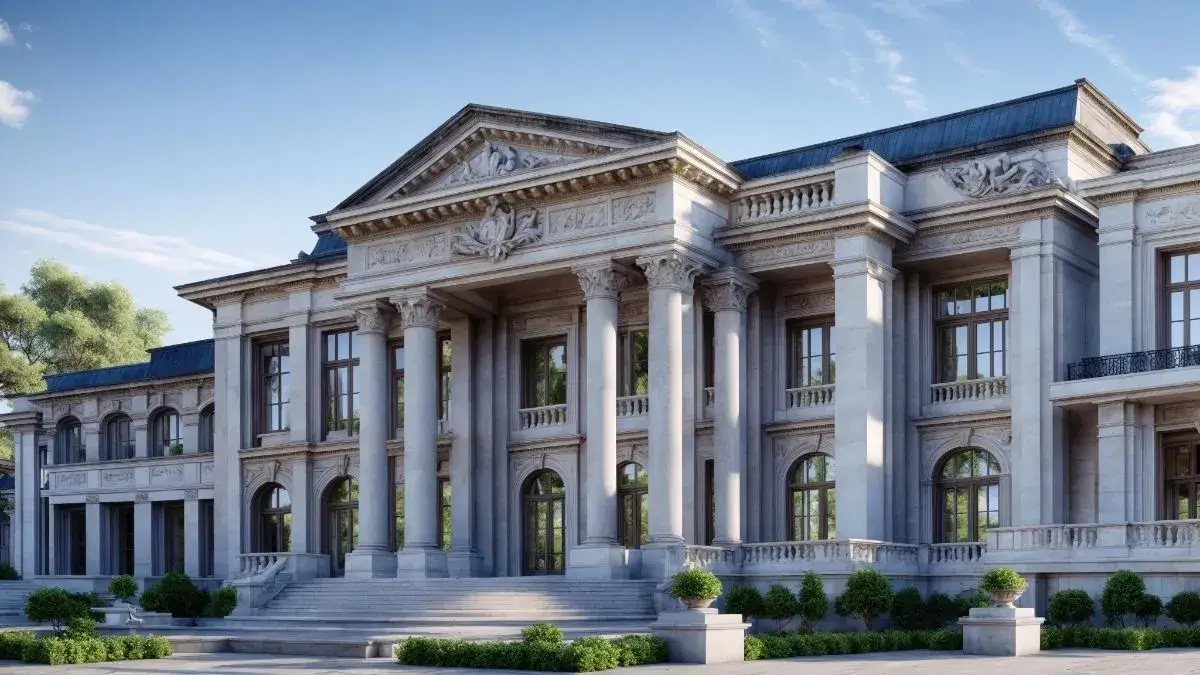
- Columns and a temple-front portico — tall Doric, Ionic, or Corinthian columns supporting a projecting entry porch.
- Triangular pediment — a low gable, often with a plain or decorated tympanum, crowning the façade like a Greek temple.
- Bold symmetry — a balanced, rectangular plan with the entrance centered beneath the portico.
- White painted exterior — wood, brick, or stucco finished in white to evoke ancient marble.
- Heavy cornice and wide entablature — a deep, unadorned horizontal band running beneath the roofline.
- Low-pitched roof and restrained ornament — clean lines, plain friezes, and minimal decoration compared with later Victorian styles.
A Short History: How Greece Came to American Main Streets
The style began in mid-18th-century Europe, fueled by archaeological discoveries in Greece and a wave of scholarly publications that documented ancient temples in precise detail. British and German architects led the early revival, applying Greek forms to museums, monuments, and government buildings.
In the United States the style took hold in the 1820s and flourished through the 1850s. Several forces aligned: admiration for Greek democracy in a young republic, American sympathy for Greece’s 1820s war of independence, and a desire for a national identity distinct from British Georgian and Federal design. Pattern books spread the look to carpenters in nearly every region, so the style appeared on grand banks and courthouses as well as modest farmhouses. By the time of the Civil War, changing tastes and the rise of Gothic and Italianate styles brought the Greek Revival era to a close.
Greek Revival Homes and Mansions: Types and Regional VariationsGreek Revival Homes and Mansions: Types and Regional Variations
Greek Revival houses range from columned plantation mansions to compact town cottages, but most fall into a few recognizable types:
- Southern plantation mansion — a two-story, near-square block wrapped on three or four sides by a colonnade, designed for shade and grandeur in the warm South.
- Temple-front house — a gable-end façade facing the street with a full-height portico, mimicking a classical temple.
- Northern townhouse — a narrower urban version with a side entrance, pilasters, and a heavy entablature rather than a full colonnade.
- Front-gabled cottage — a modest one- or two-story home with simplified pediment, pilasters, and trim that signaled the style on a small budget.
Regional climate and materials shaped each variation — full wrap-around colonnades in the South, brick and stucco in Northern cities, and timber-framed interpretations along the expanding western frontier. For studios recreating these homes today, accurate proportion and material response are everything; see how we approach 3D residential rendering for period properties.
Greek Revival vs Neoclassical vs Federal Architecture
Greek Revival is often confused with related classical styles. The simplest distinction: Greek Revival copies the Greek temple directly, while broader neoclassical architecture blends both Greek and Roman sources, and Federal style is a lighter, more delicate American mode that came just before it.
| Style | Main inspiration | Defining look |
| Greek Revival | Ancient Greek temples | Bold full-height columns, temple-front portico, white symmetrical façade, heavy cornice |
| Neoclassical | Both Greek and Roman classical design | Domes, grand porticoes, varied classical orders; broader and more monumental |
| Federal | Roman classicism (Adam style) | Delicate ornament, fanlights, slender proportions, decorative swags and elliptical windows |
Famous Greek Revival Buildings in America
Some of the most recognizable Greek Revival landmarks in the United States include:
- The Second Bank of the United States, Philadelphia — a marble temple-front bank widely cited as an early American masterpiece of the style.
- The Tennessee State Capitol, Nashville — a monumental columned statehouse by architect William Strickland.
- The Ohio Statehouse, Columbus — an austere, colonnaded capitol exemplifying civic Greek Revival.
- Plantation houses of the Deep South — colonnaded mansions across Louisiana, Mississippi, and Alabama that became the popular image of the style.
- Federal Hall, New York — a Greek Revival landmark on Wall Street built on the site of the first U.S. Capitol.

Greek Revival Interior Design Elements
Inside, Greek Revival interiors echoed the order and restraint of the exterior:
- High ceilings and generous proportions that matched the scale of the columned exterior.
- Wide, symmetrical center-hall plans with rooms balanced on either side of the entrance.
- Bold but simple plaster moldings, Greek key motifs, and acanthus or palmette details.
- Tall windows and double parlor doors that emphasized light and formality.
- Restrained color palettes — whites, creams, and soft tones that reinforced the marble-like exterior.
Visualizing Greek Revival Architecture in 3D
Recreating Greek Revival buildings convincingly is as much about light and proportion as it is about columns. White stucco and marble respond dramatically to sunlight, column entasis and capital geometry must be exact, and the deep portico shadows are what make a render read as authentic rather than flat. Whether you are restoring a historic mansion, marketing a new classically inspired home, or documenting a landmark, accurate visualization brings the style to life. Explore our work in 3D exterior rendering, detailed architectural 3D modeling, and the full range of our architectural rendering services.

Turn Ideas Into Visual Stories

Free field guide
How to Brief a Style So You Get It Back
Why naming a style transmits almost nothing, the seven measurable variables that actually carry one, and a one-page brief you fill in for any style at all.
If it didn't open, download it here.
Download the PDF