A 3D visualization portfolio is a curated showcase of a studio’s or artist’s CGI, rendering, and animation work that lets clients judge realism, relevance, and commercial impact before they hire. This guide breaks down what a strong portfolio must include, how to build one that wins work, and real examples worth studying.
Comparing studios to hire rather than building your own? See our ranking of the best architectural visualization studios in the world.
A strong 3D visualization portfolio does more than show attractive images. It helps developers, architects, product teams, and brand leaders judge whether a studio can deliver the right mix of realism, clarity, and commercial relevance — and it helps a working 3D visualizer prove exactly that to the people doing the hiring.
Whether you are reviewing a 3D rendering portfolio for an off-plan real estate launch or building your own 3D architectural visualization portfolio to land studio work, the way the work is presented matters just as much as the visuals themselves.
What a Strong 3D Visualization Portfolio Must IncludeWhat a Strong 3D Visualization Portfolio Must Include
A strong 3D visualization portfolio includes eight to twelve of your best, most relevant projects, each with enough context to explain the brief and the result, visible evidence of process, and proof of commercial impact — presented on a fast, easy-to-navigate page. The most effective portfolios are understood at a glance: they show not only what a studio can create, but whether that work is relevant, credible, and useful to the client in front of it. In practice, the strongest examples include the following:
- A focused selection of your best work A smaller portfolio with eight to twelve excellent projects is usually more convincing than a large archive with uneven quality.
- Clear relevance to the client’s sector A good 3D rendering portfolio should make it obvious whether the studio has experience in residential, commercial, hospitality, product CGI, or branded environments.
- Enough context around each project Strong portfolios explain the brief, the challenge, the visual approach, and the result. Without that context, even great images can feel anonymous.
- Some evidence of process Mood boards, early concepts, lighting studies, or before-and-after comparisons help show that the work was shaped by clear decisions rather than software alone.
- Proof of impact The most persuasive portfolios connect visuals to outcomes, whether that means faster approvals, better investor presentations, stronger engagement, or improved pre-sales performance.
- Easy navigation A professional 3D architectural visualization portfolio should be simple to browse by sector, geography, project type, or format.
- Good mobile performance If the site is slow or difficult to use on a phone, even excellent work loses impact. Fast loading and clean presentation still matter.
How to Build a 3D Visualization Portfolio That Wins WorkFrom our studio — It’s not about many projects or few — it’s about having the ones that fit the task. Apply to an interior studio with one interior and 200 exteriors, and they’ll look at the interior and throw the rest away. Send a client who needs a yacht 20 works with the one yacht buried in the middle, and they won’t scroll far enough to see it, so they won’t pick you, because they never saw you’d done something similar. Lead with the relevant project.
Dim Kuzmenko, Company Owner, Maverick Frame
How to Build a 3D Visualization Portfolio That Wins Work
Start by curating with discipline.
A 3D architecture portfolio of eight to ten outstanding, carefully selected projects will always outperform an extensive archive of everything you’ve ever done. Don’t include outdated or subpar work just because it came from a recognizable client. Inconsistency undermines credibility more than selectivity ever could.
For each project, go beyond the final image. Share the story behind it:
- What challenge did the client face?
- How did you approach it visually?
- What changed as a result?
- Did your rendering help sell units in a difficult location?
- Did your product visualization reduce returns by setting accurate expectations?
From our studio — The number of projects matters less than the trajectory across them. What convinces me is dynamics — work that was weaker and then clearly got better. You see it on the strong ArtStation accounts: a visible climb. That reads far better than a portfolio that swings good, bad, good, bad. A shorter set with an upward curve beats a bigger set with no direction.
Dim Kuzmenko, Company Owner, Maverick Frame
Remember that your portfolio lives online and must be found there. Use clear, descriptive file names and alt text, as well as structured data so search engines can understand your work. However, never optimize at the expense of the human experience. Clean layouts, intuitive navigation, and fast loading times are just as important as keywords.
While it’s tempting to end with a hard sell, a softer invitation works better in professional contexts. Instead of saying “Hire me now,” try something like “See how we helped a London developer accelerate pre-sales. Let’s explore what’s possible for your project.” This approach is confident without being pushy.
Showing your process adds real value — and in 2026 it does something extra: it proves the work is yours. With so much imagery now generated in AI tools, a studio hiring a CGI specialist or modeler struggles to judge who actually did the work. Mood boards, the raw model, lighting studies, and before-and-after breakdowns cut through that doubt and build trust that a polished final render alone can no longer earn.
From our studio — Showing process massively increases trust right now, because so much is made in AI. The neural net itself isn’t the problem — but for a studio choosing a CGI artist or modeler, a finished render is hard to trust on its own. When you show what the model looked like, the raw renders, the stages it went through, how the lighting was set up — that’s what earns confidence.
Dim Kuzmenko, Company Owner, Maverick Frame
Finally, design for mobile first. Over 60% of B2B professionals start their research on phones. If your site doesn’t load quickly or display cleanly on a small screen, you’ve already lost them, no matter how stunning your work is.
Should Your 3D Visualization Portfolio Be a Website or a PDF?
Use both, but understand what each is for. The real question is not website versus PDF — it’s how many images load, and at what quality. A website is the fast, searchable front door, but to keep it loading quickly every image on it is compressed, so it loses fidelity. A high-resolution PDF catalog (or a shared drive link) delivers every render at full quality in one download. The website earns the click; the catalog closes the judgment on craft.
From our studio — It’s less about website versus PDF and more about how many images load and in what quality. A PDF usually wins here — it’s heavy, but you get everything at once in final quality. A website is worse the moment it doesn’t load: you don’t know how long to wait, whether it’ll even open, and that’s where it gets frustrating. So people compress every image to keep the site fast — and the quality drops with it.
Dim Kuzmenko, Company Owner, Maverick Frame
One more thing we see constantly: don’t rush it. A newcomer who spends a week instead of a month and shows up with a raw, unfinished portfolio usually gets a no, and a second chance is much harder to earn. Build a tight, relevant, finished portfolio the first time, even if it takes longer.
What Makes These Portfolios WorkWhat Makes These Portfolios Work
A truly effective 3D visualization portfolio acts as a silent sales representative, demonstrating expertise, reliability, and business acumen. Our analysis of top-performing portfolios reveals a clear pattern: the most compelling ones resemble strategic case studies more than art galleries.
The strongest studios understand that realism relies on nuance rather than perfection. Instead of creating sterile, overly polished renders, they incorporate subtle human touches, such as slightly rumpled sofa cushions, unevenly spilled natural light, and swaying foliage that suggests wind. These details build trust by mirroring the imperfect reality clients expect to see.
Equally important is depth over volume. A tightly curated selection of eight to twelve projects, each accompanied by a clear narrative about the client’s challenge, your specific role, and the constraints you navigated, carries far more weight than dozens of anonymous thumbnails. Decision-makers are looking for relevance and proof of your ability to solve problems.
Navigation plays a surprisingly important role. Professionals often evaluate studios on the go or between meetings. Portfolios that allow for quick filtering by sector, format, or geography help users swiftly find what matters to them. This self-serve clarity signals professionalism and respect for clients’ time.
Technical performance is also important. With over half of all B2B research now beginning on mobile devices, a slow-loading site is a silent deal-breaker. Google’s 2025 data shows that 53% of visitors abandon a page if it doesn’t load within three seconds. Optimized assets, lazy loading, and clean code are essential to keeping your audience engaged.
Finally, the most persuasive portfolios demonstrate measurable impact. Instead of ending with a rendering, they include a statement such as: “This visual sequence contributed to $4.2M in pre-sales.” This single sentence transforms an image from an aesthetic exercise into business evidence.
10 3D Visualization Portfolios Worth StudyingFrom our studio — The first thing anyone sees — in five or ten seconds, really one second for the brain — is simply: is this beautiful or not? If it’s beautiful, they keep looking. If it’s not, it doesn’t matter how technical or complex the work is. They just don’t buy it. It has to be beautiful first.
Dim Kuzmenko, Company Owner, Maverick Frame
10 3D Visualization Portfolios Worth Studying
The studios below are not ranked against each other — each is worth studying for a different reason. As you browse, look at five things: visual quality and technical control, the range and relevance of their projects, how much case-study context each project carries, how easily the site lets you find work that matters to you, and how clearly they speak the client’s language rather than software jargon.
To ground those criteria, here are four examples from our own portfolio that show what strong 3D visualization work looks like across different sectors. Notice how each one is built around a specific commercial job, not just a pretty picture.

Exterior CGI like this island-resort masterplan answers a developer’s need to sell scale, setting, and lifestyle before a single foundation is poured.

An interior render shows a different need entirely: material, light, and mood at eye level, the way a buyer or hospitality client actually experiences a space.

Product CGI, such as this smart-bed visual, proves a studio can light and stage a single object for e-commerce and campaigns, not just buildings.
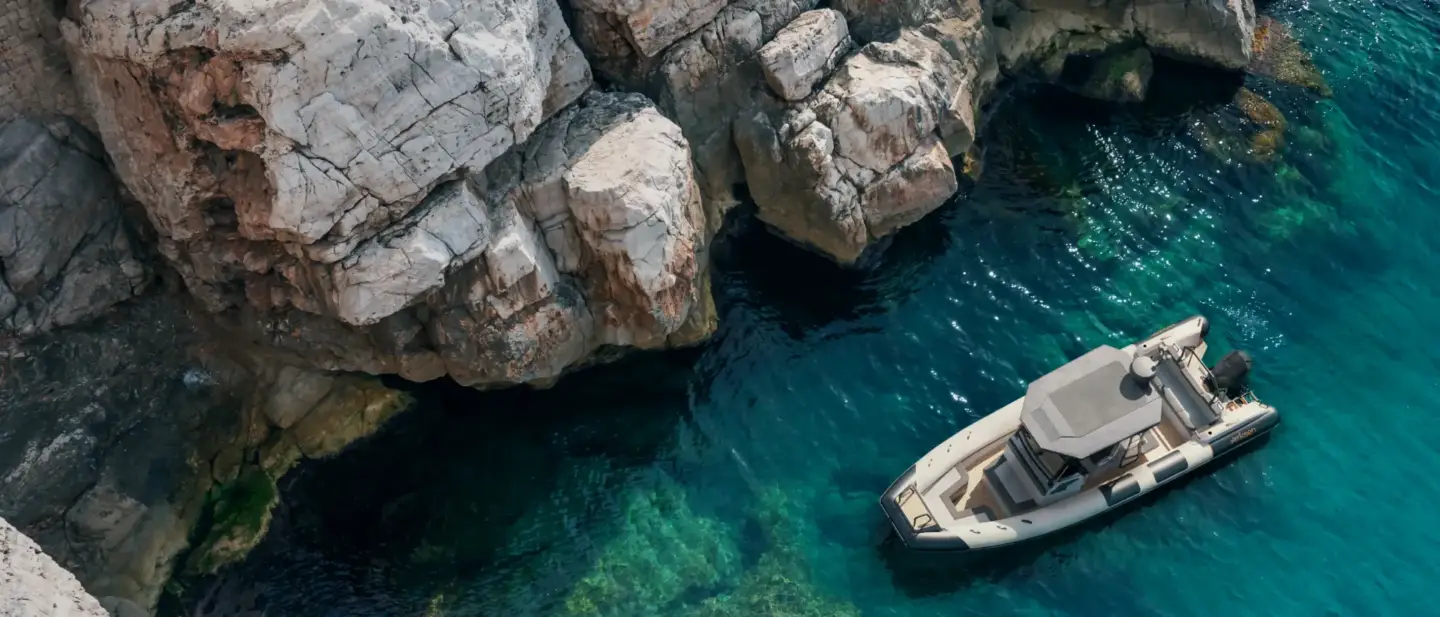
Marine and lifestyle work signals range, but range only matters when a relevant example is the first thing a client sees.
Brick Visual (Hungary)
Brick Visual consistently sets the standard for excellence in architectural visualization portfolios. Their showcase blends cinematic realism with strategic storytelling. Each project includes a brief summary, the evolution of the mood board, and post-rendering analytics.
What to learn: their Project Journey section uses scroll-driven narratives that walk through sketches, modeling, and final renders. That transparency — process on full display — is exactly what fosters trust with developers and architects.
The Boundary (UK)
Specializing in high-end residential and cultural architecture, The Boundary’s CGI portfolio rivals a design magazine. They excel at emotional precision, from dusk lighting in London penthouses to the subtle texture of hand-troweled plaster.
What to learn: they publish failed iterations alongside final designs, showing how client feedback shapes the outcome, and filter work by geography so international clients can gauge local relevance fast.
MIR (Norway)
MIR leans into artistic minimalism without sacrificing clarity, renowned for hauntingly beautiful architectural landscapes and atmospheric storytelling — fog over Nordic cabins, the golden hour on concrete.
What to learn: their downloadable PDF project dossiers are built for jury submissions. It’s a reminder that the delivery format is part of the portfolio — though this poetic approach suits competition work more than fast-turnaround sales renders.
Luxigon (France)
Luxigon bridges art and commerce, specializing in large-scale urban projects — master plans, mixed-use developments, transit hubs. Each image balances human scale against the macro context, avoiding the empty-utopia trap.
What to learn: their interactive hotspots explain material choices and sustainability features on hover — subtle interactivity that adds depth for investor-grade communication without overwhelming the viewer.
Neoscape (USA)
Boston-based Neoscape spans product visualization and elite architectural work, with dual expertise that shines in mixed-media campaigns rendered in-house.
What to learn: their portfolio is segmented by industry and pairs visuals with clear ROI metrics — a model for anyone selling cross-category versatility and branded environments.
Hayes Davidson (UK)
A major name in European architectural visualization for over 30 years, Hayes Davidson turns concepts into compelling visual stories, known for photorealism and deep contextual understanding.
What to learn: their Sales Toolkit spans brochure-grade renders, interactive VR presentations, and optimized social formats — a portfolio built as ready-made marketing assets, not just pretty pictures.
Beauty & The Bit (Spain)
Don’t let the playful name fool you. This Barcelona studio creates stunning 3D product visualizations for cosmetics, fashion, and luxury goods — liquid pouring into a perfume bottle with subsurface scattering so precise you can almost smell it.
What to learn: they expose technical detail — shader networks, lighting setups, render times — which appeals to art directors who need to replicate the work, and they offer portfolio audits that position them as consultants, not vendors.
ZOA Studio (Netherlands)
ZOA merges architecture and animation, including short films of every major project with camera moves, day/night cycles, and seasonal changes — ideal for digital billboards, investor pitches, and immersive web.
What to learn: their Render Diaries time-lapses show complex scenes being built. Motion isn’t always needed, but ZOA proves that still images alone can undersell premium positioning.
Vizoo (Germany)
Vizoo focuses on material accuracy, using proprietary scanning to digitize real fabrics, woods, and metals for unmatched tactile realism in furniture, automotive interiors, and retail spaces.
What to learn: their side-by-side comparisons of physical samples and digital twins are a powerful trust device in any industry where material authenticity is paramount.
Maverick Frame (UK)
Our own approach reflects a balance of photorealism and commercial intent — luxury off-plan residences, high-end product CGI, and investor-grade architectural narratives for clients in London, Dubai, Singapore, and beyond.
What to learn: we design each image to solve a specific problem — boosting pre-sales conversion, clarifying complex spatial concepts, or elevating brand perception — and lead every sector view with the most relevant project. See the full 3D rendering portfolio for how that plays out across residential, product, and marine work.

3D Rendering Portfolio vs. 3D Visualization Portfolio vs. Architectural Visualization Portfolio
These terms overlap, but they are not always used in the same way, and the distinction matters when you name or compare a portfolio.
A 3D rendering portfolio usually emphasizes the final output — still images, animations, or CGI scenes created to present a product, property, or concept in its best light, often through architectural rendering. It is the broadest term, used across architecture, interiors, and product visualization.
A 3D visualization portfolio goes a step further. It includes not just the finished images but the thinking behind them, the project context, and the role the visuals played in marketing, approvals, investor communication, or pre-sales.
A 3D architectural visualization portfolio is more specific, focused on buildings, interiors, developments, and urban environments — judged not only by realism but by how well it communicates scale, materials, atmosphere, and commercial intent. In practice, the strongest studios bring all three together.
A portfolio piece worth studying in that context is our luxury yacht CGI visualization.

Turn Ideas Into Visual Stories
Frequently Asked Questions
What is a 3D visualization portfolio?
A 3D visualization portfolio is a curated selection of work that shows how a studio or artist presents ideas through CGI, rendering, animation, or architectural imagery. The strongest portfolios add context, so potential clients understand not just the visuals, but the thinking and business purpose behind them.
Where can I find good 3D visualization portfolio examples?
Start with established studios that publish recent, well-documented work — the examples above collect ten strong studios for 2026. Platforms like Behance also host large volumes of architectural and product visualization, though quality varies. Look for portfolios that pair finished renders with real project context, not just thumbnails.
What is the difference between a 3D rendering portfolio and a 3D visualization portfolio?
A 3D rendering portfolio usually focuses on final images or animations, while a 3D visualization portfolio often has a broader purpose. It may include storytelling, project context, and the role the visuals played in sales, approvals, investor presentations, or brand communication.
What should a 3D architectural visualization portfolio include?
A good 3D architectural visualization portfolio should include high-quality renders, relevant sector experience, clear case study context, evidence of process, and examples that show how the visuals support planning, marketing, or investor communication.
How many projects should a 3D visualizer portfolio have?
Usually eight to twelve high-quality projects are enough. But the real rule is relevance and trajectory: a smaller portfolio with the right projects for a specific client, and a visible climb in quality across them, beats a large archive where the one relevant example is buried.
Should a 3D visualization portfolio be a website or a PDF?
Use both. A website is the fast, searchable front door, but its images are compressed for speed. A high-resolution PDF catalog or shared drive link is where you show the true quality of your renders. The website earns the click; the catalog proves the craft.
How do I make a 3D visualizer portfolio?
Curate eight to twelve of your strongest, most relevant projects, and for each one explain the brief, your role, and the result. Add evidence of process, keep navigation simple, optimize for mobile and fast loading, and lead with the work most relevant to the client or job you are targeting.
How do you show process in a 3D portfolio, and why does it matter?
Include mood boards, the raw model, lighting studies, and before-and-after breakdowns alongside final renders. In 2026, with so much imagery generated in AI tools, showing process is what proves the work is genuinely yours and builds trust with studios hiring a CGI artist or modeler.
What makes a good 3D visualization portfolio?
A good 3D visualization portfolio combines visual quality with relevance, clarity, and proof of value. It should be beautiful first, then help potential clients understand not only what the studio can create, but why that work matters commercially.