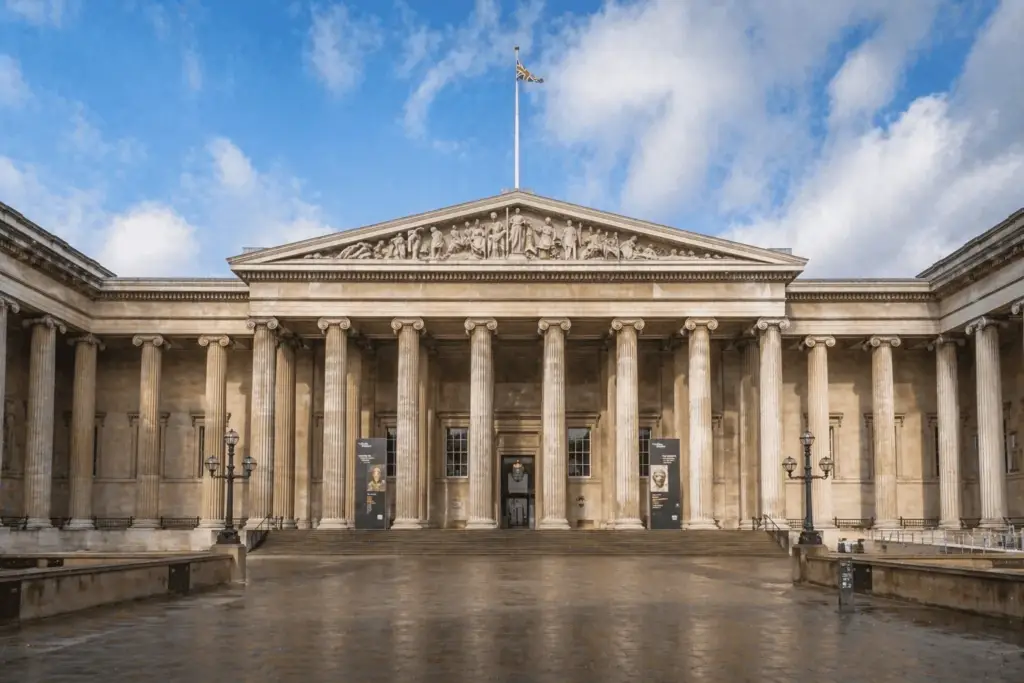
Georgian architecture is the dominant building style across Britain and its colonies from 1714 to 1830, named after the four British kings called George who reigned in that period. It is defined by strict symmetry, classical proportion, brick or stone facades, sash windows, and a centered front door — an orderly, restrained look drawn from ancient Greek and Roman models.
This guide covers the historical Western style — not the architecture of the country of Georgia or the U.S. state of Georgia, which are unrelated. Below you will find the key characteristics of Georgian architecture, its main house types, famous examples, and how it differs from the Victorian and Regency styles that followed. For the wider family of period looks, see our overview of popular architectural styles.
What Is Georgian Architecture?What Is Georgian Architecture?
Georgian architecture is a classical style that shaped homes, churches, and civic buildings throughout the English-speaking world for more than a century. It takes its name from the Hanoverian kings George I, George II, George III, and George IV, whose combined reigns ran from 1714 to 1830. The style was a deliberate move away from the heavy drama of the Baroque toward calm, mathematical order based on the rules of ancient Greece and Rome.
The look rests on three ideas: symmetry, proportion, and restraint. A typical Georgian facade is balanced so precisely that you could fold it down the middle and the two halves would match. As Britain’s wealth and cities grew, the style spread from grand country estates to ordinary brick terraces, and across the Atlantic to the American colonies, where it became known as Georgian Colonial.
One quick note on the name. “Georgian” here refers to the British and American period style. It has nothing to do with the architecture of the country of Georgia in the Caucasus, or the architecture of the U.S. state of Georgia — both are entirely separate subjects that happen to share the word.
| Georgian Architecture at a Glance | Details |
| Time period | 1714–1830 (reigns of George I–IV) |
| Origin | Great Britain; spread to American colonies |
| Roots | Classical Greek and Roman orders; Palladianism |
| Key features | Symmetry, classical proportion, centered door, sash windows |
| Common materials | Red brick, Portland stone, stucco (later phase) |
| Followed by | Regency, then Victorian architecture |
Key Characteristics of Georgian Architecture
The defining characteristics of Georgian architecture are symmetry, classical proportion, and disciplined restraint. A Georgian building reads as calm and balanced because every element is placed according to a clear set of rules. The seven features below appear, in some combination, on almost every Georgian house.
- Strict symmetry — windows and rooms are arranged in mirror image around a central front door.
- Classical proportion — facades follow mathematical ratios borrowed from Greek and Roman orders.
- Brick or stone facades — red brick in Britain and America, Portland stone for grander buildings, stucco later on.
- Sash windows — multi-pane, double-hung, and arranged in straight vertical rows that get shorter on the upper floors.
- Centered, paneled front door — often crowned with a pediment, flanked by pilasters or columns, and topped by a fanlight.
- Low hipped or side-gabled roof — modest in pitch, frequently with dormers and paired, symmetrical chimneys.
- Restrained classical ornament — cornices, quoins, and dentil molding used sparingly, never to excess.
A Brief History of Georgian Architecture
The Georgian era began in 1714, when George I took the British throne and the country turned away from Baroque excess toward classical clarity. The early decades were dominated by the Palladian revival, led by figures such as Lord Burlington and Colen Campbell, who looked back to the Italian architect Andrea Palladio and the earlier English work of Inigo Jones.
By the mid-1700s, the architect Robert Adam refined the style with lighter, more delicate interiors and a fresh reading of antiquity — a sensibility closely tied to neoclassical architecture. This was also the great age of British town planning. The Royal Crescent in Bath, Edinburgh’s New Town, and the garden squares of Bloomsbury in London all show Georgian principles applied at the scale of whole streets and districts.
The style traveled with the British Empire, taking root in the American colonies and across the Caribbean. It ran until roughly 1830, when the lighter Regency phase gave way to the eclectic, ornamental Victorian era.
Georgian House Styles and TypesGeorgian House Styles and Types
Georgian architecture covers several house types, from modest urban terraces to sprawling country estates. What unites them is the shared grammar of symmetry and proportion, applied at different scales and budgets.
- Terraced town house — narrow, multi-story brick homes built in unified rows, the backbone of Georgian cities like Bath and London.
- Detached country house — grand symmetrical manors and estates, often in stone, with classical porticos and formal gardens.
- Georgian Colonial — the American adaptation: two-story, symmetrical brick or clapboard homes with a centered door and evenly spaced windows.
Because the style depends so heavily on exact balance, recreating a Georgian home in 3D is more demanding than it looks — every window, course of brick, and roofline has to line up. This is where careful 3D residential rendering and disciplined architectural 3D modeling earn their place.
From our studio — with older styles like Georgian, most of the battle is in the modeling: getting the “box” of the building right. It’s not a simple box, and honestly most CGI artists don’t want to spend their time there. You need someone who actually understands how Georgian differs from Victorian or Federal, and who reviews the model at the intermediate stages — not at the very end, when everything is already rendered and it’s too late to fix the proportions.
— Dim Kuzmenko, Co-Founder, Maverick Frame
Georgian Interior Features and Design Principles
Inside, Georgian homes carry the same logic of balance found on the facade. Rooms are arranged symmetrically around a central hall and staircase, with matching proportions that make each space feel calm and deliberate. The overall effect is elegant restraint rather than display.
- Central hall plan — a symmetrical layout with rooms balanced on either side of the entrance.
- High ceilings — generous room heights, especially on the main reception floor.
- Plaster detailing — refined cornices, ceiling roses, and dado rails.
- Paneled walls — wood paneling and applied moldings in a restrained palette.
- Fireplaces as focal points — classical mantels centered on each main wall.
Georgian vs. Victorian vs. Regency Architecture
Georgian, Regency, and Victorian are easy to confuse because they follow one another in time, but they look very different. Georgian is symmetrical and restrained, Regency is its lighter late phase, and Victorian breaks the rules with asymmetry and heavy decoration. The table below shows the quickest ways to tell them apart.
| Feature | Georgian (1714–1830) | Regency (c. 1811–1830) | Victorian (1837–1901) |
| Symmetry | Strict, formal | Symmetrical but lighter | Often asymmetrical |
| Facade | Red brick or stone | Painted stucco, rendered | Mixed brick, terracotta, color |
| Ornament | Minimal, classical | Delicate, refined | Elaborate, eclectic |
| Windows | Multi-pane sash | Tall sash, bow windows | Large panes, bay windows |
| Overall mood | Calm, ordered | Elegant, airy | Decorative, dramatic |
Georgian Revival and Georgian Colonial Architecture
Georgian Colonial architecture is the version built in Britain’s American colonies during the 1700s — symmetrical two-story homes in brick or clapboard, with a centered paneled door and balanced rows of windows. Independence Hall in Philadelphia and many homes in Annapolis and Williamsburg are classic examples.
The style never really disappeared. From the late 1800s into the 20th century, architects revived it as Georgian Revival (often grouped with Colonial Revival), reproducing the symmetry, brick facades, and classical doorways for new houses, schools, and banks. Revival buildings are usually larger and more standardized than their 18th-century models, but the symmetry and centered entrance give them away. These traits make the style a favorite for 3D exterior rendering when developers want a sense of timeless prestige.
Famous Examples of Georgian ArchitectureFamous Examples of Georgian Architecture
The best way to understand Georgian architecture is to look at its landmark buildings. These examples, on both sides of the Atlantic, show the style at every scale — from a single grand house to an entire planned street.
- The Royal Crescent, Bath — a sweeping curved terrace of 30 houses, the icon of Georgian town planning.
- Kedleston Hall, Derbyshire — Robert Adam’s neoclassical country house, with a vast columned portico.
- Bedford Square, London — one of the best-preserved Georgian garden squares in the city.
- Edinburgh New Town — a whole district laid out on Georgian principles, now a World Heritage Site.
- Independence Hall, Philadelphia — the most famous American Georgian Colonial public building.
- Hammond-Harwood House, Annapolis — a refined Georgian Colonial home modeled on Palladian design.
Whether you are restoring a period home or marketing a Georgian-inspired new build, accurate visuals make the difference. Our team handles projects like these through full 3D architectural rendering, capturing the symmetry and proportion that define the style.

Turn Ideas Into Visual Stories

Free field guide
How to Brief a Style So You Get It Back
Why naming a style transmits almost nothing, the seven measurable variables that actually carry one, and a one-page brief you fill in for any style at all.
If it didn't open, download it here.
Download the PDF