Federal architecture is the classical style built across the United States from roughly 1780 to 1830, in the decades after the American Revolution. Defined by symmetry, brick or clapboard facades, delicate fanlight windows, and refined neoclassical detail, it gave the young republic an elegant visual identity drawn from ancient Rome and Britain’s Adam style.
One quick note before we start: “federal architecture” sometimes refers to U.S. government buildings — a separate, modern usage tied to civic construction. This guide covers the historic Federal style of homes and early-republic landmarks.
| At a Glance | Federal Style |
| Period | c. 1780–1830 (post-Revolution) |
| Origin | United States, after the American Revolution |
| Derived from | Neoclassicism, the Adam style, Roman classicism |
| Signature features | Symmetry, fanlights, brick facades, slender columns, elliptical rooms |
| Common materials | Red brick, clapboard, fine wood and plaster detailing |
| Succeeded by | Greek Revival (c. 1825 onward) |
The Origins of Federal Style Architecture (1780–1830)
The Federal period in architecture takes its name from the new federal republic that formed after 1776. As the United States built its first capitals, banks, churches, and merchant houses, designers wanted a look that felt dignified, modern, and distinctly American — yet rooted in the prestige of the classical world.
The dominant influence was the Adam style, named for Scottish architect Robert Adam, whose lighter, more delicate take on classical design was sweeping Britain. American architects adapted it, blending Roman proportion with restraint and refinement. The result evolved directly out of the earlier Georgian style, but traded Georgian heaviness for slender lines, curved forms, and graceful ornament. Architects such as Charles Bulfinch, Samuel McIntire, and Asher Benjamin carried the style across New England and beyond.

Key Characteristics of Federal Style Architecture
Federal buildings are recognized by a consistent set of neoclassical traits. The seven below are the most reliable signals when you are trying to identify the style:
- Symmetry and balance — a centered front door with evenly spaced windows on either side, often three or five bays wide.
- Fanlight and sidelights — a semicircular or elliptical window above the entrance, frequently framed by narrow vertical windows.
- Flat brick or clapboard facades — restrained, smooth wall surfaces with minimal projection.
- Slender classical details — thin columns, pilasters, and dentil molding rather than heavy Georgian ornament.
- Delicate decorative motifs — swags, garlands, urns, and oval medallions, often in carved wood or molded plaster.
- Elliptical and oval rooms — curved interior geometry that distinguishes Federal from its boxy predecessors.
- Low-pitched roofs with balustrades — shallow rooflines, sometimes topped by a decorative railing or cupola.
Federal vs. Georgian vs. Colonial: How to Tell Them Apart
These three terms overlap constantly, which is why the same house gets labeled differently by different sources. The short version: “Colonial” is the broad pre-Revolution umbrella, Georgian is the formal style within it, and Federal is the lighter style that followed independence.
| Style | Period | How to recognize it |
| Colonial (umbrella) | 1600s–1776 | Broad pre-Revolution category; covers many regional sub-styles, including Georgian. |
| Georgian | c. 1700–1780 | Heavier, more robust proportions; bold symmetry; the direct precursor to Federal. |
| Federal | c. 1780–1830 | Lighter and more refined; adds fanlights, curved rooms, and delicate ornament. |
| Greek Revival | c. 1825–1860 | Bolder temple fronts and full columns; the style that replaced Federal. |
The quickest tell between Georgian and Federal is the front door: a Georgian entrance tends to sit under a rectangular transom and heavier trim, while a Federal entrance carries that signature fanlight curve and slimmer surrounding detail.
Famous Examples of Federal ArchitectureFamous Examples of Federal Architecture
From state capitols to merchant mansions, Federal-style landmarks survive across the eastern United States. Some of the most studied examples include:
- Massachusetts State House, Boston — Charles Bulfinch, completed 1798, with its iconic dome and balanced brick facade.
- The Octagon House, Washington, D.C. — William Thornton, 1801, famous for its curved, geometry-driven plan.
- Nathaniel Russell House, Charleston, South Carolina — celebrated for its free-flying elliptical staircase.
- Gore Place, Waltham, Massachusetts — a refined country estate often called New England’s finest Federal mansion.
- Homewood House, Baltimore, Maryland — a textbook study in Federal symmetry and delicate detail.
- Hamilton Grange, New York City — the country home of Alexander Hamilton.

Common Materials and Construction in Federal Buildings
Federal builders favored materials that read as orderly and refined. In the mid-Atlantic and the South, red brick laid in neat Flemish bond was the default, often paired with stone lintels and marble trim. Across New England, wood clapboard painted in light, restrained colors was more common, with the same classical detailing rendered in carved wood instead of masonry.
Inside and out, the fine ornament that defines the style — fanlights, swags, slender columns, dentil cornices — was produced in molded plaster and turned wood, allowing delicate neoclassical motifs without the cost of carved stone. Reproducing that level of period-correct detail is exactly where architectural 3D modeling earns its keep on restoration and heritage projects today.
Federal Style Interior DesignFederal Style Interior Design
Federal interiors carry the same restraint as the facade. Rooms are organized around symmetry and proportion, but the style’s signature move is geometry: oval and elliptical rooms, curved walls, and sweeping staircases that turn circulation into a centerpiece. Ceilings and mantels are decorated with fine plaster swags, garlands, and urns rather than heavy carving.
Color palettes lean light and clear — soft greens, pale blues, cream, and muted yellows — to keep the delicate detailing legible. The overall effect is elegant but practical, which is a large part of why Federal interiors still translate so well into contemporary residential rendering for renovation and resale.

How to Identify a Federal Style Home
If you are standing in front of a building and want to confirm it is Federal, run through this quick checklist:
- Look at the front door — is there a semicircular or elliptical fanlight above it?
- Count the windows — are they symmetrically arranged around a centered entrance, usually three or five bays?
- Check the wall surface — flat brick or clapboard with little projection?
- Study the trim — is the ornament slender and delicate rather than bold and heavy?
- Note the roofline — low-pitched, possibly with a balustrade or cupola?
- Peek at the plan if you can — any curved or oval rooms inside?
Hit four or more of these and you are almost certainly looking at a Federal-style building rather than a Georgian or Greek Revival one.
From our studio — When a client asks for a home “in the Federal style,” the hard part isn’t the render — it’s pinning down what Federal actually means. The historical sources contradict each other constantly, so half the job is sorting which details are genuinely Federal and which got borrowed from Georgian or Greek Revival. These days we lean on AI to pressure-test a facade: it flags the elements that don’t belong to the period before we ever commit them to a final image.
Dim Kuzmenko, Maverick Frame
That interpretive step matters because the value of a historic style only lands when the details are right. Whether the goal is a faithful restoration study, a marketing image, or an architectural animation of a heritage building, getting the fanlights, proportions, and ornament period-correct is what separates a convincing Federal render from a generic old brick house. For symmetry-driven exteriors specifically, that precision is the whole game in 3D exterior rendering.
Federal architecture endures because of its discipline. It never tried to overpower — it organized space around order, balance, and clarity, and those qualities still read as timeless today. For studios working across historical styles in architectural rendering, the Federal style remains one of the most rewarding to get right.

Turn Ideas Into Visual Stories
Free field guide
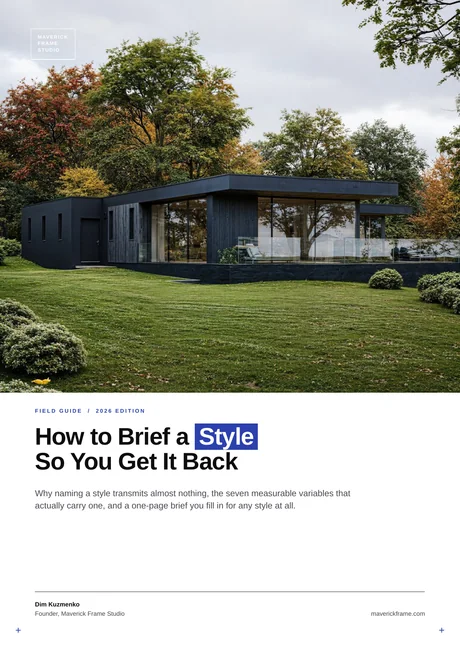
How to Brief a Style So You Get It Back
Why naming a style transmits almost nothing, the seven measurable variables that actually carry one, and a one-page brief you fill in for any style at all.
If it didn't open, download it here.
Download the PDF