Real estate advertising is the paid promotion of properties, listings, and agent or developer brands across digital and offline channels — Google, Meta, listing portals, video, and print — to attract buyers, renters, and investors. Unlike organic marketing, it buys reach and speed: you pay to put the right property in front of the right audience at the moment they are ready to act.
What Is Real Estate Advertising?What Is Real Estate Advertising?
Real estate advertising is the slice of marketing where you pay for visibility — search ads, social ads, sponsored listings, video, and direct mail — rather than waiting for reach to build organically. Marketing is the whole system (brand, content, SEO, referrals, advertising); advertising is the paid accelerator inside it. For most agents and developers the two work together: organic builds trust over months, while paid ads generate leads this week.
The goal is rarely “awareness” for its own sake. A good real estate ad drives one measurable action: a saved listing, a tour booking, a brochure download, or a direct inquiry. Everything below — ideas, platforms, budgets — is in service of that single conversion.
12 Real Estate Advertising Ideas That Work in 202612 Real Estate Advertising Ideas That Work in 2026
The ideas that move the needle in 2026 share one trait: they lead with strong visuals and a clear next step. Here are twelve proven formats, from paid channels to creative assets.
- Meta lead ads (Facebook & Instagram) — geo- and interest-targeted ads that capture buyer details inside the platform, ideal for new listings and open houses.
- Google Search ads — intercept high-intent searches like “homes for sale in [area]” and send them to a dedicated listing page.
- Listing-portal promotion — paid featured placement on Zillow, Realtor.com, or your local portal to surface a listing above the fold.
- Short-form video tours — 20–45 second walkthroughs for Reels, TikTok, and YouTube Shorts that show curb appeal and flow.
- Interactive 3D tours and 360° panoramas — let buyers explore the property themselves, day or night, before they ever visit.
- Photorealistic CGI renders — for pre-construction or unstaged units, renders sell the finished home before it exists.
- Retargeting ads — follow people who viewed a listing with a reminder ad until they book or move on.
- Email and SMS campaigns — new-listing alerts and price-drop notices to a warm database of past and prospective clients.
- Direct-mail postcards — “just listed” and “just sold” mailers that still cut through in a digital-saturated market.
- Local sponsorships and events — community visibility that builds the brand referrals depend on.
- LinkedIn ads — for commercial real estate, investor outreach, and high-net-worth clientele.
- Branded landing pages — one page per property or campaign so every ad dollar lands somewhere that converts.
You do not need all twelve. Most successful campaigns combine one paid traffic channel, one strong visual asset, and one follow-up mechanism — then scale what converts.

Best Real Estate Advertising Platforms, Compared
The best platform depends on intent. Search captures buyers who already know what they want; social creates demand and builds brand; portals reach people actively browsing properties. The table below compares the main channels by fit, typical cost, and buyer intent.
| Platform | Best for | Typical cost | Buyer intent |
| Google Search | Active buyers searching by location | $2.53–$5.50 per click | High |
| Meta (Facebook & Instagram) | Awareness, listings, lead capture | $0.91–$1.57 per click | Medium |
| Listing portals (Zillow, Realtor.com) | People already browsing homes | Featured-listing fees vary by market | High |
| TikTok & Reels | First-time buyers, video tours | Low CPM, high reach | Low–Medium |
| Commercial real estate, investors | $8–$11 per click | Medium |
For residential listings, a Google + Meta pairing covers both intent levels. For commercial deals and investor outreach, LinkedIn earns its higher cost per click because its audience skews toward professionals and higher-income households.
How Much Does Real Estate Advertising Cost?How Much Does Real Estate Advertising Cost?
Plan on $1,500–$2,000 per month for a serious multi-platform campaign, or $500–$1,000 per month if you start on a single channel. A common guideline is to reinvest about 10–20% of gross commission into marketing. Beyond the monthly budget, costs are measured per click or per lead — the benchmarks below show what to expect in 2026.
| Channel | Cost metric | 2026 benchmark |
| Google Search ads | Cost per click / cost per lead | $2.53–$5.50 CPC · $65–$170 CPL |
| Facebook / Instagram | Cost per click / cost per lead | $0.91–$1.57 CPC · ~$16.61 CPL |
| Cost per click / CPM | $8–$11 CPC · ~$33.80 CPM | |
| Google Local Service Ads | Cost per qualified lead | $20–$60 per lead |
| Starting budget | Monthly, per platform | $500–$1,000 |
The hidden cost most advertisers underestimate is the creative itself. A campaign with a $2,000 ad budget and weak photos will lose to a $1,000 campaign with strong visuals — and good visuals are no longer expensive.
CGI renders almost always pay for themselves in advertising, because a render simply looks better than a photo. If the unit is brand new and freshly renovated, sure — shoot real photos. But ask what’s actually cheaper: renders are usually faster, cheaper, and better for an empty or unbuilt apartment, and you can change anything in them. Move a wall, swap the finish, restage the room — try doing that with a photoshoot.
From our studio — Dim Kuzmenko
If you are weighing visuals against a photoshoot, our breakdown of what 3D renders cost shows where rendering comes out ahead per image.
Paid vs. Organic Real Estate AdvertisingPaid vs. Organic Real Estate Advertising
Paid advertising buys speed; organic marketing builds compounding trust. Paid ads put a listing in front of thousands within hours but stop the moment you stop spending. Organic — SEO, referrals, social content, email — takes months to gain traction but keeps working without per-click fees. The strongest real estate brands run both: ads for this month’s listings, organic for next year’s pipeline.
- Choose paid when you have a specific listing to move now, a new development to fill, or a measurable lead target this quarter.
- Choose organic when you are building a personal brand, ranking for your local market, or nurturing past clients for referrals.
- Run both when you want predictable lead flow today and lower cost-per-lead over time.
How Visuals Make Real Estate Ads Convert
Visuals are the single biggest lever in a real estate ad. The same property, same price, and same channel will perform completely differently depending on whether the first image stops the scroll. Buyers decide in seconds, and they decide on the picture — not the copy.
Open Booking, or almost any listing site, and you see a flood of genuinely awful images — shot however, by whoever, in bad light. It’s never been easier or cheaper to make beautiful pictures, and that alone is a huge edge over the competition. I still don’t understand why people don’t do it. On top of that, there’s now a wave of cheap or even free tools that extend a static render — 3D tours, 360° panoramas. We offer that as a service: the buyer gets a full 3D walkthrough of the apartment, and it lifts conversion a lot — especially now that making a tour has become so cheap.
From our studio — Dim Kuzmenko
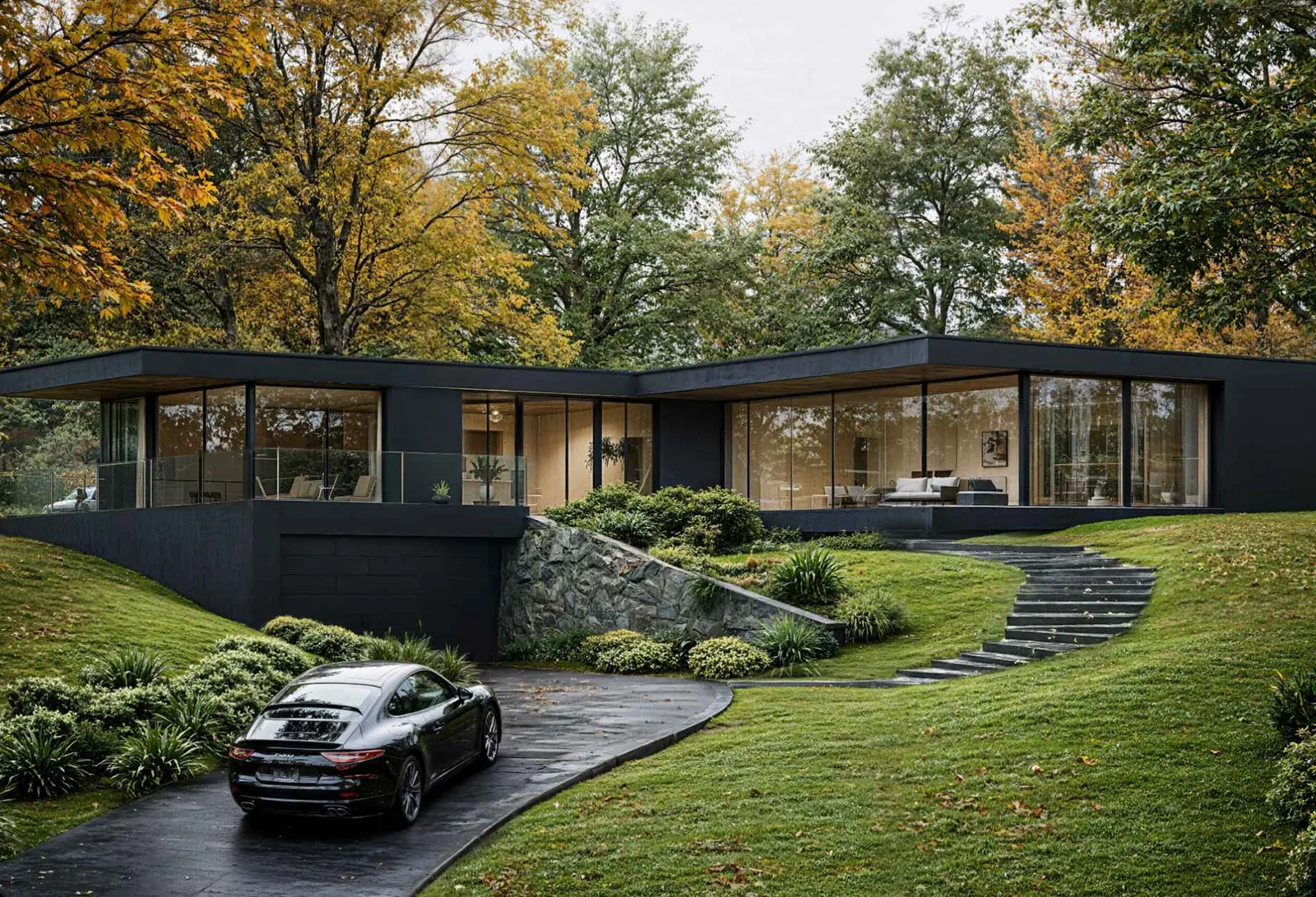
Three visual assets consistently outperform plain photography in ads: photorealistic renders for unbuilt or unstaged units, interactive 3D tours that let buyers explore on their own, and short video walkthroughs for social feeds. For pre-construction especially, CGI for real estate marketing lets you advertise a finished home months before it is built.
Commercial vs. Residential Real Estate Advertising
Residential and commercial advertising chase different buyers, so they use different channels and creative. Residential is emotional and visual — it sells a lifestyle to individuals scrolling social feeds and portals. Commercial is analytical — it sells returns to investors and tenants who respond to data, location, and projections on LinkedIn and industry platforms.
- Residential — Meta, listing portals, short-form video, lifestyle renders; the hook is how the home feels.
- Commercial — LinkedIn, Google Search, investor newsletters, masterplan and aerial visuals; the hook is yield, footfall, and location.
- Both — benefit from 3D tours and high-quality visuals that reduce the number of in-person visits needed to close.

How to Build a Real Estate Advertising Plan
A workable plan takes five steps. Move through them in order, then double down on whatever produces the lowest cost per qualified lead.
- Define the audience — first-time buyers, luxury clients, downsizers, or investors. Every later choice follows from this.
- Set one goal and budget — a lead target and a monthly figure, starting at $500–$1,000 per platform.
- Prepare the visuals first — renders, a 3D tour, or a video before you write a single ad.
- Pick one or two channels — match platform to audience rather than spreading thin across all of them.
- Measure and reallocate — track cost per lead weekly and shift spend to the winning channel.
The biggest mistake I see: a developer or designer orders visuals in the style they personally like, not the style that sells. Those are two different jobs. The artist might love minimalism — but a project in Kazakhstan or the Emirates calls for a richer, more luxurious look, and that’s what converts there. Or someone who prefers classical taste tries to render a Manhattan high-rise as an expensive traditional interior. Build the images for the buyer you’re advertising to, not for your own taste.
From our studio — Dim Kuzmenko
Get those five steps right and advertising stops being a gamble. You will know exactly what each lead costs and which channel deserves the next dollar.
Launch campaigns need assets before the product exists, as in this product launch visualization.

Turn Ideas Into Visual Stories
Free field guide
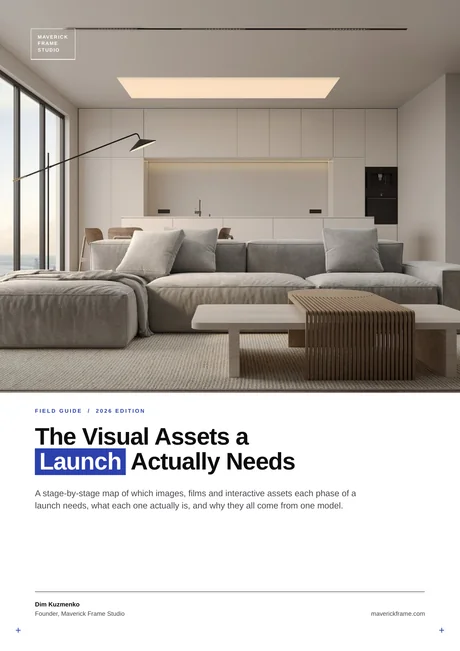
The Visual Assets a Launch Actually Needs
A stage-by-stage map of which images, films and interactive assets each phase of a launch needs, what each one actually is, and why they all come from one model.
If it didn't open, download it here.
Download the PDF