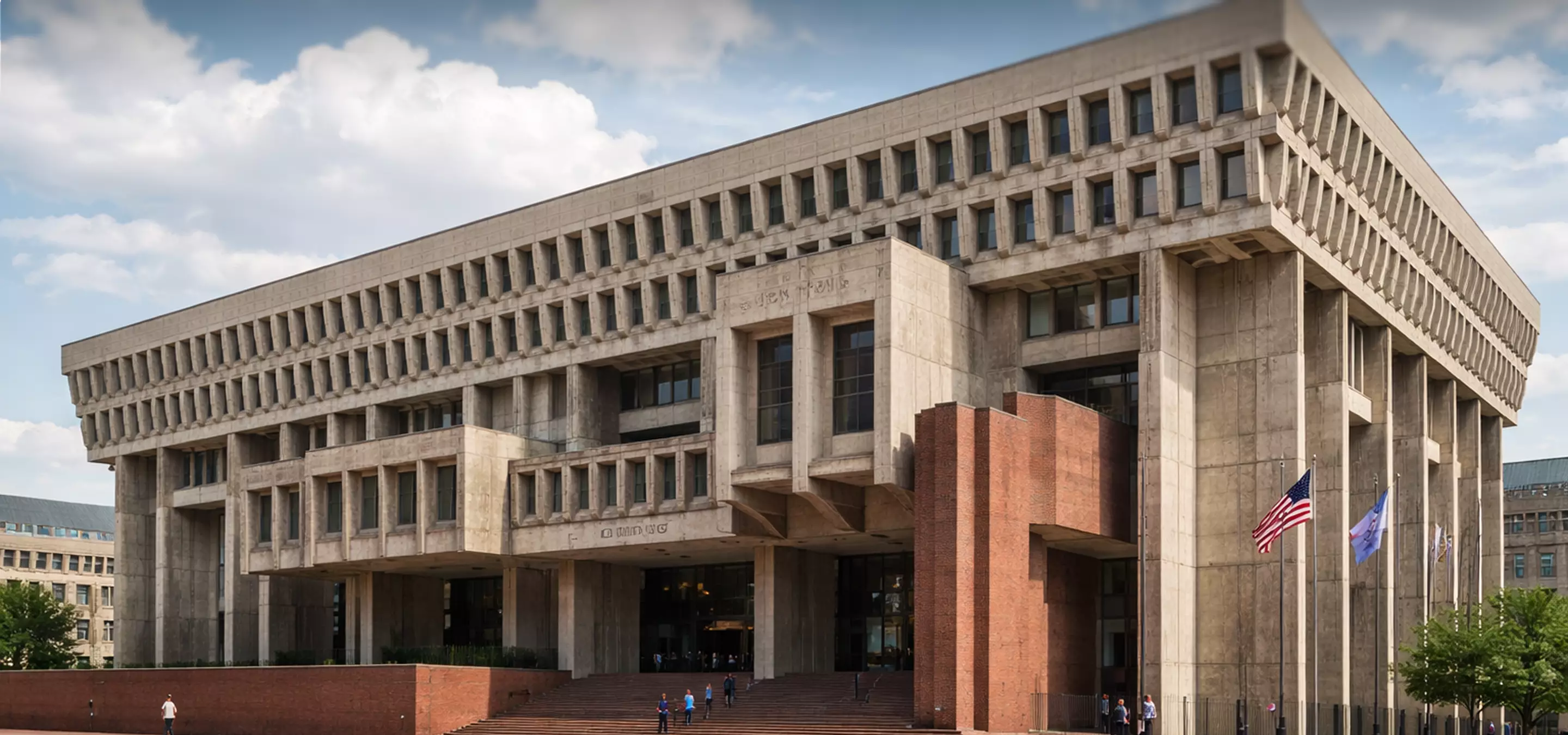
Brutalist architecture is a style that emerged in the mid-20th century, defined by raw concrete, bold geometric forms, and a focus on structural honesty rather than decoration. In simple terms, it is a branch of modern design that exposes materials and construction instead of hiding them.
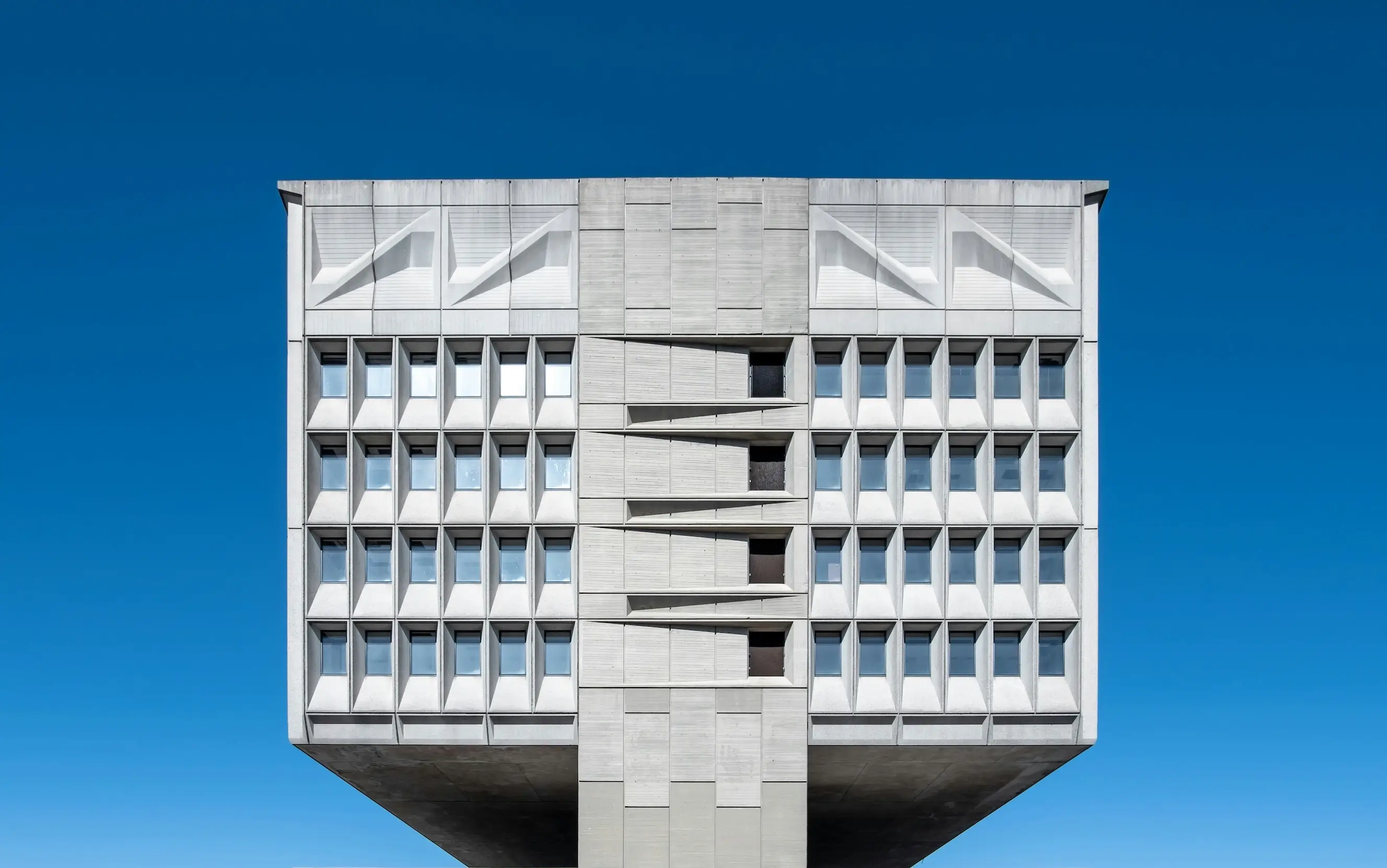
The movement grew after World War II and quickly became associated with civic buildings, housing projects, and institutional structures. At its core, brutalism aimed to express function and material without compromise, often resulting in buildings that feel heavy, monumental, and unapologetically direct.
Reactions to Brutalism remain sharply divided. Some associate it with clarity, strength, and sculptural power, while others view it as coldness and urban decay. This guide explains the meaning of the term, the origins of the style, its defining features, and why it continues to provoke debate decades later.
What Is Brutalist Architecture?What Is Brutalist Architecture?
A precise definition starts with the core principles of Brutalist architecture. It is an architectural approach within modernism that prioritizes raw materials, visible structure, and bold massing over ornament or refinement. Within the wider history of architectural styles, Brutalism stands out for its emphasis on material honesty and structural expression.
To understand the term, it helps to look beyond surface appearance. The style is built on the idea that architecture should communicate how it is made. Concrete, steel, and masonry are left exposed, turning construction into visual language.
A clear brutalism definition also includes its philosophical intent. Rather than creating polished facades, architects emphasized honesty, social purpose, and functional clarity. This placed the movement firmly within the broader context of modern architecture, where innovation and rational design shaped the built environment.
What Does Brutalist Mean?What Does Brutalist Mean?
The term is often misunderstood. It does not refer to violence or literal harshness, even though the buildings can feel imposing.
So, what does brutalist mean? The word comes from the French phrase béton brut, meaning raw concrete. It refers to a material condition rather than an emotional one.
Understanding the term requires recognizing that it reflects texture and construction. Early architects embraced unfinished surfaces, allowing the marks of formwork and casting to remain visible as part of the design language.
History of Brutalist ArchitectureHistory of Brutalist Architecture
The development of Brutalism is inseparable from the social and economic realities of the postwar period. Cities across Europe needed fast, affordable reconstruction, and concrete offered both efficiency and durability.
As brutalism evolved, it became a global phenomenon. The style spread from the United Kingdom and France to North America, Eastern Europe, and beyond, shaping universities, government centers, and housing developments.
Why Brutalism Emerged After the WarWhy Brutalism Emerged After the War
The rise of Brutalism was driven by necessity. Reconstruction required scalable solutions, and concrete allowed architects to build quickly while maintaining structural integrity.
Limited budgets and urgent housing needs pushed designers toward functional solutions. This practical mindset can still be recognized in later architectural work where form follows purpose and materials remain exposed.
The recent film The Brutalist also revisits this era, portraying how ambition, displacement, and modernist ideals shaped architectural expression in the mid-20th century.
Notable Brutalist ArchitectsNotable Brutalist Architects
Brutalism was shaped by a relatively small group of architects whose work helped define the movement across countries and building types. Their approaches differed, but they shared an interest in exposed materials, structural clarity, and bold form.
Le Corbusier is often regarded as one of the key precursors to Brutalism. Although he was not exclusively a brutalist architect, projects such as Unité d’Habitation strongly influenced the movement through their raw concrete surfaces, monumental scale, and emphasis on mass.
Alison and Peter Smithson played a central role in shaping Brutalism in Britain. Through both their buildings and their writing, they presented the movement as more than a visual style, linking it to postwar life, public need, and the realities of the modern city.
Marcel Breuer brought Brutalism into civic, institutional, and religious architecture. His work showed that concrete buildings could feel monumental without losing compositional discipline.
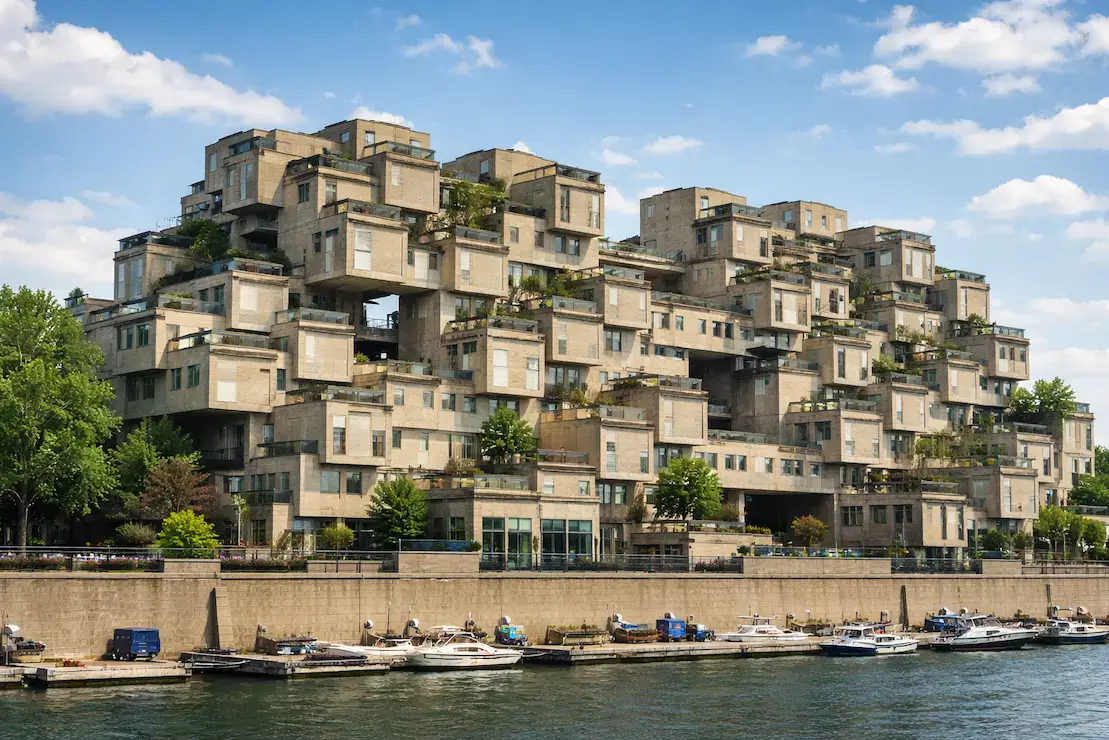
Moshe Safdie is closely associated with Habitat 67, one of the most recognizable examples of brutalist housing. His work explored how modular construction and high-density living could be combined in more experimental ways.
Paul Rudolph pushed Brutalism in a more expressive direction. His buildings often used dramatic interior sequences, deep shadows, and heavily textured surfaces, showing that the movement could be spatially complex as well as visually severe.
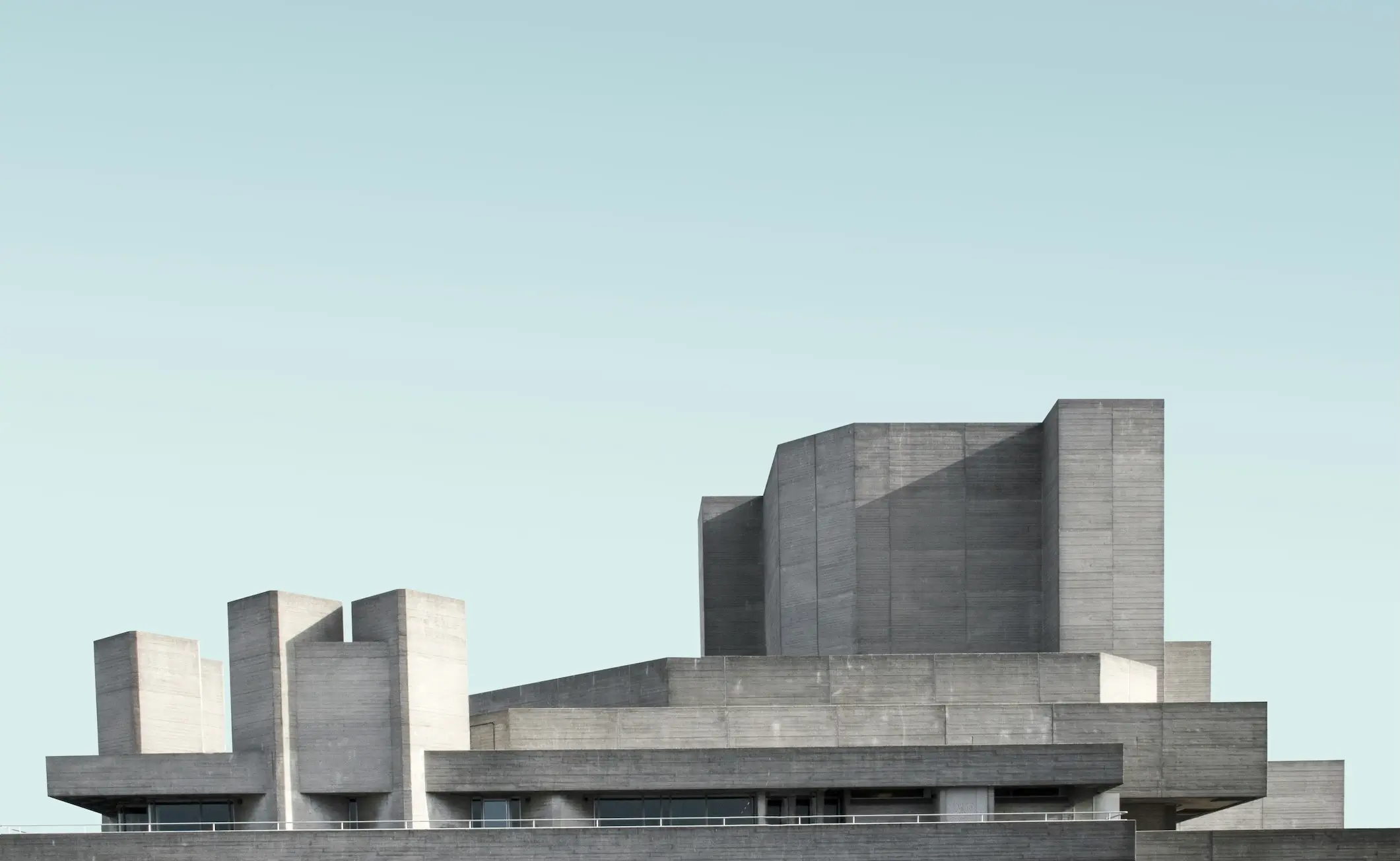
Denys Lasdun helped define the public face of British Brutalism through major civic and cultural projects such as the National Theatre in London. His work is especially important for the way it combines mass, geometry, and public presence.
Ernő Goldfinger is another major figure associated with Brutalism, especially through residential towers such as Trellick Tower. His work came to symbolize both the ambition and the controversy of postwar housing design.
Together, these architects shaped Brutalism across housing, education, government, and culture. Their work remains essential to understanding how the movement developed into one of the most recognizable architectural languages of the 20th century.
Main Features of Brutalist ArchitectureMain Features of Brutalist Architecture
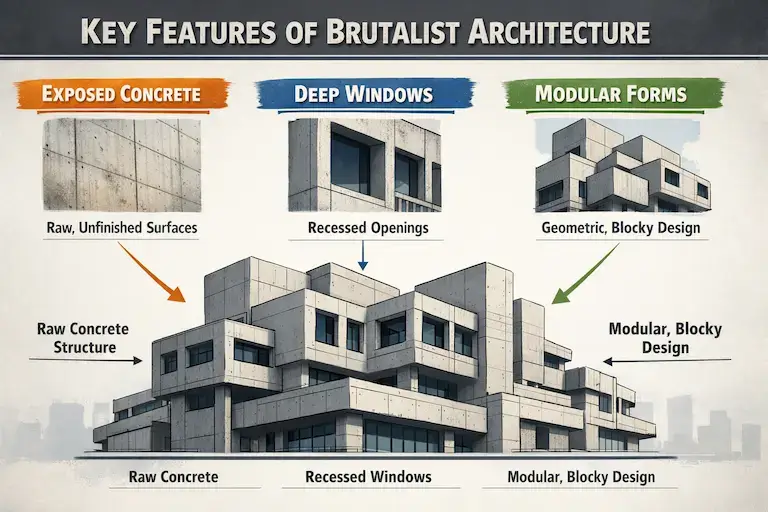
Understanding the main features of Brutalist architecture is essential for recognizing the style in practice. The defining characteristics are visually distinct and conceptually consistent.
Key elements of brutalist design include:
- Exposed concrete surfaces
- Large geometric volumes
- Massive, heavy proportions
- Repetitive modular elements
- Deep-set windows and recessed openings
- Minimal decorative detail
- Visible structural systems
These qualities define Brutalist architecture as both functional and expressive, where structure becomes the primary aesthetic.
Explanatory visuals similar to 3D exterior rendering can help show how massing, light, and shadow interact in these buildings.
How to Identify a Brutalist Building
A brutalist building can usually be recognized immediately by its scale and material presence. These structures rarely try to blend in or soften their impact.
The defining trait of the brutalist style is its emphasis on weight, texture, and form. Unlike generic concrete construction, Brutalism uses these elements deliberately to create a strong visual identity.
Materials, Mass, and TextureMaterials, Mass, and Texture
The brutalist aesthetic relies heavily on concrete, often left unfinished to reveal grain, seams, and imperfections.
Other materials such as steel and brick may appear, but the emphasis remains on solidity and permanence. Projects visualized through 3D rendering for architecture and design studios often highlight these textures clearly before construction begins.
Why Is Brutalist Architecture So Controversial?Why Is Brutalist Architecture So Controversial?
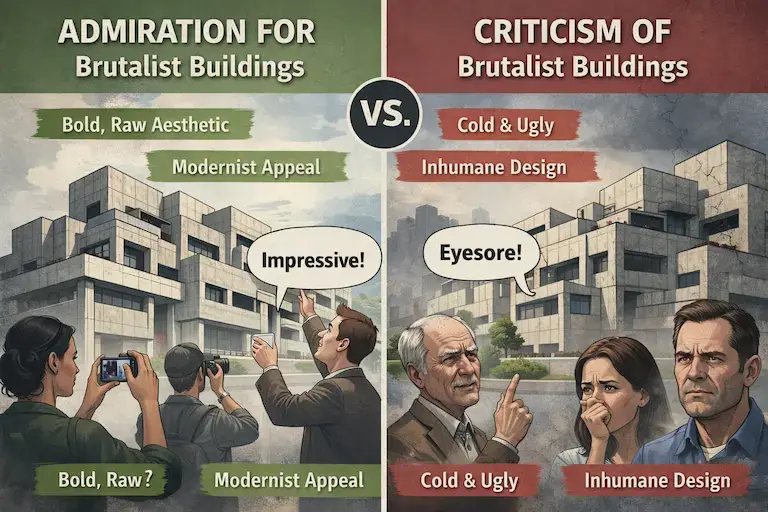
Few styles divide opinion like brutalist architecture. Its boldness and refusal to conform to traditional beauty standards have made it both admired and criticized.
At the heart of the debate around brutalism is perception. For some, the style represents honesty and strength. For others, it evokes coldness, bureaucracy, and urban decline.
Why People Criticize Brutalism
Criticism often focuses on the emotional impact of the buildings. Large, heavy forms can feel overwhelming, especially at street level.
Weathering concrete, maintenance challenges, and associations with failed housing projects have reinforced negative views, especially where later adaptations softened the original visual language.
Why Brutalism Still Has Strong SupportersWhy Brutalism Still Has Strong Supporters
Supporters argue that brutalist design offers clarity and authenticity rarely found in other styles.
Architects, photographers, and designers appreciate its sculptural qualities and graphic presence, especially in the way light and shadow reveal its complexity.
The Fall and Return of BrutalismThe Fall and Return of Brutalism
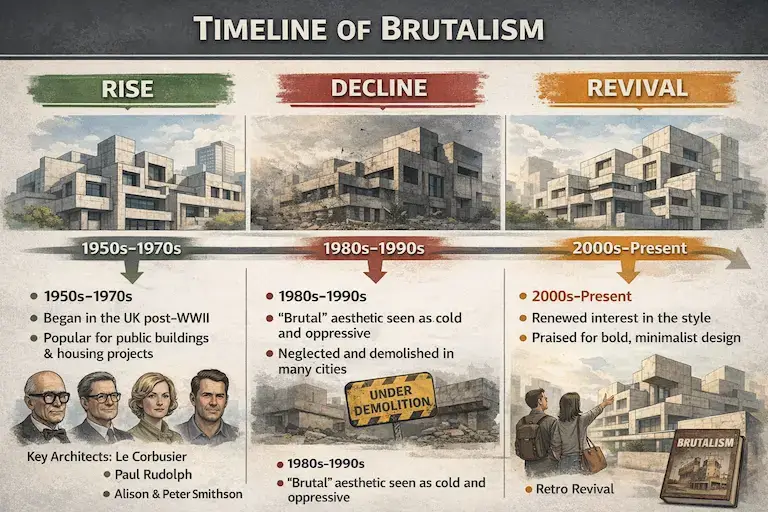
By the late 20th century, brutalism had fallen out of favor. Public opinion shifted toward lighter, more decorative styles, and many buildings were demolished or neglected.
Today, Brutalism is being reevaluated. Designers are rediscovering its principles while adapting them to modern expectations in both physical and digital design practice.
A renewed interest in material honesty and bold form has fueled a quiet comeback, especially in digital and conceptual design.
Historic Brutalism vs. Contemporary Revival
The resurgence of brutalism is often misunderstood because historic brutalism and the contemporary revival are not one and the same. Although they share visual similarities, they emerged from different contexts and often have different objectives.
Historic brutalism emerged from the postwar world. Shaped by reconstruction, public need, limited budgets, and the modernist belief that architecture should directly express its structure, purpose, and material, historic brutalism emerged as a response to the postwar world. Many original buildings were designed for civic institutions, universities, social housing, and public infrastructure. Their scale was often collective rather than private, and their significance stemmed from social ambition as much as aesthetics.
By contrast, contemporary interpretations of the style are usually more selective, much like broader trends in contemporary architecture. Similar principles can be seen in contemporary projects such as the retreat house design, where material honesty and form-driven composition are interpreted in a more controlled context. Architects and designers borrow brutalism’s language of monolithic forms, exposed materials, sharp geometry, and strong shadows, but not the exact political and economic conditions that produced the historic movement. The appeal of many current projects lies in atmosphere, visual clarity, and material character rather than large-scale public building programs.
This difference matters. Historic brutalism was not just a style of dramatic concrete forms. It was also tied to ideas about welfare, civic identity, education, and the role of architecture in rebuilding society. Contemporary neo-brutalist is often more controlled and refined, considering comfort more carefully. While surfaces may appear raw, the detailing is cleaner, maintenance expectations are higher, and the interiors are often warmer than those of many mid-century precedents.
The revival also reflects a change in cultural perception. For decades, brutalism was dismissed as harsh, outdated, and a social failure. Today, however, architects, preservationists, and design enthusiasts are more likely to appreciate its spatial clarity and visual discipline. What was once seen as only severity is now often viewed as confidence, formal precision, and resistance to superficial decoration.
Nevertheless, the revival should not gloss over the contradictions of the original movement. While historic brutalism produced some of the most compelling civic and housing architecture of the 20th century, the movement was also susceptible to poor maintenance, political neglect, and public hostility. The contemporary return of brutalist ideas is most effective when it learns from both sides of that legacy: the power of material honesty and sculptural form, as well as the need for humane scale, durability, and urban empathy.
Famous Examples of Brutalist ArchitectureFamous Examples of Brutalist Architecture
Exploring famous examples of Brutalist architecture helps clarify why the style remains influential.
Many Brutalist architecture examples show how the movement addressed housing, civic identity, and urban planning at scale.
| Building | Location | Architect | Why It Matters |
| Boston City Hall | Boston, USA | Kallmann McKinnell & Knowles | One of the most recognizable civic examples of Brutalism in the United States |
| Habitat 67 | Montreal, Canada | Moshe Safdie | Reimagined high-density housing through modular design |
| Barbican Estate | London, UK | Chamberlin, Powell and Bon | A large-scale urban vision combining housing, culture, and infrastructure |
| National Theatre | London, UK | Denys Lasdun | A defining cultural landmark of British Brutalism |
| Geisel Library | San Diego, USA | William Pereira | Demonstrates the sculptural and futuristic side of the movement |
| Trellick Tower | London, UK | Ernő Goldfinger | A controversial yet iconic residential brutalist building |
| Unité d’Habitation | Marseille, France | Le Corbusier | A foundational project that strongly influenced later Brutalist architecture |
| Robin Hood Gardens | London, UK | Alison and Peter Smithson | A key case study in the debate around Brutalism and social housing |
Civic and Institutional Icons
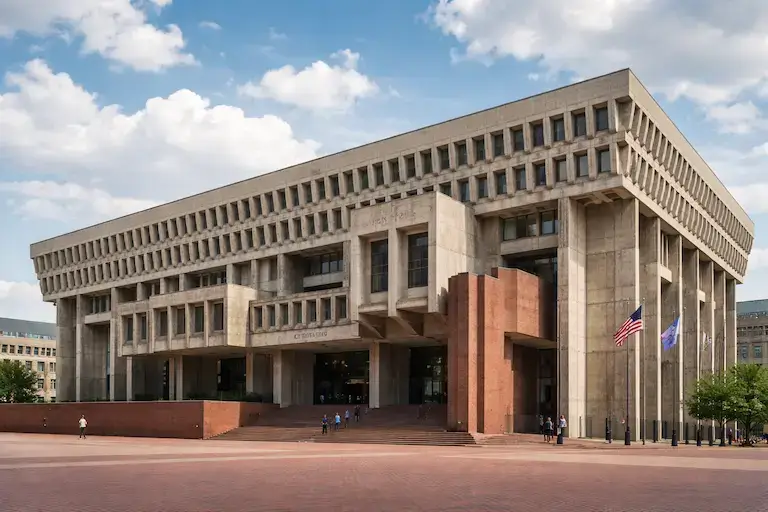
Some of the most recognizable brutalist buildings fall into the civic category.
Boston City Hall, the National Theatre in London, and the Breuer Building in New York showcase the monumental quality of famous brutalist architecture.
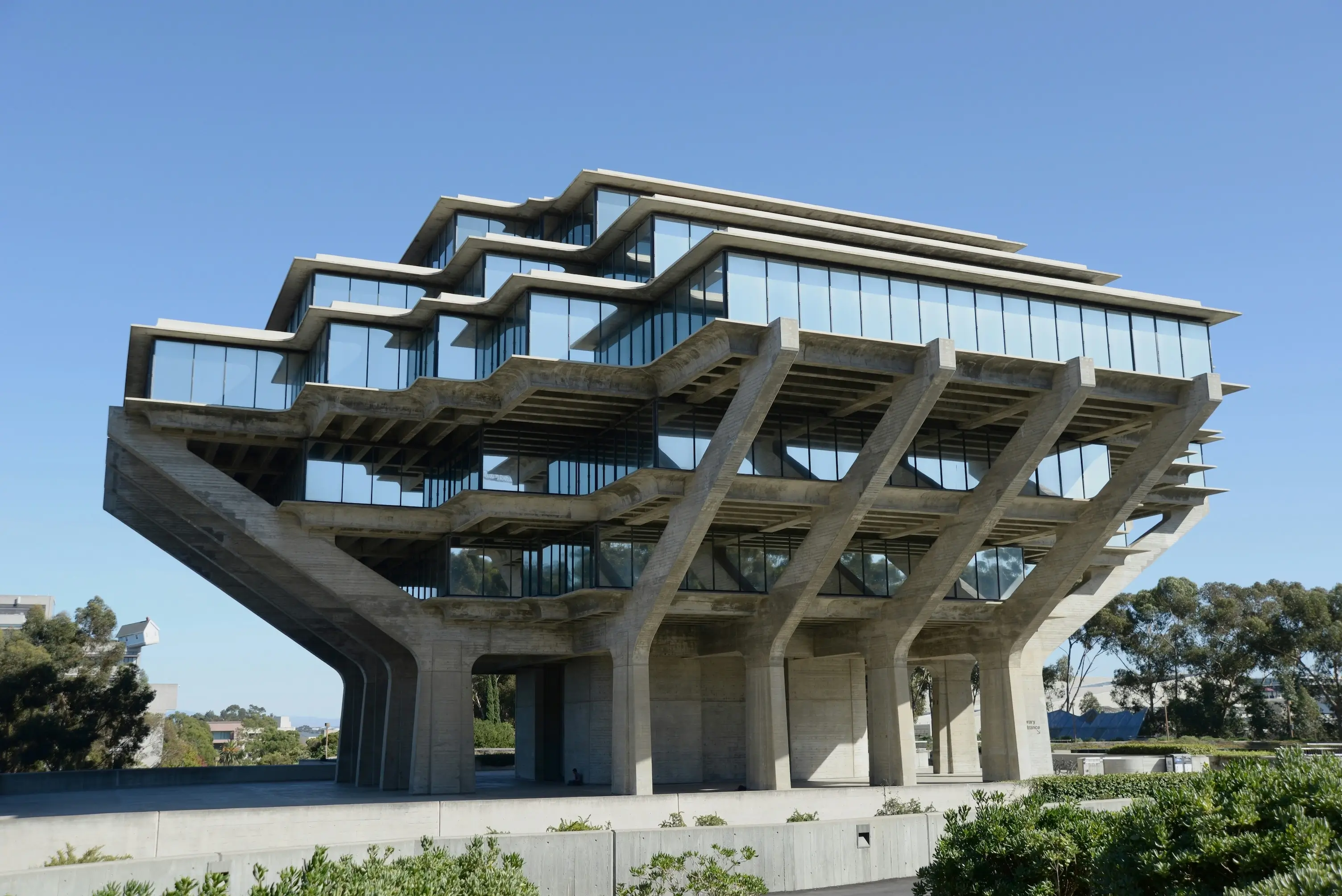
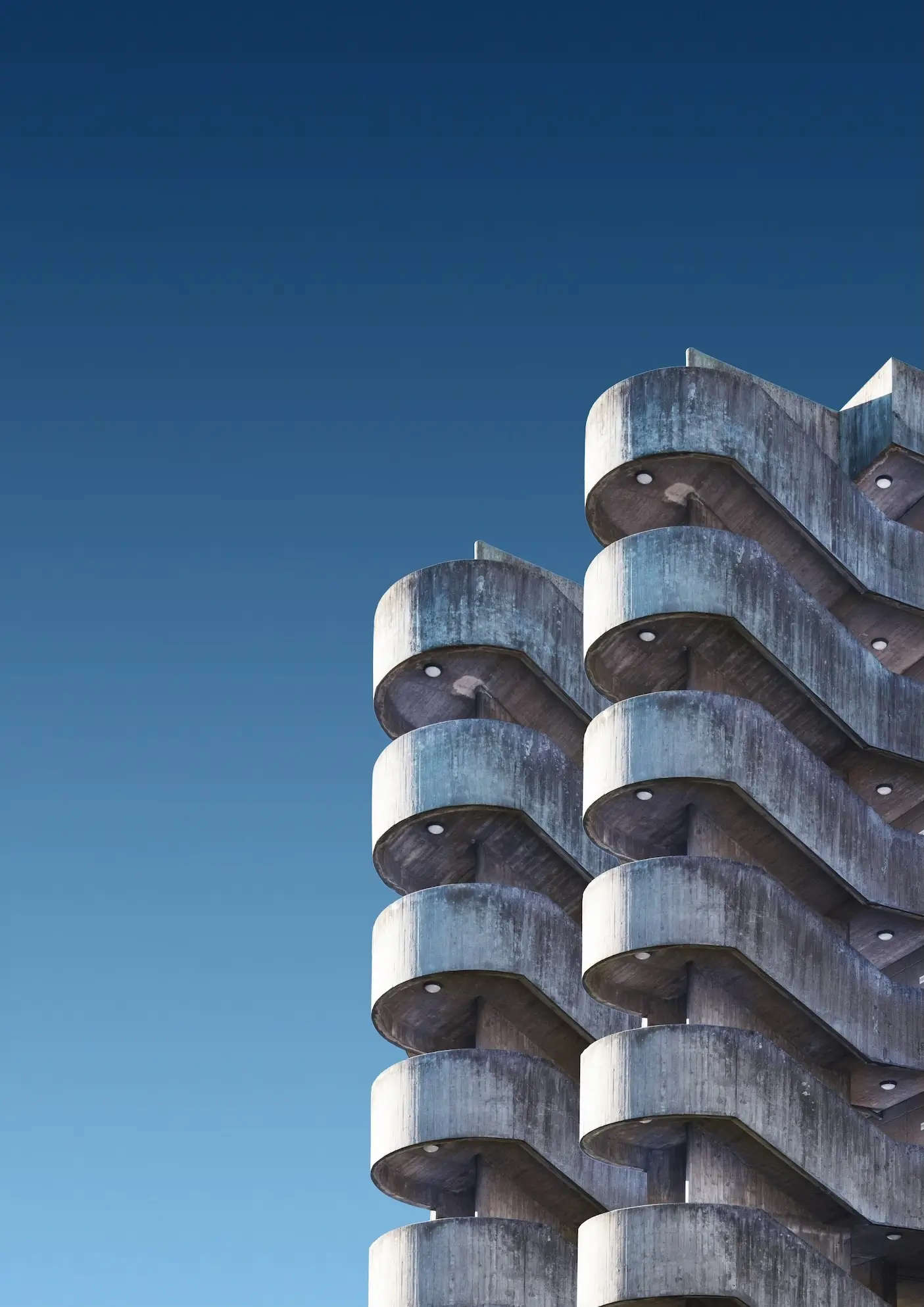
The Geisel Library at the University of California, San Diego, deserves to be included in the same conversation. Unlike the heavier, horizontal mass of many brutalist civic buildings, the library expresses brutalism through dramatic structural projection and sculptural balance. Its stacked concrete tiers flare outward from the base, creating a silhouette that is both futuristic and unmistakably monumental. The building shows that brutalism is not limited to bunker-like forms. At its best, the style can be dynamic, elevated, and formally inventive.
What makes the Geisel Library especially important is the way it translates institutional identity into architectural form. A university library must communicate seriousness, permanence, and intellectual purpose, and this building accomplishes that without relying on historical ornamentation or symbolic decoration. Its exposed concrete massing exudes authority, and its unusual geometry gives it a distinct public presence. This combination of functional clarity and sculptural expression explains why brutalism remains compelling to architects and photographers.
These projects became iconic because they expressed institutional power through form. Visual studies like residential rendering help reinterpret their scale and structure for modern audiences.
Housing and Urban Experiments
Housing projects represent some of the most ambitious examples of Brutalist architecture.
Cité Radieuse, Habitat 67, and the Barbican Estate explored new ways of living in dense urban environments.
Robin Hood Gardens belongs in this group because it embodies the ambition and controversy of brutalism better than almost any other housing project. Designed by Alison and Peter Smithson, the project was conceived as a social vision for modern urban life, not just a set of apartments. It reimagined how high-density housing could foster community, circulation, and shared spaces. In that sense, it represents brutalism at its most idealistic.
The project is especially significant because it embodies the Smithsons’ architectural theories. Rather than treating housing as a neutral container, the Smithsons approached it as a framework for social relations. The building’s broad access decks, elevated circulation routes, and strong concrete structure were meant to do more than solve practical problems. They were also intended to shape residents’ experiences, encourage neighborly contact, and give large-scale housing a sense of order and presence.
At the same time, Robin Hood Gardens also reveals why brutalism became so controversial. Supporters viewed it as a serious attempt to connect architecture with social purpose by using strong forms and clear structures to address the realities of postwar urban life. However, critics saw it as a symbol of the gap between architectural idealism and lived reality. Maintenance issues, broader planning failures, and shifting public expectations all affected how the project was perceived.
This tension is precisely why Robin Hood Gardens is important. It is not just a famous building that people either liked or disliked. It has become a touchstone in the debate over whether brutalist housing failed because of the architecture itself, due to neglect and policy, or because the social ambitions placed on design were too great for form alone to carry. Few examples of brutalist architecture reveal the movement’s strengths and vulnerabilities as clearly as this one.
These examples combined social ideals with experimental design, aiming to create functional yet expressive communities.
Why Brutalism Still Matters Today
The continued relevance of brutalist architecture lies in its clarity of intent. It forces both designers and viewers to confront how buildings are made and what they communicate.
In current practice, Brutalism influences not only physical construction but also digital visualization workflows, where form, light, and material must be communicated precisely.
Understanding this style helps interpret both postwar cities and contemporary design trends. It also provides a framework for evaluating how architecture balances function, expression, and public perception.

Turn Ideas Into Visual Stories
Frequently Asked Questions
Brutalist architecture is a modern style that uses raw materials, especially concrete, and emphasizes structural honesty. Emerging after World War II, it was a practical and philosophical response to reconstruction needs, focusing on bold forms and minimal decoration.
Brutalism is a design approach within modernism that values exposed materials and functional expression. Rather than being about harshness, it is about revealing how a building is constructed, often through concrete surfaces and geometric massing.
The term “brutalist” comes from the French term for raw concrete, “béton brut.” It reflects the material’s qualities rather than an emotional tone, emphasizing unfinished textures and visible construction methods.
The main features of Brutalist architecture include exposed concrete, massive geometric forms, minimal ornamentation, and visible structural elements. Together, these features create a strong visual identity based on weight, texture, and repetition.
Brutalist architecture is controversial because it challenges conventional ideas of beauty. Some people value its honesty and sculptural power, while others associate it with coldness, urban decline, and difficult living conditions.
Brutalist architecture examples include Boston City Hall, Habitat 67, the Barbican Estate, and the National Theatre in London. These buildings illustrate the style’s scale, ambition, and lasting influence.