What Is Architectural Rendering: Types, Workflow, and Uses

Discover High-Quality CGI Services Tailored to Your Business
- Key Takeaways
- What Is Architectural Rendering
- Types of Architectural Rendering
- Interior and Exterior Renderings
- Aerial, Site, and Urban Renderings
- Conceptual vs Photorealistic Rendering
- Architectural Rendering Styles
- How Architectural Rendering Works
- Where Architectural Rendering Is Used in Practice
- Architecture and Design Communication
- Construction, Planning, and Approvals
- Real Estate Marketing and Sales
- Benefits of Architectural Rendering
- Clearer Decision-Making
- Risk Reduction Before Construction
- Faster Project Alignment Between Stakeholders
- Architectural Rendering FAQs
- What Does Rendering Mean in Construction?
- What Makes a Good Architectural Render?
- What Are the Main Architectural Rendering Techniques?
- Who Typically Uses Architectural Rendering?
- When Renderings Make the Difference
Architectural rendering transforms three-dimensional models into two-dimensional images that convey design intent prior to construction. This process allows architects, developers, and planners to visualize unbuilt spaces, identify potential issues, and develop a shared understanding among stakeholders. The highest-fidelity form is photorealistic architectural visualization, which uses real-world lighting and materials to inform critical decisions. Renderings serve practical purposes throughout project phases, from early concept exploration to planning approvals and off-plan sales. They translate abstract design data into a format that is accessible to nontechnical audiences.
Key TakeawaysKey Takeaways
– Architectural rendering converts 3D models into static or animated images to visualize unbuilt spaces for communication and decision-making.
– Interior, exterior, aerial, and site renderings serve distinct purposes depending on project phase and audience needs.
– Photorealistic architectural visualization simulates real-world lighting, materials, and environmental conditions to reduce interpretation gaps.
– The 3D architectural rendering workflow moves through modeling, material assignment, lighting setup, camera positioning, rendering computation, and post-production refinement.
– Renderings support practical outcomes, such as design validation with clients, planning approvals with authorities, and pre-construction risk identification.
– Conceptual styles prioritize design intent and atmosphere, while photorealistic designs prioritize technical accuracy and material representation.
– Effective visualizations serve as decision-making tools by making spatial relationships and design choices explicit before physical work begins.
What Is Architectural RenderingWhat Is Architectural Rendering
Definition of Architectural RenderingDefinition of Architectural Rendering
The process of generating two-dimensional images or animations from three-dimensional digital models to represent proposed buildings, interiors, or landscapes before physical construction is called architectural rendering and is typically delivered through professional 3D architectural rendering services. These visualizations translate abstract geometric data into spatial experiences that stakeholders can easily understand, even if they lack technical drawing knowledge.
What 3D Architectural Rendering Is Used ForWhat 3D Architectural Rendering Is Used For
– Communicating design intent to clients who cannot interpret floor plans or elevations
– Supporting planning applications with visual context for approval bodies
– Identifying spatial conflicts or proportion issues during design development
– Coordinating between architects, engineers, and contractors on material integration
– Enabling real estate developers to market properties before construction begins
An architectural rendering is not a substitute for construction documentation. It does not replace technical drawings, structural calculations, or building information modeling (BIM) coordination. Instead, it serves as a communication tool that makes design decisions visible and discussable across disciplines and stakeholder groups.
In practice, a residential architect might use an exterior visualization to show clients how afternoon sunlight will interact with the placement of proposed windows. The same image could support a later planning submission by showing how the building’s massing compares to neighboring properties. Thus, a single visual product serves multiple audiences.
Types of Architectural RenderingTypes of Architectural Rendering
Rather than artistic style, the type of architectural rendering is defined by viewpoint and scope. At each project phase, the appropriate view is selected based on which spatial relationships require clarification.
Interior and Exterior RenderingsInterior and Exterior Renderings
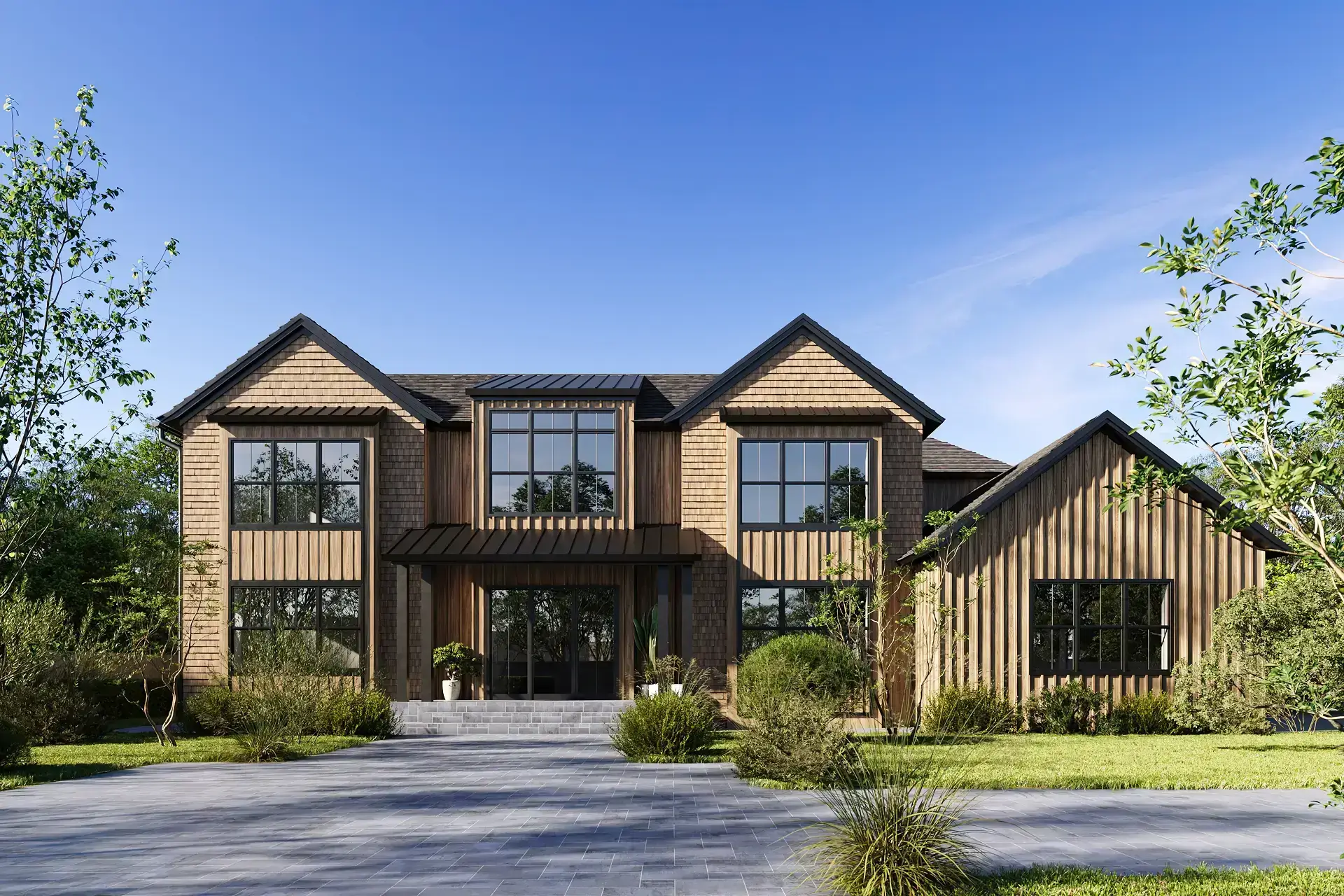
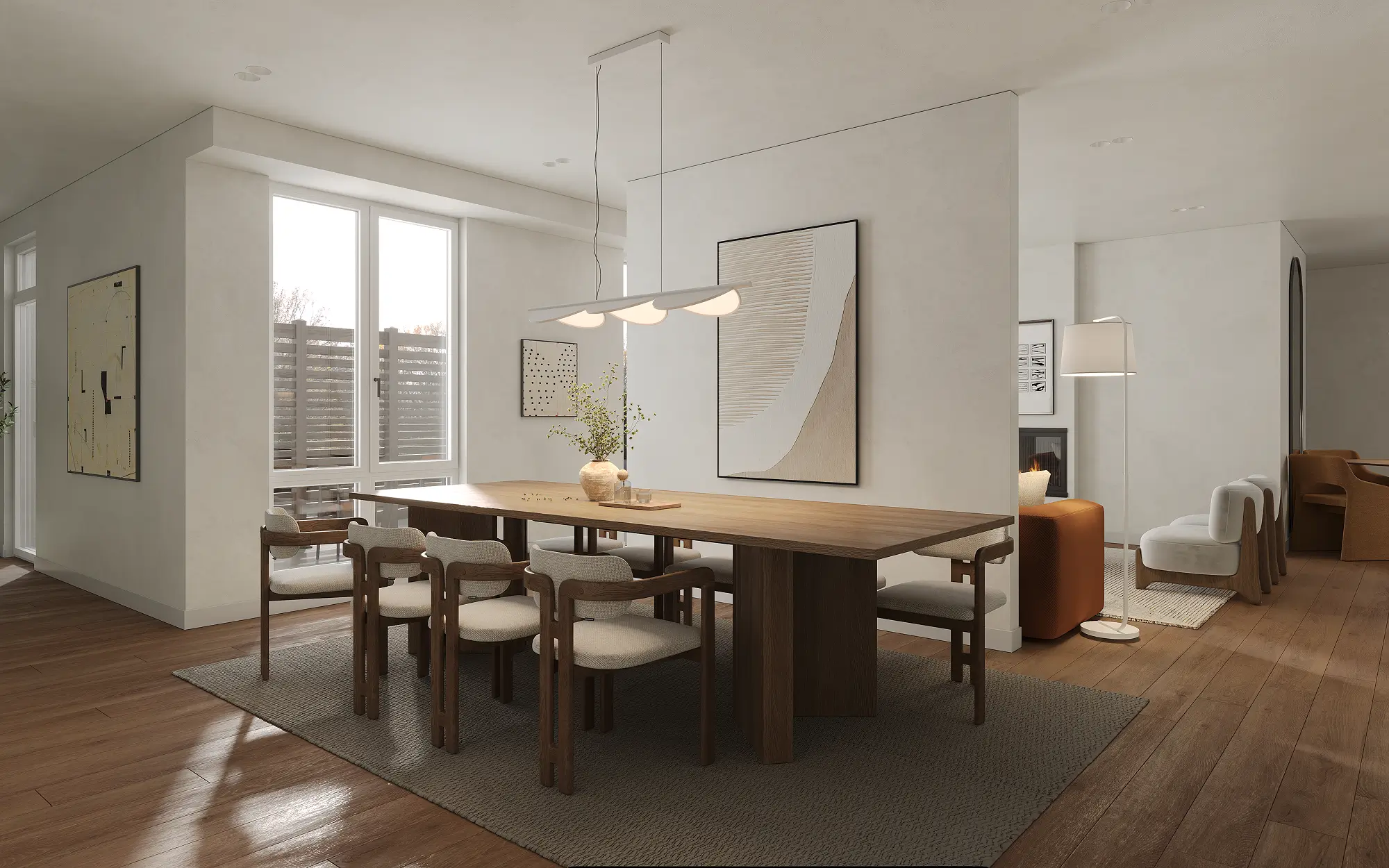
Focusing on the human-scale spatial experience, interior renderings – including dedicated 3D interior visualizations – address room proportions, material transitions, furniture placement, and lighting quality within enclosed spaces. In contrast, exterior renderings communicate the building’s form, facade composition, materiality, and relationship to its immediate context, such as the landscaping or nearby structures.
These types serve complementary purposes. The interiors address the experiential quality for occupants, and the exteriors handle urban integration and regulatory compliance. Mixed-use developments usually require both to balance the impact on the public realm with private amenity spaces.
Aerial, Site, and Urban RenderingsAerial, Site, and Urban Renderings
To illustrate site organization, building placement, circulation patterns, and landscape integration, aerial renderings position the camera above ground level. Urban-scale visualizations go beyond a single plot of land to show how a proposal affects streetscapes, sightlines, and neighborhood character.
These broader views are essential for planning approvals because authorities use them to assess the impact on public spaces, overshadowing, and the surrounding heritage. Unlike ground-level views, these perspectives address questions about density, massing, and connectivity.
Conceptual vs Photorealistic RenderingConceptual vs Photorealistic Rendering
While conceptual renderings use simplified geometry, suggestive lighting, and illustrative techniques to emphasize design ideas, photorealistic scenes simulate physical light behavior, material properties, and environmental conditions with technical precision.
From a functional standpoint, this distinction matters because conceptual types support early-stage design exploration when details are still undefined. In contrast, photorealistic designs support late-stage decisions that require material specifications or regulatory approvals. Neither type is inherently superior. The appropriate choice depends on the project’s maturity and the requirements of the decisions.

Architectural Rendering Styles
How viewers interpret a design is affected by its style. The range of possibilities extends from abstract representation to physical simulation. Designers select a style based on communication goals rather than aesthetic preference.
Conceptual and Illustrative StylesConceptual and Illustrative Styles
Deliberately avoiding photorealism, conceptual styles keep the focus on spatial organization, circulation, and massing relationships. Techniques may include:
– Hand-drawn linework overlays on 3D models
– Limited color palettes emphasizing form over finish
– Atmospheric perspective suggesting depth without detailed textures
– Selective detail, with high resolution in focal areas and abstraction elsewhere
These approaches prevent premature fixation on surface finishes during the schematic design phase. For example, an architect could present conceptual renderings to a client to discuss room adjacencies without sparking debates about undecided countertop materials.
Photorealistic Architectural VisualizationPhotorealistic Architectural Visualization
The goal of 3D visualization is to produce images that are indistinguishable from photographs of completed buildings. This requires simulating the following:
– Physically accurate light behavior, including bounce lighting, caustics, and soft shadows.
– Material properties, such as roughness, reflectivity, and subsurface scattering.
– Environmental context, including sky conditions, surrounding vegetation, and neighboring buildings.
– Atmospheric effects, such as depth of field, lens characteristics, and subtle grain.
Photorealism requires precise input data, including exact material specifications, accurate sun path calculations, and contextual site modeling. This output is useful in situations where visual ambiguity poses a risk, such as when clients are approving expensive finishes, planning committees are reviewing visual impact, or contractors are coordinating complex junctions.
Digital collage, sketch visualization, and mixed-media approaches are niche styles that serve specialized communication needs rather than mainstream project workflows. They are applied only in specific presentation contexts as opposed to core decision-making processes.
How Architectural Rendering WorksHow Architectural Rendering Works
Since each stage of the 3D architectural rendering process builds upon the previous one, the process is sequential. The technical accuracy of the initial stages determines whether photorealistic results can be achieved later on.
3D Modeling and Scene Setup3D Modeling and Scene Setup
The process begins with the creation of a geometric model using software such as Rhino, Revit, or SketchUp. This defines the spatial boundaries, structural elements, and major fixtures. Accuracy is paramount because dimensional errors propagate into lighting calculations and spatial perception. For example, if a wall is modeled as 200 mm thick, it must align with construction specifications.
Setting up a scene involves placing the model in a virtual environment and adding terrain, neighboring buildings, and other landscape elements that affect lighting and context. For an exterior rendering of a downtown tower, the surrounding structures must cast accurate shadows. The same is true for an interior shot, where modeled windows must transmit the correct direction and intensity of daylight.
Materials, Textures, and LightingMaterials, Textures, and Lighting
Assigning materials defines surface properties beyond color, such as stone’s roughness, glass’s reflectivity, and fabric’s translucency. These properties interact with lighting calculations to produce realistic surface behavior. For example, a polished marble floor reflects ceiling lights differently than matte concrete, so the renderer must simulate this physical difference.
The lighting setup determines the primary light sources, including the position of the sun and artificial fixtures, as well as the secondary bounce lighting that fills shadowed areas. Photorealistic architectural visualization requires global illumination algorithms to calculate the transfer of light energy between surfaces. This computationally intensive process distinguishes professional renderers from real-time visualization tools.
Camera, Rendering, and Post-ProductionCamera, Rendering, and Post-Production
The placement of the camera affects both the composition and the distortion of the perspective. In architectural practice, extreme wide-angle distortion that misrepresents spatial proportions is typically avoided. Instead, focal lengths between 24mm and 50mm are usually used to create a more accurate perception of space.
The rendering engine computes light paths through the scene. This process takes anywhere from a few minutes to several hours, depending on the resolution and complexity of the lighting. Output passes, such as beauty, shadow, reflection, and ambient occlusion, are often rendered separately to allow for greater control during post-production.
Software like Photoshop is used for post-production adjustments to color balance, contrast, and atmospheric depth. Subtle additions, such as people to provide a sense of scale or vegetation to give context, can make a photo more believable without altering the original architectural design. The goal is refinement. Post-production clarifies the model, but it cannot compensate for missing geometry or incorrect lighting.
Where Architectural Rendering Is Used in Practice
Renderings prevent costly misunderstandings and speed up the process of reaching an agreement among stakeholders with different technical backgrounds. This creates value.
Architecture and Design CommunicationArchitecture and Design Communication
Renderings help architects bridge the gap in understanding between design professionals and clients. While section drawings communicate structural logic to engineers, they remain abstract to most customers. However, an interior rendering of the same space makes spatial volume, light quality, and material relationships immediately comprehensible.
This function also extends internally. Renderings help architects evaluate their design processes. Often, viewing a space from a human perspective reveals proportion issues invisible in plan view. These can include ceilings that feel oppressive, windows causing glare, and circulation paths lacking space.
Construction, Planning, and ApprovalsConstruction, Planning, and Approvals
Planning authorities are increasingly requiring visualizations as part of development applications. These images demonstrate compliance with regulations governing building height, setback distances, and heritage sightlines. For example, an aerial rendering could show that a proposed structure remains below protected view corridors, while an exterior shot could demonstrate continuity of materials with neighboring facades.
In Germany, for example, submissions for a zoning plan often require photorealistic visualizations in order to evaluate the visual impact on protected sightlines and the neighborhood’s character. Since the German Building Code emphasizes contextual integration, accurate 3D visualizations are essential for obtaining approval in dense urban areas like Berlin and Munich. Understanding the landscape of specialized providers, including leading 3D rendering companies in Germany, becomes relevant for projects requiring local regulatory expertise.
Contractors use detailed renderings to plan complex construction sequences. Visual coordination reduces the number of requests for information during construction, when changes result in high costs. For example, identifying a ductwork conflict with a structural beam in the rendering phase can prevent approximately €15,000 in rework costs and schedule delays.
Real Estate Marketing and SalesReal Estate Marketing and Sales
Developers market off-plan properties using renderings that depict the finished interior and amenities before construction begins. These visuals allow sales contracts to be signed 12–24 months before completion, which improves cash flow and reduces the risk of development financing. Dedicated 3D rendering solutions for real estate address the specific challenge of balancing aspirational staging with material accuracy to maintain buyer trust.
Effective marketing renderings strike a balance between aspiration and credibility. Images that are overly stylized or promise unachievable finishes may lead to disputes after completion. The most trusted renderings accurately depict the specified materials and spatial dimensions, using staging and lighting to convey lifestyle possibilities. For larger development portfolios, 3D visualization services tailored to real estate developers focus on consistency across multiple units and phases while maintaining regulatory compliance.
Benefits of Architectural Rendering
The value of rendering lies in making decisions visible before irreversible commitments are made. Benefits include avoided errors, accelerated consensus, and reduced rework.
Clearer Decision-MakingClearer Decision-Making
Renderings transform abstract parameters into observable conditions. For example, clients deciding between two facade options can see how each one interacts with the afternoon sun instead of interpreting material swatches and elevation drawings. This reduces decision latency and increases confidence in choices.
Risk Reduction Before ConstructionRisk Reduction Before Construction
Identifying a spatial conflict in a rendering only takes a few minutes. However, discovering the same conflict during construction can result in demolition, redesign, and schedule delays, costing thousands of dollars. Renderings provide a low-cost environment for simulating and testing design assumptions. Detailed analysis of 3D rendering applications in property development illustrates how visualization reduces rework across design phases.
Faster Project Alignment Between StakeholdersFaster Project Alignment Between Stakeholders
Architects, engineers, clients, and contractors all interpret technical drawings through the lens of their respective professions. Creating a shared rendering establishes a common reference point that transcends disciplinary jargon. This approach facilitates alignment on technical execution by first agreeing on visual intent, which smooths the coordination process.
Architectural Rendering FAQsArchitectural Rendering FAQs
What Does Rendering Mean in Construction?What Does Rendering Mean in Construction?
In construction, rendering refers to a visual representation of the proposed work. It is not the same as the plaster finish applied to walls, which is also called rendering. This technique facilitates pre-construction coordination, client approvals, and regulatory submissions by making the design intent visible before any physical work begins.
What Makes a Good Architectural Render?What Makes a Good Architectural Render?
To be effective, an architectural rendering must accurately depict relevant spatial relationships, material properties, and lighting conditions. Technical precision is more important than artistic flair. Correct proportions, believable lighting, and context-appropriate styling prevent misinterpretation. However, an impressive render that misrepresents ceiling height or window size can create risks further down the line.
What Are the Main Architectural Rendering Techniques?What Are the Main Architectural Rendering Techniques?
The core techniques include ray tracing, global illumination, and physically based rendering. Accessibility of these tools depends on the software used, such as V-Ray, Corona, Enscape, or Lumion. However, the workflow fundamentals remain consistent across platforms.
Who Typically Uses Architectural Rendering?Who Typically Uses Architectural Rendering?
Architects use renderings for client presentations and to validate designs. Developers rely on them for off-plan sales and investor communications. Planning consultants submit renderings with regulatory applications. Interior designers use them to design material palettes and furniture layouts. Contractors reference detailed renderings during complex assembly sequences. These examples illustrate the common thread of using 3D visualization to align expectations before irreversible decisions are made.
When Renderings Make the DifferenceWhen Renderings Make the Difference
A 3D architectural rendering acts as a translation layer between technical design data and human perception. Its value lies in facilitating discussion, testing, and alignment of spatial decisions across stakeholder groups with varying technical literacy. When executed accurately and purposefully, renderings prevent costly misunderstandings by revealing design implications before construction begins.
Photorealistic architectural visualization is the most technically demanding aspect of the field. It requires precise modeling, material specification, and lighting simulation. However, realism alone does not determine usefulness. The most effective renderings balance the level of detail with the purpose, whether conceptual or photorealistic. Early-phase concepts benefit from abstraction that encourages exploration, while late-phase approvals demand precision that eliminates ambiguity. Understanding the relationship between representation type and decision context is essential for professional rendering.
SHARE THIS...
Get High-Quality CGI for Your Business Purposes
Book a call to get started
Our other articles


Elevate Your Business with Stunning CGI
Start working on your next project as soon as tomorrow. Book a call with our team and discuss the key details:
- Learn how we achieve photorealistic quality in our visualizations and animations. Explore our award-winning projects, featured multiple times on Behance.
- Get to know our company structure and decide which services you need
- Tell us about your project and let us complete a free test task to demonstrate our approach
- Find out the exact cost of bringing your project to life